In the quest for mental peace and the spread of kindness, Transcendental Meditation ™ emerges as a beacon of hope. This ancient practice, revitalized by Maharishi Mahesh Yogi, has found a home in Mill Hill, offering a sanctuary for those seeking tranquility in a turbulent world.
The Essence of TM: A Path to Inner Serenity
Transcendental Meditation is more than just a technique; it’s a journey to the core of our being. By transcending the surface-level noise of daily life, TM guides us to a place of profound stillness. Here, in the depths of silence, mental peace is not just a concept but a lived experience. This peace is characterized by:
A deep sense of calm: TM allows practitioners to experience a state of restful awareness, where the mind is alert yet free from the clutches of stress and anxiety.
Enhanced self-awareness: Regular meditation fosters a greater understanding of oneself, leading to self-compassion and a more harmonious inner dialogue.
Emotional resilience: As one delves into TM, emotional fluctuations become less disruptive, paving the way for a more balanced and peaceful mindset.
Kindness Flows from Within: The TM Ripple Effect
The tranquility achieved through TM naturally extends beyond the individual. When we are at peace with ourselves, our capacity for kindness expands. TM cultivates an environment where:
Empathy flourishes: A clear and composed mind is more attuned to the emotions of others, allowing for genuine empathetic connections.
Altruistic actions increase: Inner serenity translates into outward expressions of kindness, as TM practitioners often find themselves more inclined to engage in acts of generosity and service.
Positive social interactions multiply: Mental peace fosters a kinder disposition, leading to more positive and meaningful interactions within the community.
Embracing TM at Transcendental Meditation Mill Hill
At Transcendental Meditation Mill Hill, individuals from all walks of life come together to learn and practice TM. The center provides a supportive atmosphere where both novices and seasoned meditators can deepen their practice. Here’s how you can join:
Participate in an introductory session: Discover the principles of TM and its role in promoting mental peace and kindness.
Enroll in a structured TM course: Receive personalized instruction and guidance to ensure your TM practice is effective and fulfilling.
Engage with the TM community: Connect with fellow practitioners, share experiences, and contribute to a collective culture of peace and kindness.
Conclusion
Transcendental Meditation is not just a personal retreat; it’s a transformative practice that can reshape our world. By fostering mental peace and kindness within ourselves, we contribute to a more compassionate society. Transcendental Meditation Mill Hill invites you to embark on this transformative journey, where every meditation session is a step towards a kinder, more peaceful world.
Inner peace is a state of mind that is characterized by calmness, serenity, and harmony. Inner peace is the opposite of inner turmoil, which is a state of mind that is characterized by stress, anxiety, and conflict. Inner peace is essential for our well-being, happiness, and success. However, in today’s fast-paced and chaotic world, many of us find it hard to achieve and maintain inner peace. We may feel overwhelmed, restless, or dissatisfied with our lives.
Fortunately, there is a simple and effective way to achieve inner peace: Transcendental Meditation ™. TM is a technique of silent mantra meditation that was introduced to the world by Maharishi Mahesh Yogi in the mid-1950s. Maharishi was a disciple of Guru Dev, a respected sage of the ancient Vedic tradition of India. Maharishi’s aim was to revive the ancient knowledge of TM and make it available to everyone, regardless of their background, culture, or religion.
TM is a simple and natural technique that anyone can learn and enjoy. It does not require any concentration, focus, or effort. It does not involve any beliefs, rituals, or changes in lifestyle. It is simply a way of relaxing the mind to its most silent and peaceful state, which Maharishi called transcendental consciousness.
TM has many benefits for your physical, mental, emotional, and spiritual well-being. TM can help you reduce stress, improve your health, enhance your creativity, develop your consciousness, and more. TM can also help you achieve inner peace by:
TM releases stress and tension. Stress and tension are common causes of inner turmoil and imbalance. They can affect our mood, energy, motivation, relationships, and health. TM helps us release stress and tension by restoring balance in our nervous system. TM also increases our resilience and adaptability to challenging situations.
TM calms and clears the mind. The mind is often cluttered with thoughts, feelings, and sensations that can distract us from our true self and purpose. TM helps us calm and clear the mind by settling it to its most silent and peaceful state. TM also helps us transcend the ordinary level of thinking and access a state of pure awareness, which is beyond thoughts, feelings, and sensations.
TM harmonizes the emotions. Emotions are the feelings that we experience in response to various stimuli or situations. They can be positive or negative, pleasant or unpleasant, mild or intense, etc. TM helps us harmonize the emotions by increasing our emotional intelligence and awareness. TM also helps us regulate our emotions better by enhancing our prefrontal cortex function.
TM connects us with our inner self. The inner self is the essence of who we are and what we can achieve. It is also the source of our inner peace, happiness, and wisdom. TM helps us connect with our inner self by enabling us to access higher states of consciousness that are normally hidden or dormant in most people. These states include cosmic consciousness (the permanent experience of transcendental consciousness along with waking, dreaming, and sleeping states), god consciousness (the refined perception of the subtle aspects of nature), and unity consciousness (the realization of one’s identity with the universal self). These states bring profound insights, blissful feelings, and universal love into our life.
How to Learn TM in London
If you are interested in learning TM and achieving inner peace, you can contact Transcendental Meditation Mill Hill, an approved centre that offers TM courses and follow-up support in a friendly and professional environment. Transcendental Meditation Mill Hill is part of the Maharishi Foundation, a national educational charity that administers the teaching of TM in the UK.
Here are the steps to learn TM from Transcendental Meditation Mill Hill:
Attend a free introductory talk. This is a one-hour presentation that gives you an overview of TM, its benefits, and how it works. You can also ask any questions you may have and meet the teachers who will instruct you. You can book your place online or by phone.
Register for the TM course. This is a four-day course that teaches you the TM technique and how to practice it correctly. The course fee varies depending on your income and circumstances, and includes lifetime follow-up and support. You can pay online or by phone.
Enjoy the benefits of TM. After completing the course, you can start practicing TM on your own and experience its positive effects on your life. You can also attend regular group meditations, advanced lectures, weekend retreats, and other events that will enrich your knowledge and enjoyment of TM.
Transcendental Meditation is a simple and effective technique that can help you achieve inner peace in various ways. Whether you want to release stress, calm your mind, harmonize your emotions, or connect with your inner self, TM can help you achieve your goals and fulfill your potential. Don’t wait any longer, learn TM today and discover the benefits for yourself!
Transcendental Meditation ™ is a technique of silent mantra meditation that was introduced to the world by Maharishi Mahesh Yogi in the mid-1950s. Maharishi was a disciple of Guru Dev, a respected sage of the ancient Vedic tradition of India. Maharishi’s aim was to revive the ancient knowledge of TM and make it available to everyone, regardless of their background, culture, or religion.
TM is a simple and natural technique that anyone can learn and enjoy. It does not require any concentration, focus, or effort. It does not involve any beliefs, rituals, or changes in lifestyle. It is simply a way of relaxing the mind to its most silent and peaceful state, which Maharishi called transcendental consciousness.
TM has many benefits for your physical, mental, emotional, and spiritual well-being. TM can help you reduce stress, improve your health, enhance your creativity, develop your consciousness, and more. TM can also help you achieve your personal and professional goals and fulfill your potential.
But what exactly is TM and how does it work? How can you learn and practice TM in London, the capital of the UK and one of the most vibrant and diverse cities in the world? In this blog post, we will answer these questions and provide you with some useful information and tips on how to learn and practice TM in London.
What is TM and How Does it Work?
TM is a technique of silent mantra meditation that uses a sound or a word that has no meaning attached to it. The sound or the word is called a mantra, and it is given to the student by a qualified teacher who has received at least six months of full-time training under Maharishi’s supervision.
The mantra is selected according to the student’s individual characteristics and preferences, and it is not revealed to anyone else. The mantra is not a name of a god, a prayer, or a slogan. It is just a sound that helps the mind to settle down and transcend the ordinary level of thinking.
The practice of TM is easy and pleasant. The student sits comfortably with eyes closed and silently repeats the mantra in the mind for 15-20 minutes twice a day, preferably in the morning and evening. The student does not need to concentrate on the mantra or try to block out any thoughts or sensations that may arise. The student just lets the mantra flow naturally and effortlessly in the mind.
During the meditation, the mind naturally becomes quieter and more relaxed, while the body gains deep rest and rejuvenation. The student experiences a state of pure awareness, which is beyond thoughts, feelings, and sensations. This is the state of transcendental consciousness, which is the source of all creativity, intelligence, and happiness.
TM is not a religion, a philosophy, or a lifestyle. It is a natural and effortless way of accessing the inner potential and experiencing higher states of consciousness. TM is compatible with any faith, culture, or worldview. TM is also scientifically proven to have many benefits, such as lowering blood pressure, increasing happiness, and boosting brain function. TM is endorsed by many celebrities, scientists, and leaders, such as Oprah Winfrey, Paul McCartney, Ellen DeGeneres, David Lynch, Russell Brand, and more. TM is also taught in many schools, universities, corporations, and prisons around the world. TM is a global phenomenon that has been practiced by millions of people from all walks of life for over 60 years. TM is a technique that can transform your life for the better.
How to Learn TM in London
The first and most important step to learn and practice TM is to learn it from a qualified teacher. TM is not something that you can learn from a book, a video, or an app. It is a personalized and interactive process that requires the guidance and feedback of a certified teacher who has received at least six months of full-time training under Maharishi’s supervision.
The learning process consists of four sessions, each lasting about an hour. In the first session, the teacher gives an overview of TM and its benefits. In the second session, the teacher gives the student a personal mantra, which is a sound that has no meaning attached to it. The mantra is selected according to the student’s individual characteristics and preferences. In the third and fourth sessions, the teacher instructs the student on how to use the mantra properly and effortlessly, and answers any questions or doubts that may arise.
The course fee varies depending on your income and circumstances, and includes lifetime follow-up and support.
To learn TM from a qualified teacher in London, you can contact Transcendental Meditation Mill Hill, an approved centre that offers TM courses and follow-up support in a friendly and professional environment. Transcendental Meditation Mill Hill is part of the Maharishi Foundation, a national educational charity that administers the teaching of TM in the UK.
Emotional well-being is the ability to experience and express positive emotions, cope with negative emotions, and maintain a sense of meaning and purpose in life. Emotional well-being is essential for our mental health, physical health, and happiness. However, in today’s fast-paced and stressful world, many of us struggle to achieve and sustain emotional well-being. We may feel overwhelmed, anxious, depressed, or dissatisfied with our lives.
Fortunately, there is a simple and effective way to enhance our emotional well-being: Transcendental Meditation ™. TM is a technique of silent mantra meditation that was introduced to the world by Maharishi Mahesh Yogi in the mid-1950s. Maharishi was a disciple of Guru Dev, a respected sage of the ancient Vedic tradition of India. Maharishi’s goal was to revive the ancient knowledge of TM and make it available to everyone, regardless of their background, culture, or religion.
TM is a simple and natural technique that anyone can learn and enjoy. It does not require any concentration, focus, or effort. It does not involve any beliefs, rituals, or changes in lifestyle. It is simply a way of relaxing the mind to its most silent and peaceful state, which Maharishi called transcendental consciousness.
TM is taught by certified teachers who have received at least six months of full-time training under Maharishi’s guidance. After attending in person or on Zoom a free info session in which the teacher gives an overview of TM and its benefits, the learning process consists of four sessions, each lasting about an hour. In the first session, the teacher gives the student a personal mantra, which is a soothing sound from the Vedic tradition that has no meaning attached to it, but which has the ability to draw the mind inwards. In the following sessions, the teacher instructs the student on how to use the mantra properly and effortlessly and answers any questions or doubts that may arise.
The practice of TM is easy and pleasant. The student sits comfortably with eyes closed and silently repeats the mantra in the mind for 15-20 minutes twice a day, preferably in the morning and evening. During this time, the mind naturally becomes more quiet and relaxed, while the body gains deep rest and rejuvenation. The student experiences a state of pure awareness, which is beyond thoughts, feelings, and sensations. This is the state of transcendental consciousness, which is the source of all creativity, intelligence, and happiness.
How does TM enhance our emotional well-being? Here are 11 techniques that TM can help us achieve balance in our emotions:
TM reduces stress and anxiety. Stress and anxiety are common causes of emotional distress and imbalance. They can affect our mood, energy, motivation, relationships, and health. TM helps us reduce stress and anxiety by releasing accumulated tension and restoring balance in our nervous system. TM also increases our resilience and adaptability to challenging situations.
TM improves our mood. Mood is the general feeling or state of mind that we have at any given moment. It can be influenced by various factors such as hormones, environment, events, thoughts, etc. TM helps us improve our mood by increasing our levels of serotonin, dopamine, endorphins, and other neurotransmitters that are responsible for positive emotions. TM also helps us regulate our emotions better by enhancing our prefrontal cortex function.
TM boosts our happiness. Happiness is the overall evaluation of how satisfied we are with our lives. It can be measured by various indicators such as life satisfaction, positive affect, meaning in life, etc. TM helps us boost our happiness by increasing our self-esteem, optimism, gratitude, altruism, and spirituality. TM also helps us find more joy in everyday activities by expanding our awareness beyond the boundaries of space and time.
TM enhances our creativity. Creativity is the ability to produce original and valuable ideas or products. It can be applied to various domains such as art, science, business, education, etc. TM helps us enhance our creativity by increasing coherence between different brain regions, activating the right hemisphere, and expanding our awareness beyond the boundaries of space and time. TM also boosts our confidence, motivation, and joy in expressing our unique talents.
TM develops our consciousness. Consciousness is the essence of who we are and what we can achieve. It can be defined as the subjective experience of awareness or self-awareness. It can also be described as a spectrum of states ranging from lower to higher levels of awareness. TM helps us develop our consciousness by enabling us to access higher states of consciousness that are normally hidden or dormant in most people. These states include cosmic consciousness (the permanent experience of transcendental consciousness along with waking, dreaming, and sleeping states), god consciousness (the refined perception of the subtle aspects of nature), and unity consciousness (the realization of one’s identity with the universal self). These states bring profound insights, blissful feelings, and universal love into our life.
TM improves our relationships. Relationships are the connections and interactions that we have with other people. They can be of various types such as family, friends, romantic partners, colleagues, etc. TM helps us improve our relationships by increasing our empathy, compassion, trust, and communication skills. TM also helps us resolve conflicts and forgive others more easily.
TM increases our productivity. Productivity is the measure of how efficiently and effectively we perform our tasks and achieve our goals. It can be influenced by various factors such as motivation, skills, resources, environment, etc. TM helps us increase our productivity by enhancing our focus, memory, learning, problem-solving, and decision-making abilities. TM also helps us manage our time and energy better by reducing procrastination and fatigue.
TM supports our growth. Growth is the process of improving ourselves and expanding our potential. It can be achieved by various means such as education, training, coaching, mentoring, etc. TM helps us support our growth by increasing our curiosity, openness, flexibility, and adaptability. TM also helps us overcome our fears and challenges by increasing our courage, confidence, and resilience.
TM fosters our spirituality. Spirituality is the aspect of ourselves that relates to the transcendent or the sacred. It can be expressed in various ways such as religion, philosophy, ethics, values, etc. TM helps us foster our spirituality by connecting us with our inner self and the universal self. TM also helps us cultivate our virtues and values by increasing our wisdom, morality, and compassion.
TM balances our emotions. Emotions are the feelings that we experience in response to various stimuli or situations. They can be positive or negative, pleasant or unpleasant, mild or intense, etc. TM helps us balance our emotions by increasing our emotional intelligence and awareness. TM also helps us regulate our emotions better by enhancing our prefrontal cortex function.
How to Join the TM Community
If you are interested in joining the TM community, you can contact Transcendental Meditation Mill Hill, https://uk.tm.org/london-mill-hill#enquiries an approved centre that offers TM courses and follow-up support in a friendly and professional environment. Transcendental Meditation Mill Hill is part of the Maharishi Foundation, a national educational charity that administers the teaching of TM in the UK.
Here are some of the benefits of joining the TM community:
You will receive lifetime follow-up and support. After completing the TM course, you will be able to attend regular group meditations, advanced lectures, weekend retreats, and other events that will enrich your knowledge and enjoyment of TM. You will also be able to contact your teacher anytime for any questions or guidance that you may need.
You will meet like-minded people. By joining the TM community, you will be able to connect with other people who share your interest and passion for TM. You will be able to exchange your experiences, insights, and tips with them. You will also be able to make new friends and expand your social network.
You will contribute to a better world. By joining the TM community, you will be part of a global movement that aims to create a more peaceful and harmonious world. You will be able to participate in various projects and initiatives that promote TM as a tool for personal and social transformation.
Transcendental Meditation is a simple and effective technique that can enhance your emotional well-being in various ways. Whether you want to reduce stress, improve your mood, boost your happiness, enhance your creativity, develop your consciousness, improve your relationships, increase your productivity, support your growth, foster your spirituality, or balance your emotions, TM can help you achieve your goals and fulfill your potential. Don’t wait any longer, discover the benefits of TM today!
Transcendental Meditation ™ is a technique of silent mantra meditation that was introduced to the world by Maharishi Mahesh Yogi in the mid-1950s. Maharishi was a disciple of Guru Dev, a respected sage of the ancient Vedic tradition of India. Maharishi’s aim was to revive the ancient knowledge of TM and make it available to everyone, regardless of their background, culture, or religion.
TM is a simple and natural technique that anyone can learn and enjoy. It does not require any concentration, focus, or effort. It does not involve any beliefs, rituals, or changes in lifestyle. It is simply a way of relaxing the mind to its most silent and peaceful state, which Maharishi called transcendental consciousness.
TM has many benefits for your physical, mental, emotional, and spiritual well-being. TM can help you reduce stress, improve your health, enhance your creativity, develop your consciousness, and more. TM can also help you achieve your personal and professional goals and fulfill your potential.
But how do you practice TM? What are the steps involved? How do you know if you are doing it correctly? In this blog post, we will answer these questions and provide you with a step-by-step guide on how to practice TM.
Step 1: Learn TM from a Qualified Teacher
The first and most important step to practice TM is to learn it from a qualified teacher. TM is not something that you can learn from a book, a video, or an app. It is a personalized and interactive process that requires the guidance and feedback of a certified teacher who has received at least six months of full-time training under Maharishi’s supervision.
After attending in person or on Zoom a free info session in which the teacher gives an overview of TM and its benefits, the learning process consists of four sessions, each lasting about an hour. In the first session, the teacher gives the student a personal mantra, which is a soothing sound from the Vedic tradition that has no meaning attached to it, but which has the ability to draw the mind inwards. In the following sessions, the teacher instructs the student on how to use the mantra properly and effortlessly, and answers any questions or doubts that may arise.
The course fee varies depending on your income and circumstances, and includes lifetime follow-up and support. You can pay online or by phone.
To learn TM from a qualified teacher, you can contact Transcendental Meditation Mill Hill https://uk.tm.org/london-mill-hill#enquiries , an approved centre that offers TM courses and follow-up support in a friendly and professional environment. Transcendental Meditation Mill Hill is part of the Maharishi Foundation, a national educational charity that administers the teaching of TM in the UK.
To book your place for the TM course from Transcendental Meditation Mill Hill, visit their website https://uk.tm.org/london-mill-hill#enquiries or call them at 07960 683 160. You can also email them at michael.pierce@tm.org or follow them on Facebook or Twitter.
Step 2: Practice TM Twice a Day
The second step to practice TM is to practice it twice a day, preferably in the morning and evening. The ideal time to practice TM is before breakfast and before dinner, when your stomach is not too full or too empty. However, you can choose any time that suits your schedule and convenience.
The duration of each TM session is 15-20 minutes. You do not need to use a timer or an alarm, as you will naturally come out of the meditation when it is time. You can also adjust the duration according to your needs and preferences, as long as you do not exceed 20 minutes.
To practice TM, you need to find a comfortable and quiet place where you will not be disturbed or distracted. You can sit on a chair, a sofa, a bed, or the floor, as long as you are comfortable and relaxed. You do not need to adopt any special posture or position.
To start the meditation, you close your eyes and silently repeat the mantra in your mind. You do not need to pronounce the mantra aloud or move your lips or tongue. You do not need to control the speed, volume, or clarity of the mantra. You just let it flow naturally and effortlessly in your mind.
You do not need to concentrate on the mantra or try to block out any thoughts or sensations that may arise. You just let them come and go without paying attention to them or judging them. You do not need to force anything or expect anything. You just let go and enjoy the process.
When you finish the meditation, you do not open your eyes immediately. You take a few minutes to come out of the meditation gradually and gently. You can stretch your body, take some deep breaths, and open your eyes slowly. You can also take some time to appreciate the calmness and clarity that you feel after the meditation.
Step 3: Attend Regular Follow-Up Sessions
The next step to practice TM is to attend regular follow-up sessions with your teacher or at your local TM centre. These sessions are designed to help you refine your technique, clear any doubts, and enhance your experience of TM.
The follow-up sessions consist of various activities such as group meditations, advanced lectures, personal checking, question and answer sessions, etc. These activities will provide you with valuable feedback, guidance, and support from your teacher and other TM practitioners.
The follow-up sessions are also an opportunity to learn more about the theory and philosophy of TM, as well as its applications in various fields such as health, education, business, science, etc. You will also learn about the advanced programs of TM that can help you deepen your practice and explore higher states of consciousness.
The follow-up sessions are free of charge and open to all TM practitioners who have completed the TM course. You can attend them as often as you like, depending on your availability and interest. You can also access online resources such as videos, podcasts, articles, etc., that will supplement your learning and enjoyment of TM.
The final step to practicing TM is to join the TM community and connect with other people who share your interest and passion for TM. The TM community is a global network of people who practice TM and support each other in their personal and social transformation.
By joining the TM community, you will be able to:
Meet like-minded people. You will be able to interact with other people who practice TM and exchange your experiences, insights, and tips with them. You will also be able to make new friends and expand your social circle.
Participate in various events. You will be able to attend various events that are organized by the TM community such as group meditations, festivals, concerts, workshops, seminars, etc. These events will enrich your knowledge and enjoyment of TM and expose you to different cultures and perspectives.
Contribute to a better world. You will be able to join various projects and initiatives that are initiated by the TM community such as peace projects, humanitarian projects, environmental projects, etc. These projects aim to create a more peaceful and harmonious world by spreading the benefits of TM to more people and places.
Transcendental Meditation is a simple and effective technique that can help you improve your physical, mental, emotional, and spiritual well-being. By following these four steps, you can practice TM correctly and enjoy its benefits fully. Don’t wait any longer, start your TM journey today!
What Transcendental Meditation ™ is and how it differs from other types of meditation
How TM can improve your physical, mental, emotional, and spiritual health
How to learn TM from a qualified teacher and practice it correctly
How to join the TM community and access the resources and support available
What is Transcendental Meditation?
Transcendental Meditation ™ is a technique of silent mantra meditation that was introduced to the world by Maharishi Mahesh Yogi in the mid-1950s. Maharishi was a disciple of Guru Dev, a respected sage of the ancient Vedic tradition of India. Maharishi’s goal was to revive the ancient knowledge of TM and make it available to everyone, regardless of their background, culture, or religion.
TM is a simple and natural technique that anyone can learn and enjoy. It does not require any concentration, focus, or effort. It does not involve any beliefs, rituals, or changes in lifestyle. It is simply a way of relaxing the mind to its most silent and peaceful state, which Maharishi called transcendental consciousness.
TM is taught by certified teachers who have received at least six months of full-time training under Maharishi’s guidance. The learning process consists of four sessions, each lasting about an hour. In the first session, the teacher gives an overview of TM and its benefits. In the second session, the teacher gives the student a personal mantra, which is a sound that has no meaning attached to it. The mantra is selected according to the student’s individual characteristics and preferences. In the third and fourth sessions, the teacher instructs the student on how to use the mantra properly and effortlessly, and answers any questions or doubts that may arise.
The practice of TM is easy and pleasant. The student sits comfortably with eyes closed and silently repeats the mantra in the mind for 15-20 minutes twice a day, preferably in the morning and evening. During this time, the mind naturally becomes more quiet and relaxed, while the body gains deep rest and rejuvenation. The student experiences a state of pure awareness, which is beyond thoughts, feelings, and sensations. This is the state of transcendental consciousness, which is the source of all creativity, intelligence, and happiness.
How TM Can Benefit You
TM has many benefits for your physical, mental, emotional, and spiritual well-being. Here are some of the benefits you can discover by practicing TM:
TM reduces stress and anxiety. Stress is one of the main causes of many health problems and psychological disorders in modern society. TM helps you cope with stress by releasing accumulated tension and restoring balance in your nervous system. TM also increases your resilience and adaptability to challenging situations.
TM improves your health. TM has been shown to lower blood pressure, improve cardiovascular health, enhance immune system function, reduce inflammation, slow aging, and prevent or alleviate various chronic diseases. TM also improves your sleep quality and reduces your dependence on drugs or alcohol.
TM enhances your creativity. Creativity is essential for personal growth, professional success, and social innovation. TM stimulates your brain’s creative potential by increasing coherence between different brain regions, activating the right hemisphere, and expanding your awareness beyond the boundaries of space and time. TM also boosts your confidence, motivation, and joy in expressing your unique talents.
TM develops your consciousness. Consciousness is the essence of who you are and what you can achieve. TM enables you to access higher states of consciousness that are normally hidden or dormant in most people. These states include cosmic consciousness (the permanent experience of transcendental consciousness along with waking, dreaming, and sleeping states), god consciousness (the refined perception of the subtle aspects of nature), and unity consciousness (the realization of one’s identity with the universal self). These states bring profound insights, blissful feelings, and universal love into your life.
How to Learn TM
If you are interested in learning TM, you can contact Transcendental Meditation Mill Hill, an approved centre that offers TM courses and follow-up support in a friendly and professional environment. Transcendental Meditation Mill Hill is part of the Maharishi Foundation, a national educational charity that administers the teaching of TM in the UK.
What Transcendental Meditation ™ is and how it differs from other types of meditation
How TM can benefit your mind, body, and spirit in various ways
How to learn TM from a qualified teacher and practice it correctly
How to join the TM community and access the resources and support available
What is Transcendental Meditation?
Transcendental Meditation ™ is a technique of silent mantra meditation that was introduced to the world by Maharishi Mahesh Yogi in the mid-1950s. Maharishi was a disciple of Guru Dev, a respected sage of the ancient Vedic tradition of India. Maharishi’s vision was to restore the lost knowledge of TM and make it accessible to everyone, regardless of their background, culture, or religion.
TM is a simple and natural technique that anyone can learn and enjoy. It does not require any concentration, focus, or effort. It does not involve any beliefs, rituals, or changes in lifestyle. It is simply a way of calming the mind to its most silent and peaceful state, which Maharishi called transcendental consciousness.
TM is taught by certified teachers who have received at least six months of full-time training under Maharishi’s guidance. The learning process consists of four sessions, each lasting about an hour. In the first session, the teacher gives an overview of TM and its benefits. In the second session, the teacher gives the student a personal mantra, which is a sound that has no meaning attached to it. The mantra is selected according to the student’s individual characteristics and preferences. In the third and fourth sessions, the teacher instructs the student on how to use the mantra properly and effortlessly, and answers any questions or doubts that may arise.
The practice of TM is easy and pleasant. The student sits comfortably with eyes closed and silently repeats the mantra in the mind for 15-20 minutes twice a day, preferably in the morning and evening. During this time, the mind naturally becomes more quiet and relaxed, while the body gains deep rest and rejuvenation. The student experiences a state of pure awareness, which is beyond thoughts, feelings, and sensations. This is the state of transcendental consciousness, which is the source of all creativity, intelligence, and happiness.
How TM Can Benefit You
TM has many benefits for your physical, mental, emotional, and spiritual well-being. Here are some of the reasons why you should try TM:
TM reduces stress and anxiety. Stress is one of the main causes of many health problems and psychological disorders in modern society. TM helps you cope with stress by releasing accumulated tension and restoring balance in your nervous system. TM also increases your resilience and adaptability to challenging situations.
TM improves your health. TM has been shown to lower blood pressure, improve cardiovascular health, enhance immune system function, reduce inflammation, slow aging, and prevent or alleviate various chronic diseases. TM also improves your sleep quality and reduces your dependence on drugs or alcohol.
TM enhances your creativity. Creativity is essential for personal growth, professional success, and social innovation. TM stimulates your brain’s creative potential by increasing coherence between different brain regions, activating the right hemisphere, and expanding your awareness beyond the boundaries of space and time. TM also boosts your confidence, motivation, and joy in expressing your unique talents.
TM develops your consciousness. Consciousness is the essence of who you are and what you can achieve. TM enables you to access higher states of consciousness that are normally hidden or dormant in most people. These states include cosmic consciousness (the permanent experience of transcendental consciousness along with waking, dreaming, and sleeping states), god consciousness (the refined perception of the subtle aspects of nature), and unity consciousness (the realization of one’s identity with the universal self). These states bring profound insights, blissful feelings, and universal love into your life.
How to Learn TM
If you are interested in learning TM, you can contact Transcendental Meditation Mill Hill, an approved centre that offers TM courses and follow-up support in a friendly and professional environment. Transcendental Meditation Mill Hill is part of the Maharishi Foundation, a national educational charity that administers the teaching of TM in the UK.
Transcendental Meditation ™ is a simple and effective technique that can help you reduce stress, improve your health, and enhance your creativity.
TM is taught by certified teachers who have trained under Maharishi Mahesh Yogi, the founder of TM and a renowned spiritual leader.
TM is practiced for 15-20 minutes twice a day, using a personal mantra that is given to you by your teacher.
TM is not a religion, a philosophy, or a lifestyle. It is a natural and effortless way of accessing your inner potential and experiencing higher states of consciousness.
TM has been scientifically proven to have many benefits, such as lowering blood pressure, increasing happiness, and boosting brain function.
Transcendental Meditation Mill Hill is an approved centre that offers TM courses and follow-up support in a friendly and professional environment.
What is Transcendental Meditation?
Transcendental Meditation ™ is a form of silent mantra meditation that was developed by Maharishi Mahesh Yogi in the mid-1950s. Maharishi was a disciple of Guru Dev, a revered sage of the Vedic tradition of India. Maharishi’s mission was to revive the ancient knowledge of TM and make it available to everyone, regardless of their background, culture, or religion.
TM is a simple and natural technique that anyone can learn and practice. It does not require any concentration, contemplation, or effort. It does not involve any beliefs, rituals, or changes in lifestyle. It is simply a way of settling the mind to its most silent and peaceful state, which Maharishi called transcendental consciousness.
TM is taught by certified teachers who have undergone at least six months of full-time training under Maharishi’s supervision. The teaching process consists of four sessions, each lasting about an hour. In the first session, the teacher gives an introduction to TM and its benefits. In the second session, the teacher gives the student a personal mantra, which is a sound that has no meaning associated with it. The mantra is chosen according to the student’s individual characteristics and preferences. In the third and fourth sessions, the teacher instructs the student on how to use the mantra correctly and effortlessly, and answers any questions or doubts that may arise.
The practice of TM is simple and enjoyable. The student sits comfortably with eyes closed and silently repeats the mantra in the mind for 15-20 minutes twice a day, preferably in the morning and evening. During this time, the mind naturally becomes quieter and more relaxed, while the body gains deep rest and rejuvenation. The student experiences a state of pure awareness, which is beyond thoughts, feelings, and sensations. This is the state of transcendental consciousness, which is the source of all creativity, intelligence, and happiness.
Why Should You Learn Transcendental Meditation?
TM has many benefits for your physical, mental, emotional, and spiritual well-being. Here are some of the reasons why you should learn TM:
TM reduces stress and anxiety. Stress is one of the major causes of many health problems and psychological disorders in modern society. TM helps you cope with stress by releasing accumulated tension and restoring balance in your nervous system. TM also increases your resilience and adaptability to challenging situations.
TM improves your health. TM has been shown to lower blood pressure, improve cardiovascular health, enhance immune system function, reduce inflammation, slow aging, and prevent or alleviate various chronic diseases. TM also improves your sleep quality and reduces your dependence on drugs or alcohol.
TM enhances your creativity. Creativity is essential for personal growth, professional success, and social innovation. TM stimulates your brain’s creative potential by increasing coherence between different brain regions, activating the right hemisphere, and expanding your awareness beyond the boundaries of space and time. TM also boosts your confidence, motivation, and joy in expressing your unique talents.
TM develops your consciousness. Consciousness is the essence of who you are and what you can achieve. TM enables you to access higher states of consciousness that are normally hidden or dormant in most people. These states include cosmic consciousness (the permanent experience of transcendental consciousness along with waking, dreaming, and sleeping states), god consciousness (the refined perception of the subtle aspects of nature), and unity consciousness (the realization of one’s identity with the universal self). These states bring profound insights, blissful feelings, and universal love into your life.
How Can You Learn Transcendental Meditation?
If you are interested in learning TM, you can contact Transcendental Meditation Mill Hill, an approved centre that offers TM courses and follow-up support in a friendly and professional environment. Transcendental Meditation Mill Hill is part of the Maharishi Foundation, a national educational charity that administers the teaching of TM in the UK.
In the bustling heart of Meditation London, the practice of Transcendental Meditation (TM) is making waves as a powerful tool for inner peace and overall well-being. Yet, like any transformative journey, the key to reaping the full benefits of TM lies in consistency. So, let’s dive into 11 effective strategies to help you maintain a daily TM practice and stay on course toward a calmer, more centered life.
1. Set a Specific Time
Establish a dedicated time for your TM practice each day. Whether it’s in the morning to start your day on a peaceful note or in the evening to unwind, having a specific time makes it easier to incorporate meditation into your routine.
2. Create a Sacred Space
Designate a quiet, comfortable space for your meditation. Ensure it’s free from distractions and reflects a sense of serenity. Your meditation space becomes a sanctuary where you can retreat to find inner peace.
3. Use a timer
Some people find it helpful to use a timer s for their meditation session. This eliminates the need to check the clock and allows you to immerse yourself fully in the practice.
4. Stay Committed
Consistency is the cornerstone of success in TM. Commit to your daily practice and remind yourself of the positive changes it brings to your life.
5. Join a Community
Consider connecting with other TM practitioners in Meditation London. Sharing experiences and insights with a like-minded community can offer valuable support and motivation.
6. Journal Your Journey
Keep a meditation journal to track your progress and experiences. It can be enlightening to look back and see how your practice has evolved over time.
7. Accountability Partner
Find an accountability partner who shares your meditation goals. Regular check-ins and shared experiences can help keep both of you motivated.
8. Be Kind to Yourself
Remember, consistency doesn’t mean perfection. There will be days when your meditation feels less focused, and that’s okay. Be kind to yourself, acknowledge your efforts, and return to your practice with an open heart.
In the heart of Meditation London, Transcendental Meditation Mill Hill is your guiding light on this transformative journey. By implementing these strategies, you can stay consistent in your TM practice and unlock the profound benefits it offers. Each day brings an opportunity for inner peace and well-being, and with TM, you can make it a reality.
In the bustling heart of Meditation London, the practice of Transcendental Meditation (TM) is making waves as a powerful tool for inner peace and overall well-being. Yet, like any transformative journey, the key to reaping the full benefits of TM lies in consistency. So, let’s dive into 11 effective strategies to help you maintain a daily TM practice and stay on course toward a calmer, more centered life.
1. Set a Specific Time
Establish a dedicated time for your TM practice each day. Whether it’s in the morning to start your day on a peaceful note or in the evening to unwind, having a specific time makes it easier to incorporate meditation into your routine.
2. Create a Sacred Space
Designate a quiet, comfortable space for your meditation. Ensure it’s free from distractions and reflects a sense of serenity. Your meditation space becomes a sanctuary where you can retreat to find inner peace.
3. Use a timer
Some people find it helpful to use a timer s for their meditation session. This eliminates the need to check the clock and allows you to immerse yourself fully in the practice.
4. Stay Committed
Consistency is the cornerstone of success in TM. Commit to your daily practice and remind yourself of the positive changes it brings to your life.
5. Join a Community
Consider connecting with other TM practitioners in Meditation London. Sharing experiences and insights with a like-minded community can offer valuable support and motivation.
6. Journal Your Journey
Keep a meditation journal to track your progress and experiences. It can be enlightening to look back and see how your practice has evolved over time.
7. Accountability Partner
Find an accountability partner who shares your meditation goals. Regular check-ins and shared experiences can help keep both of you motivated.
8. Be Kind to Yourself
Remember, consistency doesn’t mean perfection. There will be days when your meditation feels less focused, and that’s okay. Be kind to yourself, acknowledge your efforts, and return to your practice with an open heart.
In the heart of Meditation London, Transcendental Meditation Mill Hill is your guiding light on this transformative journey. By implementing these strategies, you can stay consistent in your TM practice and unlock the profound benefits it offers. Each day brings an opportunity for inner peace and well-being, and with TM, you can make it a reality.
Meditation London is abuzz with seekers of inner peace and well-being, and Transcendental Meditation Mill Hill is here to guide you on your journey. One of the fundamental aspects of a successful meditation practice is creating a sacred space where you can find tranquility and focus. Let’s explore 11 essential tips to help you establish the perfect meditation sanctuary in the bustling heart of London.
1. Choose a Quiet Location
Begin by selecting a quiet and serene location in your home or office. A tranquil environment minimizes distractions and allows you to delve deeper into your meditation.
2. Declutter Your Space
A clutter-free space promotes mental clarity. Ensure your meditation area is tidy and organized to create a harmonious atmosphere.
3. Comfort is Key
Invest in a comfortable cushion or meditation chair to provide proper support during your practice. Your comfort enhances your ability to meditate effectively.
4. Natural Light and Fresh Air
Whenever possible, meditate in a space with ample natural light and good ventilation. It invigorates your practice and adds a refreshing touch to your meditation sanctuary.
5. Set the Mood with Lighting
Consider soft, warm lighting or natural candles to create a soothing ambiance. The right lighting sets the mood for relaxation.
6. Bring Nature In
Incorporate elements of nature, like indoor plants or a small water fountain, to infuse your space with natural energy and vitality.
7. Personalize Your Sanctuary
Add personal touches to your meditation area, such as inspirational artwork, meaningful symbols, or images that resonate with you spiritually.
8. Calming Colors
Opt for calming colors, like soft blues or earthy tones, to create a serene atmosphere. Colors have a profound impact on your emotional state.
9. Keep It Tech-Free
Resist the urge to bring electronic devices into your meditation space. Disconnect from the digital world during your practice.
10. Consistency is Key
Lastly, maintain consistency in your meditation routine. The more regularly you meditate in your sacred space, the more it becomes a sanctuary of serenity and tranquility.
Transcendental Meditation Mill Hill encourages you to embrace these tips and create your haven of peace in the midst of the bustling metropolis. Whether you’re new to meditation or a seasoned practitioner, a well-crafted meditation space enhances your experience and facilitates inner growth.
Remember, your sacred space is a reflection of your inner world. By nurturing it, you nurture yourself. Find solace and harmony in your meditation sanctuary as you embark on a transformative journey toward well-being and self-discovery in the vibrant city of London.
As you embark on your journey to discover the depths of Transcendental Meditation, you might wonder whether a teacher or instructor is necessary. Transcendental Meditation Mill Hill is here to shed light on this question and guide you toward making an informed decision that aligns with your goals.
Understanding the Essence of Transcendental Meditation
Transcendental Meditation (TM) is a unique practice that involves the use of a specific mantra to achieve a state of deep relaxation and heightened awareness. While the technique itself is simple, the guidance you receive can significantly enhance your experience and ensure you’re practicing it correctly.
The Role of a Teacher or Instructor
While Transcendental Meditation is accessible to anyone, having a certified teacher or instructor can greatly enhance your journey for several reasons:
1. Proper Instruction: A trained teacher provides you with personalized instruction tailored to your individual needs. They guide you through the process step by step, ensuring you’re using the correct technique and mantra.
2. Personalized Guidance: An instructor can address any questions or concerns you may have during your practice. This personalized guidance ensures that you’re getting the most out of your meditation sessions.
3. Enhancing Experience: Teachers often share insights and tips to deepen your experience. They can help you navigate challenges and provide valuable advice to make your practice more fulfilling.
4. Establishing Routine: Having a teacher or instructor can help you establish a consistent practice routine. They can offer support and motivation, which can be especially beneficial if you’re new to meditation.
5. Deepening Understanding: Teachers often provide context and background information about the practice, helping you understand its philosophy and benefits more profoundly.
Transcendental Meditation Mill Hills Approach to Transcendental Meditation
At Transcendental Meditation Mill Hilll, we believe that having a teacher or instructor is an invaluable asset on your journey of Transcendental Meditation. Our certified instructors bring expertise and experience to guide you through every aspect of the practice.
Why Choose a Teacher or Instructor with Transcendental Meditation Mill Hill?
Certified Instructors: Our instructors are certified and well-trained in the practice of Transcendental Meditation.
Personalized Attention: We provide personalized attention and guidance to ensure that your meditation practice is effective and rewarding.
Experience-Driven Insights: Our instructors share insights gained from their own experiences, helping you connect with the practice on a deeper level.
Supportive Community: Joining Transcendental Meditation Mill Hill’s community connects you with others on a similar journey, fostering a sense of support and belonging.
While Transcendental Meditation is accessible to all, the guidance of a certified teacher or instructor can elevate your experience to new heights. Meditation Mill Hill offers expert guidance and a supportive community to help you navigate your meditation journey with confidence. Whether you’re new to meditation or seeking to enhance your practice, having a teacher can be the key to unlocking the full potential of Transcendental Meditation.
Are you ready to embark on a journey of profound mind-body connection? Transcendental Meditation offers a pathway to unlocking the potential of your inner self. Transcendental Meditation Mill Hill presents 11 expert tips to help you harness the benefits of Transcendental Meditation and achieve optimal well-being. Let’s delve into the realm of deeper connection together.
1. Cultivate Consistency: For maximum benefits, practice Transcendental Meditation daily. Consistency strengthens the mind-body connection and allows you to experience its transformative effects more fully.
2. Embrace Silence and Stillness: In the hustle and bustle of life, silence and stillness become invaluable. Create a serene space for your practice, enabling you to dive deep within.
3. Set Intentions: Before each session, set a positive intention. Whether it’s peace, clarity, or self-discovery, these intentions guide your practice toward your desired outcomes.
4. Practice Gentle Awareness: As you meditate, gently bring your awareness to your mantra. Let the mantra guide your mind, fostering a harmonious link between your thoughts and your inner self.
5. Release Expectations: Let go of any preconceived notions about your practice. Allow Transcendental Meditation to unfold naturally, embracing each moment as it comes.
6.. Revisit Your Mantra: Your mantra is your anchor. If your mind starts to wander, gently return to your mantra, using it to realign your focus.
7. Reflect Post-Meditation: After each session, take a few moments to reflect. Notice how your mind and body feel, and acknowledge any shifts in your awareness.
8. Incorporate Gratitude: Gratitude enhances the mind-body connection. Before or after your practice, express gratitude for the opportunity to cultivate this profound connection.
9. Mindfully Transition: After your meditation, transition back to your daily activities mindfully. Carry the sense of peace and connection with you, allowing it to infuse your actions.
10. Seek Guidance and Community: Transcendental Meditation Mill Hill offers guidance and a supportive community. Connecting with others who share your journey can amplify the benefits of Transcendental Meditation.
Why Choose Transcendental Meditation with Transcendental Meditation Mill Hill?
Guidance from Certified Instructors: Our certified instructors offer expert guidance, ensuring you experience the full range of benefits.
Comprehensive Approach: Our meditation tips encompass every aspect of this transformative journey.
Balanced Mind-Body Connection: The tips provided by Transcendental Meditation Mill Hill help you achieve a balanced and profound mind-body connection.
Personalized Experience: We understand that each individual’s journey is unique. Our tips can be tailored to suit your personal preferences and goals.
Embark on Your Mind-Body Journey with Transcendental Meditation Mill Hill
Transcendental Meditation is a gateway to a harmonious mind-body connection. Experience the transformative power of this practice with Transcendental Meditation Mill Hill. As you immerse yourself in these 10 expert tips, you’ll discover a new dimension of well-being and connection. Begin your journey today and explore the vast benefits awaiting you. Connect with us to take your first step toward a more enriched and balanced life.
Embarking on the journey of Transcendental Meditation opens the door to a world of inner peace, clarity, and rejuvenation. As you delve into this practice offered by Transcendental Meditation Mill Hill, you might be curious about the optimal frequency of meditation sessions. Let’s explore the recommended approach to incorporating Transcendental Meditation into your routine.
Understanding Transcendental Meditation
Transcendental Meditation (TM) is a technique that involves sitting comfortably with closed eyes and silently repeating a specific mantra. This practice allows the mind to settle into a state of deep rest while maintaining alertness. TM is known for its effectiveness in reducing stress, enhancing clarity of thought, and promoting overall well-being.
Quality Over Quantity
When it comes to Transcendental Meditation, the emphasis lies more on the quality of your practice than the quantity. Unlike some forms of meditation that require long sessions, TM is characterized by its ease and simplicity. Each meditation session typically lasts around 20 minutes.
Recommended Frequency
For optimal results, it’s generally recommended to practice Transcendental Meditation twice a day. These sessions can be scheduled in the morning and evening, providing you with a refreshing start to your day and a peaceful transition into the evening hours.
Creating Consistency
Consistency is key when it comes to Transcendental Meditation. Regular practice allows you to experience the cumulative benefits of reduced stress, increased mental clarity, and enhanced overall well-being. By integrating TM into your daily routine, you establish a foundation for experiencing its profound effects.
Listening to Your Body and Mind
While practicing TM twice a day is recommended, it’s important to listen to your body and mind. Some individuals find that life overtakes them – it is better to meditate once a day or even for 10 minutes than not at all.
Adapting to Your Lifestyle
One of the beauties of Transcendental Meditation is its adaptability to various lifestyles. Whether you have a busy schedule or a more relaxed routine, you can adjust the timing of your meditations in the day to suit your needs. The key is to find a rhythm that resonates with you and allows you to reap the benefits of TM.
Meditation London’s Guidance
AtTranscendental Meditation Mill Hill, our certified instructors can help you personalize your Transcendental Meditation practice. They can provide insights into integrating TM seamlessly into your daily routine and offer guidance on achieving a consistent practice that aligns with your lifestyle.
In Conclusion
The key to practicing Transcendental Meditation is to find a rhythm that allows you to experience the benefits of TM while accommodating your lifestyle. Transcendental Meditation Mill Hill is here to support you on your meditation journey, offering guidance and a community that fosters growth and well-being. The transformative effects of TM await you. We are your expert guide for Meditation Classes in London!
Step 1: Find a Certified Teacher for Your Transcendental Meditation Journey
To fully grasp the nuances of the technique, learn from a certified Transcendental Meditation teacher. Connect with Transcendental Meditation Mill Hill’s certified instructors to receive proper guidance and instruction.
Step 2: Dedicate Time Daily for Consistent Practice
Consistency is key. Dedicate a specific time each day to your meditation practice. Even just 20 minutes of Transcendental Meditation can significantly impact your well-being.
Step 3: Choose a Quiet Space for Immersive Practice
Select a quiet, interruption-free space where you can comfortably practice. This allows you to fully immerse yourself in the Transcendental Meditation experience.
Step 4: Relax and Let Go – Embrace Effortless Relaxation
Transcendental Meditation is about relaxation, not effort. Let your mind effortlessly settle beyond thought during the practice.
Step 5: Use a Personalized Mantra for Mind Settling
A mantra is a specific sound that aids in mind settling. Your certified instructor from Transcendental Meditation Mill Hill will provide you with a mantra tailored to your individuality.
Step 6: Embrace Non-Attachment to Thoughts
During practice, thoughts may arise. Instead of getting entangled in them, gently return to your mantra, letting go of attachment to thoughts.
Step 7: Practice Twice Daily for Optimal Benefits
Transcendental Meditation is most effective when practiced twice daily – once in the morning and once in the evening.
Step 8: Prioritize Self-Care and Recharge
Incorporate Transcendental Meditation into your routine as a way to recharge and nourish your well-being.
Step 9: Notice Positive Shifts in Daily Life
Pay attention to positive shifts resulting from your practice – increased clarity, reduced stress, and more. These changes highlight the power of Transcendental Meditation.
Step 10: Stay Patient and Open to the Process
Results may vary, and that’s normal. Stay patient and open to the process, allowing the benefits of Transcendental Meditation to unfold naturally.
Step 11: Connect with a Supportive Community
Consider connecting with Transcendental Meditation Mill Hill’s community. Sharing experiences and insights can enhance your journey and provide valuable support.
Why Choose Transcendental Meditation with Transcendental Meditation Mill Hill?
Transcendental Meditation Mill Hill offers an authentic learning experience: • Certified Instructors: Our instructors are certified by the Transcendental Meditation organization for accurate instruction. • Proven Benefits: Backed by research, Transcendental Meditation reduces stress and enhances well-being. • Tailored Approach: We customize the practice to your needs. • Ongoing Support: Beyond learning, we offer ongoing support for optimal results.
Discover inner calm, heightened awareness, and improved well-being through Transcendental Meditation with Transcendental Meditation Mill Hill. Tap into the transformative power of this practice. Connect with us to embark on this enlightening journey.
In the bustling metropolis of London, where the fast-paced rhythm of life often takes center stage, the allure of inner peace and serenity becomes all the more enchanting. Enter Transcendental Meditation (TM), a practice that beckons individuals from all walks of life to embark on a transformative journey within. But here’s the question that often arises amidst the urban buzz: Can anyone practice Transcendental Meditation?
The All-Inclusive Nature of Transcendental Meditation
Transcendental Meditation, often abbreviated as TM, is a practice that resonates with the diversity of humanity. Whether you’re a busy professional navigating the corporate jungle, a student grappling with academic challenges, or a retiree seeking tranquility in the golden years, TM’s embrace knows no bounds.
Unveiling the Essence of Transcendental Meditation
At its core, TM is a technique that transcends barriers and preconceptions. The practice does not demand specific beliefs, prior experience, or athletic prowess. Instead, it invites anyone with an open heart and a willingness to explore the depths of their own consciousness to partake in its profound benefits.
The Rhythms of London and the Rhythms Within
Amid the vibrant streets of London, where red buses traverse historic avenues and the Thames River weaves tales of centuries gone by, the need for an oasis of calm becomes paramount. Transcendental Meditation London offers a respite from the cacophony, allowing Londoners to find their center amidst the whirlwind of life.
Bridging Ancient Wisdom with Modern Demands
The practice of Transcendental Meditation is not a departure from the modern world but rather a bridge that connects ancient wisdom with contemporary demands. As the cityscape evolves, the ancient echoes of TM’s origins remind us that the quest for inner harmony is timeless.
Unlocking the Potential Through “Meditation London”
As seekers of solace type in “Meditation London” into their search engines, the path to TM unfurls. The practice becomes more than just a personal journey; it becomes a communal experience that echoes through the vibrant heart of the city. London becomes a canvas for the strokes of tranquility that TM brings, each stroke as unique and diverse as the city itself.
Conclusion: A Symphony of Inner and Outer Realities
So, can anyone practice Transcendental Meditation in the midst of London’s dynamic tapestry? The resounding answer is yes. TM transcends the boundaries of age, profession, and background, offering an invitation to delve into the realms of self-discovery and serenity. As “Meditation London” guides the curious to this transformative practice, the symphony of inner and outer realities harmonizes, weaving a tapestry of peace amidst the energetic rhythms of London life.
Rights Reserved: Meditation London – Transcendental Meditation London
Remember to practice TM two times per day. Practicing Transcendental Meditation (TM) is a powerful way to access your inner calmness, clarity, and self-awareness. It’s crucial to differentiate TM from mindfulness, even during activity. To help you excel in TM and maximize its benefits, we have compiled 10 valuable tips in this blog post:
Seek Certified TM Instruction: Start your TM journey by learning from a certified TM teacher. Their personalized guidance will help you understand the technique and address any questions during practice.
Establish a Daily Routine: Consistency is key in TM. Dedicate specific times each day for meditation and commit to them.
Design a Serene Space: Create a calm and clutter-free meditation area. Choose a tranquil environment without distractions to enhance your TM experience.
Find Comfortable Seating: During TM, ensure you sit comfortably using a cushion or chair that supports your posture and relaxation, enhancing the depth of meditation.
Use Your Unique Mantra: TM involves repeating a personalized mantra. Embrace the uniqueness of your mantra and use it gently to anchor your attention and transcend surface-level thinking.
Embrace Effortlessness: TM is all about effortless practice. Allow your mind to naturally settle into a transcendent state without trying to control or manipulate your thoughts.
Accept Thoughts and Distractions: It’s normal for thoughts and distractions to arise during TM. Instead of fighting them, practice acceptance and gently refocus on your mantra, fostering inner peace and flow.
Cultivate Patience and Persistence: Mastery in TM requires patience and persistence. Trust the process and believe in your ability to deepen your practice over time. Each session is an opportunity for growth and self-discovery.
Observe the Transition: Pay attention to the effortless transition from thinking to transcending during TM. Notice the subtle shift in your awareness as you connect with a deeper level of consciousness.
Embrace the Lifelong Journey: Remember that mastering TM is a lifelong process. Embrace the ups and downs, moments of stillness and activity, and the continuous growth that accompanies dedicated meditation practice. Approach it with an open heart and curious mind.
By incorporating these 10 tips into your Transcendental Meditation practice, you can deepen your experience and unlock the transformative power of this ancient technique. Remember, mastering TM is a gradual process that requires patience, consistency, and an open mind. Embrace the journey, trust the process, and enjoy the profound benefits that TM brings to your life. If you are looking for a meditation studio in London, think Transcendental Meditation London!
All Rights Reserved – Transcendental Meditation London
In the world of meditation, various techniques and practices exist, each offering unique approaches to achieve a state of calm and self-awareness. Transcendental Meditation (TM) stands out as a distinctive form of meditation that has gained popularity for its simplicity and effectiveness. In this blog post, we will explore how Transcendental Meditation differs from other meditation practices, highlighting its key characteristics and benefits.
Effortless Technique: One of the significant differences with Transcendental Meditation is its emphasis on effortlessness. Unlike some meditation practices that involve focusing on specific objects or techniques, TM uses a simple mantra that allows the mind to effortlessly settle into a state of deep relaxation and inner silence.
Customized Mantra: In Transcendental Meditation, each practitioner is given a unique mantra by a certified TM teacher. This mantra is carefully selected based on individual factors such as age and gender. The mantra serves as a vehicle to transcend the surface level of the mind and access deeper states of consciousness.
Evidence-Based Approach: Transcendental Meditation has a strong foundation of scientific research supporting its benefits. Numerous studies have shown its positive effects on reducing stress, improving cognitive function, and promoting overall well-being. The evidence-based approach of TM sets it apart from other meditation practices.
Non-Religious: TM is a non-religious practice that is accessible to individuals from all religious and cultural backgrounds. It does not require specific beliefs or affiliations, making it inclusive and adaptable for anyone seeking to experience its benefits.
Transcending Surface Level Thinking: The aim of Transcendental Meditation is to go beyond the surface level of thinking and experience a state of transcendence or pure awareness. This state is characterized by inner calmness, expanded consciousness, and profound rest.
Regular Practice: TM involves practicing twice a day for 20 minutes each session. The regularity of the practice contributes to its effectiveness in promoting deep relaxation and overall well-being.
Natural Stress Release: By accessing deep states of rest and relaxation, Transcendental Meditation provides a natural and effective way to release stress and tension from the mind and body. This differs from other meditation practices that may focus on concentration or mindfulness techniques.
Teacher-Led Instruction: Learning Transcendental Meditation involves receiving personalized instruction from a certified TM teacher. The teacher guides the practitioner in the correct use of the mantra and provides ongoing support to ensure a proper and fulfilling practice.
Universal Application: Transcendental Meditation can be practiced by people of all ages and walks of life. It is not limited to specific demographics or fitness levels, making it accessible and beneficial for anyone seeking greater clarity, relaxation, and personal growth.
Life Integration: One of the distinguishing aspects of TM is its integration into daily life. The benefits of TM are not confined to the meditation practice itself but extend to various aspects of life, such as improved focus, creativity, relationships, and overall well-being.
Transcendental Meditation sets itself apart from other meditation practices with its effortless technique, customized mantras, evidence-based approach, and focus on transcending surface level thinking. Its non-religious nature, regular practice, and natural stress release make it accessible and beneficial for people of all backgrounds. By understanding the unique features of TM, individuals can make an informed decision about incorporating this transformative practice into their lives.
Transcendental Meditation (TM) is a profound practice that allows individuals to experience deep relaxation, inner calmness, and expanded awareness. As you continue on your TM journey, there are various techniques and approaches you can incorporate to deepen your experience and cultivate even greater inner peace. In this blog post, we will explore 11 techniques that can help you enhance your Transcendental Meditation practice and access deeper levels of tranquility and well-being.
Practice Regularly: Consistency is key to deepening your TM practice. Aim to meditate twice a day, ideally in the morning and evening. Establishing a regular routine helps train your mind to settle more effortlessly into the transcendent state.
Embrace Silence: Create a serene environment for your TM practice by minimizing external distractions. Find a quiet space where you can immerse yourself in silence and allow your mind to settle more easily into deep relaxation.
Explore Advanced Techniques: As you progress in your TM practice, you may have the opportunity to learn advanced techniques from certified TM teachers. These techniques, such as the TM-Sidhi program, can further expand your consciousness and enhance your experience.
Breathing Exercises: Before starting your TM practice, engage in yogic breathing called pranayama to help relax your body and mind. Yogic breathing can assist in releasing tension and preparing your system for a more profound meditation experience.
Practice Gratitude: Cultivate a grateful mindset by reflecting on the things you appreciate in your life before and after your TM sessions. Expressing gratitude helps shift your focus to positive aspects, deepening your sense of inner peace and contentment.
Journaling: Keep a meditation journal where you can jot down your experiences, insights, and reflections after each TM session. Journaling allows you to track your progress, deepen self-awareness, and gain a deeper understanding of your inner journey.
Seek Community and Support: Connect with fellow TM practitioners or join TM meditation groups to share experiences and insights. Being part of a supportive community can provide additional encouragement, inspiration, and a sense of belonging.
Attend TM Retreats or Workshops: Consider attending TM retreats or workshops led by experienced teachers. These immersive experiences offer an opportunity to deepen your practice, gain valuable knowledge, and connect with like-minded individuals on the same path.
Deepening your Transcendental Meditation journey is a continuous process of self-exploration and inner growth. By incorporating these 8 techniques into your practice, you can enhance your TM experience, access deeper levels of tranquility, and cultivate a profound sense of inner peace. Remember, each individual’s journey is unique, so be open to exploring what resonates with you and embrace the transformative potential of Transcendental Meditation.
Transcendental Meditation (TM) is a unique form of meditation that has gained popularity for its simplicity, effectiveness, and wide-ranging benefits. In this blog post, we will explore what Transcendental Meditation is, its origins, the technique itself, and the transformative impact it can have on your life.
Understanding Transcendental Meditation: Transcendental Meditation is a technique introduced by Maharishi Mahesh Yogi in the mid-1950s. It is a form of mantra meditation, where practitioners repeat a personalized mantra silently, allowing their mind to settle into a state of deep relaxation and inner awareness.
The Technique: The technique of Transcendental Meditation involves sitting comfortably with closed eyes and silently repeating a specific mantra given by a certified Transcendental Meditation teacher. The mantra is a meaningless sound that acts as a vehicle to transcend the surface level of thinking and access deeper levels of consciousness. Through effortless repetition of the mantra, the mind settles into a state of profound rest while remaining alert and awake.
Benefits of Transcendental Meditation: Transcendental Meditation offers a wide range of benefits for practitioners. These benefits include:
Deep Relaxation: TM allows the body to experience deep rest and relaxation, promoting physical and mental rejuvenation.
Reduced Stress and Anxiety: Regular practice of TM has been shown to decrease stress and anxiety levels, helping individuals better cope with daily challenges.
Improved Clarity and Focus: TM enhances mental clarity and focus, enabling individuals to make decisions with greater ease and efficiency.
Enhanced Creativity: The practice of TM has been associated with increased creativity and problem-solving abilities, as it allows the mind to tap into deeper levels of consciousness.
Improved Relationships: TM can enhance interpersonal relationships by fostering inner calmness, empathy, and better communication skills.
Increased Energy and Vitality: Regular practice of TM has been linked to higher levels of energy, vitality, and overall well-being.
Better Sleep: TM can help improve the quality of sleep, leading to more restful nights and increased daytime alertness.
Stress Reduction and Blood Pressure Management: TM has been found to have positive effects on reducing blood pressure and managing hypertension.
Inner Peace and Happiness: TM cultivates a sense of inner peace, contentment, and overall well-being, allowing individuals to experience greater happiness in their lives.
Personal Growth and Self-Realization: TM provides a platform for personal growth and self-discovery, enabling individuals to tap into their full potential and live more fulfilling lives.
Transcendental Meditation is a powerful technique that offers a host of benefits for individuals seeking greater peace, clarity, and well-being. By practicing TM regularly, you can experience deep relaxation, reduced stress, improved focus, enhanced creativity, and many other positive outcomes. If you are interested in exploring the transformative potential of Transcendental Meditation, consider connecting with a certified TM teacher who can guide you through the process and provide personalized instruction. Embrace this powerful practice and embark on a journey of self-discovery, inner peace, and personal growth with Transcendental Meditation.
Transcendental Meditation (TM) is a powerful technique that allows individuals to experience deep relaxation and inner peace. As a practitioner of TM, you have embarked on a journey of self-discovery and personal growth. In this blog post, we will explore 11 tips to enhance and deepen your practice of Transcendental Meditation, helping you unlock its transformative power and experience profound benefits in your daily life.
Establish a Regular Practice: Consistency is key when it comes to Transcendental Meditation. Set aside a specific time each day to dedicate to your practice, creating a routine that becomes an integral part of your daily life.
Find a Quiet and Peaceful Space: Choose a quiet and peaceful space where you can meditate without distractions. Create an environment that promotes relaxation and allows you to focus inward.
Sit Comfortably: Ensure that you are sitting in a comfortable and relaxed position during your meditation practice. Use cushions or a meditation chair if needed to support your posture and maintain comfort.
Use your Mantra: A mantra is a repeated word or phrase that helps quiet the mind and focus your awareness. Use the themantra given to you by a certified Transcendental Meditation teacher as a vehicle to transcend thought and access deeper levels of consciousness.
Let Thoughts Come and Go: During your meditation practice, it’s natural for thoughts to arise. Rather than getting caught up in them, gently acknowledge their presence and let them pass by, refocusing your attention on your mantra.
Embrace Effortlessness: Transcendental Meditation is a practice of effortlessness. Allow yourself to effortlessly dive into the state of transcending, surrendering any effort or expectation and simply being present in the experience.
Practice Twice a Day: For optimal results, practice Transcendental Meditation twice a day. Aim for a morning session to start your day with clarity and focus, and an afternoon or evening session to release accumulated stress and rejuvenate your mind.
Don’t Force Results: Transcendental Meditation is a process that unfolds naturally over time. Avoid striving for specific outcomes or experiences during your practice. Trust in the process and allow the benefits to unfold in their own time.
Seek Guidance and Support: Consider attending refresher courses or checking in with a certified Transcendental Meditation teacher periodically. They can provide guidance, answer questions, and offer valuable insights to support your practice.
Notice the Benefits Beyond Meditation: Transcendental Meditation is not limited to the time spent in meditation. Observe the positive effects permeating into your daily life—increased clarity, reduced stress, improved focus, and enhanced overall well-being.
Embrace Patience and Persistence: Like any skill, the benefits of Transcendental Meditation deepen with time and regular practice. Embrace patience and persistence as you continue to explore the depths of your meditation practice, knowing that each session contributes to your growth and well-being.
Transcendental Meditation holds immense potential for personal growth, well-being, and inner transformation. By following these 11 tips, you can unlock the power of Transcendental Meditation and experience profound benefits in your daily life. Through this simple but effective practice, you can tap into the boundless potential within you and cultivate a life filled with peace, clarity, and fulfillment.
Transcendental Meditation (TM) is a powerful technique that allows individuals to tap into their inner reservoir of calmness, clarity, and self-awareness. As you embark on your TM journey, it’s important to understand that TM is practiced twice a day and should not be confused with mindfulness, even in activity. To help you master Transcendental Meditation and unlock its profound benefits, we have revised this blog post to include 10 valuable tips:
Find a Certified TM Teacher: To establish a strong foundation in TM, it’s essential to learn from a certified TM teacher. They will provide personalized instruction, guide you through the technique, and address any questions or concerns that may arise during your practice.
Establish a Consistent Practice Routine: Consistency is key when it comes to TM. Set aside dedicated time twice a day for your meditation practice. Find times that work best for you and commit to them.
Create a Calm and Quiet Meditation Space: Designate a serene and clutter-free space for your TM practice. This space should be free from distractions and create a peaceful ambiance that supports your meditation experience.
Sit Comfortably: During your TM practice, ensure you are sitting comfortably. Use a cushion or chair that supports your posture and allows you to relax without strain. Maintaining a comfortable seated position enhances the depth and quality of your meditation.
Use Your Personalized Mantra: TM involves the repetition of a personalized mantra. Honor the uniqueness of your mantra and use it as a gentle tool to anchor your attention and transcend surface-level thinking.
Embrace Effortlessness: One of the fundamental principles of TM is effortlessness. Allow your mind to effortlessly settle into the state of transcending, without trying to control or manipulate your thoughts. Embrace the natural flow of the meditation process.
Accept Thoughts and Distractions: During your TM practice, it’s normal for thoughts and distractions to arise. Instead of resisting or fighting them, practice acceptance and gently refocus your attention on your mantra. This non-judgmental attitude cultivates a sense of inner peace and flow.
Cultivate Patience and Persistence: Mastery in TM comes with patience and persistence. Trust the process and have faith in your ability to deepen your practice over time. Embrace each meditation session as an opportunity for growth and self-discovery.
Notice the Effortless Transition: As you meditate, pay attention to the effortless transition from thinking to transcending. Observe the subtle shift in your awareness as you move beyond the surface-level of thoughts and connect with a deeper level of consciousness.
Embrace the Journey: Remember that mastering TM is a lifelong journey. Embrace the moments of stillness and activity, and the continuous growth and evolution that comes with a dedicated meditation practice. Approach your practice with an open heart and a curious mind.
By incorporating these 10 tips into your Transcendental Meditation practice, you can deepen your experience and unlock the transformative power of this ancient technique. Remember, TM is practiced twice a day and should not be confused with mindfulness, even in activity. Mastery in TM is a gradual process that requires patience, consistency, and an open mind. Embrace the journey, trust in the process, and enjoy the profound benefits that TM brings to your life.
In today’s fast-paced world, finding moments of peace and nurturing our soul is vital for overall well-being. Transcendental meditation offers a profound way to connect with your inner self and create a nurturing space for your soul to thrive. In this blog post, we will delve into the practice of transcendental meditation and how it can help you nurture your soul and enhance your well-being.
The Essence of Transcendental Meditation: Transcendental meditation is a simple and effortless technique that allows you to transcend the surface level of your thoughts and experience deep inner peace. By silently repeating a personalized mantra, you can settle the mind and access a transcendent level of awareness.
Connecting with Your Inner Self: Transcendental meditation facilitates a deep connection with your inner self, fostering profound inner peace, clarity, and unity within yourself. This practice allows you to establish a deeper connection with your soul and its needs.
Cultivating Stillness and Serenity: Through regular practice, transcendental meditation helps create a space of stillness and serenity within. This quiet space allows you to detach from the mind’s constant chatter and find a place of tranquility, fostering a sense of calm and balance.
Enhancing Self-Awareness and Self-Discovery: Transcendental meditation is a journey of self-awareness and self-discovery. It heightens your awareness of thoughts, emotions, and inner experiences, enabling you to cultivate a deeper understanding of yourself and nurture your soul’s needs and desires.
Promoting Emotional Well-being: Nurturing your soul also involves tending to your emotional well-being. Transcendental meditation can be a powerful tool for managing and balancing emotions, fostering resilience, self-compassion, and a sense of inner joy.
Cultivating Mind-Body Connection: Transcendental meditation nurtures the mind-body connection, promoting relaxation and releasing tension and stress from the body. This integration of mind and body enhances overall well-being and vitality.
Creating a Sacred Practice: Approach transcendental meditation as a sacred practice by setting aside dedicated time and space for your sessions. Create an environment free from distractions and interruptions, embracing this time as a sacred ritual to nourish your soul and deepen your self-connection.
Making Transcendental Meditation a Daily Practice: Consistency is key in reaping the benefits of transcendental meditation. Set aside a specific time each day for your practice, even if it’s just a few minutes. Embrace it as a daily routine to nurture your soul and experience its transformative power.
Joining a Transcendental Meditation Community: Consider joining a transcendental meditation community or seeking guidance from a qualified teacher. Being part of a supportive community can enhance your meditation journey and provide valuable insights and connections.
Embracing the Journey of Soul Nurturing: Nurturing your soul through transcendental meditation is an ongoing journey. Embrace the process, allowing yourself to grow and evolve along the way. Remember that nurturing your soul is an act of self-love and self-care.
Transcendental meditation is a powerful practice that can nurture your soul and enhance your overall well-being. By connecting with your inner self, cultivating stillness, and promoting self-awareness, you can create a sacred space for soul nourishment. Embrace transcendental meditation as a daily practice and embark on a journey of self-discovery, emotional well-being, and profound inner peace. Start nurturing your soul today and experience the transformative benefits it brings.
In the midst of a hectic and demanding world, finding inner peace can seem elusive. However, Transcendental Meditation (TM) offers a powerful pathway to tap into a deep sense of tranquility and serenity. Let’s explore how TM can guide you on a transformative journey towards inner calm.
The Essence of Transcendental Meditation: TM is a simple yet highly effective technique that allows the mind to settle into a state of deep relaxation and restful awareness. By silently repeating a mantra, TM helps transcend ordinary thoughts and experiences, leading to a profound sense of peace.
Benefits of Transcendental Meditation:
Stress Reduction: TM alleviates stress and anxiety, promoting a profound sense of calm and well-being.
Mental Clarity: Regular practice enhances mental clarity, memory, and cognitive abilities.
Emotional Balance: TM restores emotional balance, stability, and inner peace.
Physical Health: TM has been associated with reduced blood pressure, improved sleep quality, and enhanced vitality.
Creativity and Intuition: TM nourishes creativity and intuition, fostering deeper insights and problem-solving abilities.
Finding Your Inner Oasis:
Seek Proper Instruction: Connect with a certified TM teacher for personalized guidance.
Establish a Regular Practice: Dedicate a specific time each day for TM.
Create a Sacred Space: Designate a quiet and comfortable space for meditation.
Embrace the Practice: Approach TM with openness, surrendering to the process.
Integrate Mindfulness: Extend mindfulness beyond meditation to daily life.
Transcendental Meditation is a powerful practice for discovering inner peace amidst the chaos of life. With its numerous benefits, including stress reduction, mental clarity, emotional balance, improved physical health, and heightened creativity, TM offers a pathway to unlock your inner tranquility. Begin your journey of discovering inner peace with Transcendental Meditation today.
In today’s fast-paced world, stress has become a common part of our lives. Finding effective ways to manage and release stress is crucial for our overall well-being. Transcendental Meditation offers a powerful technique that can help us let go of stress and experience a deep sense of relaxation and inner peace. In this blog post, we will explore how Transcendental Meditation can be a valuable tool in letting go of stress and restoring balance to our lives.
Understanding Transcendental Meditation: Transcendental Meditation is a simple and effortless technique that involves silently repeating a mantra or sound. By allowing the mind to settle into a state of deep restfulness, Transcendental Meditation helps release accumulated stress and tension. It provides a natural and holistic approach to managing stress, without the need for any specific beliefs or practices.
Letting Go of Stress: Transcendental Meditation works by allowing the mind to transcend its active, thinking state and access a deeper level of consciousness. This deep state of restfulness allows the body to release accumulated stress and tension, promoting a sense of calm and relaxation. Through regular practice, Transcendental Meditation helps us let go of stress in a profound way, restoring balance and well-being.
Benefits of Letting Go of Stress: Letting go of stress through Transcendental Meditation offers numerous benefits for our mental, emotional, and physical well-being. It can help reduce anxiety and depression, improve concentration and focus, enhance creativity, and promote better sleep. Letting go of stress also boosts our immune system, lowers blood pressure, and improves overall cardiovascular health.
Incorporating Transcendental Meditation into Your Daily Routine: To experience the full benefits of Transcendental Meditation, it is recommended to practice it twice a day for about 20 minutes each session. Find a quiet and comfortable place where you can sit with your eyes closed. Allow yourself to effortlessly repeat the mantra or sound, letting go of any thoughts or distractions that arise. With regular practice, you will gradually notice the positive effects on your stress levels and overall well-being.
Letting go of stress is essential for maintaining a balanced and healthy life. Transcendental Meditation offers a powerful and effective technique to release stress, promote relaxation, and restore inner peace. By incorporating Transcendental Meditation into your daily routine, you can experience the transformative benefits it brings to your mental, emotional, and physical well-being. Start your journey towards stress-free living with Transcendental Meditation today
Transcendental Meditation is a powerful technique that has the potential to rejuvenate both the mind and body. This ancient practice involves silently repeating a mantra or sound to promote deep relaxation and calmness. Beyond just providing a sense of relaxation, Transcendental Meditation can also help to increase mental alertness and concentration.
Through the practice of Transcendental Meditation, individuals can access deeper levels of consciousness, allowing them to connect with their inner selves and tap into their full potential. This practice can enhance mental clarity and focus, enabling individuals to perform better in their daily lives.
Studies have shown that Transcendental Meditation can lead to improved brain function, including increased activity in the prefrontal cortex, which is responsible for attention and decision-making. This increased mental alertness and focus can translate into greater productivity and efficiency in both personal and professional settings.
In addition to its mental benefits, Transcendental Meditation has also been shown to have a positive impact on physical health. This technique can help to reduce stress and anxiety, lower blood pressure, and improve cardiovascular health. With regular practice, Transcendental Meditation can lead to greater overall wellbeing, both mentally and physically.
By incorporating Transcendental Meditation into your daily routine, you can rejuvenate your mind and body, and tap into your full potential. Whether you’re looking to improve mental clarity and focus, reduce stress and anxiety, or enhance your overall wellbeing, Transcendental Meditation is a powerful tool that can help you achieve your goals.
Transcendental Meditation is not just a practice, it’s a tool that can help you unleash your inner potential and discover your true passion. This ancient technique has been proven to be highly effective in enhancing mental clarity, reducing stress, and increasing self-awareness. In this blog post, we’ll explore how Transcendental Meditation can help you tap into your inner potential and find your true passion.
Meditation helps you focus your mind and increase your clarity, enabling you to see things from a new perspective. When your mind is clear and free from distractions, you’ll be able to focus on what truly matters to you. This clarity can be highly motivating and help you uncover your true passions and desires.
By regularly meditating, you’ll be able to access deeper levels of consciousness, where you can find inspiration, creativity, and new ideas. This inner awareness can help you develop a greater sense of motivation and drive, as you gain a better understanding of your true purpose and potential.
Transcendental Meditation is also highly effective in reducing stress, which can often hold you back from pursuing your passions. With less stress and anxiety in your life, you’ll be able to focus more on your goals and desires, and feel more motivated to take action towards achieving them.
Meditation can also help you connect with your intuition, the inner voice that guides you towards your true path. This connection can be highly empowering, giving you the courage to follow your passions and take risks to achieve your goals.
In conclusion, Transcendental Meditation is a powerful tool for unlocking your inner potential and discovering your true passions. Through regular practice, you’ll be able to gain mental clarity, reduce stress, connect with your intuition, and access deeper levels of consciousness. These benefits can help you gain a greater sense of motivation and drive, and empower you to pursue your passions with purpose and determination.
Transcendental Meditation (TM) can be a powerful tool for connecting to nature and enhancing your spiritual well-being. This ancient practice involves repeating a mantra or sound silently, promoting relaxation and a calm mind. By deepening your meditation practice, you can tap into the natural world around you and experience a greater sense of peace and harmony.
TM can help you cultivate a deeper connection with nature by enhancing your awareness and appreciation for the natural world. By quieting your mind and focusing on your inner self, you can develop a greater understanding of the interconnectedness of all living beings and the environment.
Through TM, you can learn to appreciate the beauty of the natural world in a more profound way. You may find yourself feeling more grateful for the world around you and more aware of the intricate details of nature. By connecting with the natural world through TM, you can experience a sense of oneness with the universe and a deeper understanding of your place within it.
If you’re interested in exploring the connection between TM and nature, there are a few simple steps you can take. Start by finding a quiet space in nature where you can meditate, such as a park or a wooded area. Sit yourself against a tree or on a bench – it’s important to be comfortable! – away from direct sunlight so you don’t get burned. Allow yourself to drift away from the sounds and sensations around you in the natural world using your TM technique until you enter a state of pure awareness, the simplest and most peaceful form of consciousness.
In conclusion, TM can be a powerful tool for connecting with nature and enhancing your spiritual well-being. By cultivating a deeper connection with the natural world, you can experience a greater sense of peace and harmony in your life.
Transcendental Meditation is a potent and transformative technique that can transport you to new levels of consciousness, expand your horizons, and connect you to the deepest parts of yourself.
The practice involves silently repeating a mantra or sound, which helps to calm the mind and promote relaxation. This deep relaxation enables you to transcend the surface level of consciousness and access a deeper level of awareness, where you can tap into your intuition, inner wisdom, and creativity.
Through regular practice, you can experience a wide range of benefits, including increased spiritual awareness, improved mental and emotional well-being, reduced stress and anxiety, enhanced cognitive performance, better sleep quality, and more.
For example, let’s say you’re feeling stuck in your current situation, whether it’s your job, relationship, or life in general. Transcendental Meditation can help you break through those limitations and expand your horizons, enabling you to see new possibilities and opportunities that you may not have considered before.
Or, perhaps you’re struggling with anxiety, depression, or other mental health challenges. Transcendental Meditation can help you reduce those negative feelings and cultivate a greater sense of calm, inner peace, and emotional stability.
Overall, Transcendental Meditation is a powerful and life-changing practice that can help you discover new horizons within yourself and in the world around you. With the guidance of a certified instructor, you can begin your journey today and experience the many benefits that this technique has to offer.
Transcendental Meditation (TM) is a powerful technique that can help elevate your spiritual consciousness and lead you on a path of self-discovery. This ancient practice has been around for centuries and is well-known for its numerous benefits. In this blog post, we’ll explore how TM can help you achieve a higher level of spiritual awareness and provide guidance on how to get started with this practice.
TM is a simple and effortless technique that involves silently repeating a mantra or sound. This practice promotes relaxation and helps calm the mind. By allowing the mind to relax deeply, TM enables it to transcend the surface level of consciousness and access a deeper level of awareness.
Transcendental Meditation can help you connect with your inner self and achieve an increased level of spiritual awareness. This practice can help you tap into your intuition and gain a better understanding of yourself and your surroundings. Additionally, TM may cultivate a stronger sense of compassion and empathy, leading to deeper connections with others.
The benefits of Transcendental Meditation extend well beyond spiritual awareness. This technique can also aid in reducing stress, anxiety, and depression. Studies have shown that TM can improve cardiovascular health, lower blood pressure, and enhance cognitive performance. TM can also improve sleep quality and alleviate insomnia.
If you’re interested in experiencing the benefits of TM, it’s essential to find a certified instructor to guide you through the process. A TM instructor can provide personalized training and support to help you start a regular meditation practice.
Transcendental Meditation is a powerful practice that can enhance your spiritual awareness and lead you on a path of self-discovery. By connecting with your inner self and cultivating a deeper level of awareness, you can experience a range of benefits, including reduced stress and anxiety. To get started with TM, find a certified instructor and begin your journey towards a more mindful and connected life.
Transcendental Meditation (TM) is a simple and natural technique that can help you achieve inner peace and relaxation. By sitting comfortably with your eyes closed for 20 minutes twice a day and repeating a mantra, TM can provide a range of benefits such as reduced stress and anxiety, improved sleep, and increased focus and productivity. In this blog post, we’ll explore the joys of experiencing TM with Meditation London.
Part 1: Expert Guidance
One of the key benefits of practicing TM with Meditation London is the expert guidance you’ll receive. Our trained instructors will provide you with personalized instruction and support to help you achieve a deep state of relaxation and experience the full benefits of TM. They’ll be there for you every step of the way, answering any questions you may have and ensuring that you’re practicing TM correctly.
Part 2: Online Instruction
If you prefer to learn TM from the comfort of your own home, Meditation London offers online instruction. Our trained instructors provide personalized instruction and support through video conferencing, allowing you to experience the joys of TM regardless of your location. It’s a convenient and effective way to learn TM and achieve inner peace and relaxation.
Part 3: Personalized Instruction
At Meditation London, we understand that everyone’s meditation journey is unique. That’s why we offer personalized instruction tailored to your individual needs and goals. Whether you’re new to meditation or an experienced practitioner, our instructors will work with you to help you achieve your full potential.
Part 4: Group Meditation Sessions
Meditation can be a deeply personal experience, but it can also be a great opportunity for community and connection. At Meditation London, we offer group meditation sessions where you can connect with like-minded individuals and share in the joys of TM together. It’s a great way to deepen your practice and feel supported on your meditation journey.
Part 5: Continued Support and Resources
Meditation is a lifelong journey, and we’re here to support you every step of the way. We offer continued support and resources to help you deepen your practice and achieve greater success and happiness in your life. Whether you need advice on your practice or want to connect with other meditators, we’re here for you.
If you’re looking to experience the joys of Transcendental Meditation, Meditation London is the perfect place to start. With expert guidance, a warm and welcoming environment, personalized instruction, group meditation sessions, and continued support and resources, we’re here to help you achieve inner peace, relaxation, and greater success and happiness in your life. So, why not give it a try and see what TM can do for you?
At Meditation London, we believe in the power of Transcendental Meditation to transform lives. In this post, we’ll explore some of the amazing benefits of this practice and how you can experience them through meditation classes in London.
Part 1: Reduced Stress and Anxiety Transcendental Meditation has been shown to be effective in reducing stress and anxiety, helping individuals to feel calmer and more relaxed on a daily basis. This can lead to better overall mental health and well-being.
Part 2: Improved Sleep Many people struggle with sleep issues, such as insomnia or restless sleep. Transcendental Meditation can help to improve sleep quality and promote deeper, more restful sleep.
Part 3: Increased Creativity Transcendental Meditation has been shown to enhance creativity and improve cognitive function. By promoting greater mental clarity and focus, it can help individuals tap into their inner creativity and find new solutions to problems.
Part 4: Better Overall Health Regular practice of Transcendental Meditation has been linked to a range of health benefits, including lower blood pressure, reduced risk of heart disease, and improved immune function.
Part 5: Finding Meditation Classes in London If you’re interested in experiencing the amazing benefits of Transcendental Meditation for yourself, Meditation London offers a range of meditation classes in London to suit your needs. Our experienced instructors can help guide you through the process and provide ongoing support as you develop your practice.
At Meditation London, we believe that Transcendental Meditation offers amazing benefits for both physical and mental health. Through our meditation classes in London, you can experience these benefits for yourself and transform your life. Contact us today to learn more about how Transcendental Meditation can help you achieve greater health, happiness, and fulfillment.
At Meditation London, we believe in the power of Transcendental Meditation to transform lives. In this post, we’ll explore what Transcendental Meditation is, how it works, and the benefits it can offer to those looking for meditation classes in London.
Part 1: What is Transcendental Meditation? Transcendental Meditation is a simple and natural form of meditation that involves the use of a mantra, or sound, to achieve a deep state of relaxation and inner peace. It is practiced for 20 minutes twice a day, sitting comfortably with eyes closed.
Part 2: How Does Transcendental Meditation Work? Transcendental Meditation works by allowing the mind to settle into a state of deep relaxation, reducing stress and promoting feelings of calm and well-being. It is a technique that can be learned quickly and easily with the guidance of a qualified instructor.
Part 3: Benefits of Transcendental Meditation Transcendental Meditation has been shown to offer a wide range of benefits for both physical and mental health. These include reduced stress and anxiety, improved sleep, increased creativity, and better overall health and well-being.
Part 4: Finding Meditation Classes in London If you’re interested in learning Transcendental Meditation and are looking for meditation classes in London, Meditation London offers a range of classes and courses to suit your needs. Our experienced instructors can help guide you through the process and provide ongoing support as you develop your practice.
Part 5: The Power of Transcendental Meditation The power of Transcendental Meditation lies in its ability to promote deep relaxation and inner peace, allowing you to access your innermost self and tap into your full potential. With regular practice, Transcendental Meditation can help you achieve greater clarity, creativity, and overall well-being.
Conclusion: At Meditation London, we believe that Transcendental Meditation can offer tremendous benefits to those looking for meditation classes in London. With its ability to promote deep relaxation and inner peace, it can help you achieve greater health, happiness, and fulfillment. Contact us today to learn more about how Transcendental Meditation can help you transform your life.
Welcome to the wonderful world of meditation and deep inner peace! Unlocking the power of your breath is one of the most effective ways to free yourself from stress and anxiety and open the door to a calmer, more relaxed state of being.
We all have the potential to achieve a greater level of inner peace and relaxation through the power of our breath. When we practice mindful breathing techniques, we can learn to activate the parasympathetic nervous system, allowing us to reach a more relaxed state. The parasympathetic nervous system helps slow down our heart rate, relax our muscles, and reduce cortisol levels.
Breathing deeply and rhythmically can help us to become more aware of our bodies and recognize patterns of physical tension so that we can release it. As we learn to control our breath, we can also begin to understand and modify our thoughts and feelings to become more in tune with the present moment.
Learning how to use your breath to reach a tranquil state is the key to unlocking deep inner peace. Through mindful practice, we can train ourselves to tap into a place beyond thought, where we can experience true relaxation and contentment. Once we can achieve this, we can be free to enjoy life’s joys and beauty in a deeper, more authentic way.
As you practice using your breath to reach greater levels of inner peace and relaxation, remember to stay mindful and gentle with yourself. It may take some time to reach a state of complete rest and tranquility, so have patience with yourself and be kind. Allow yourself to acknowledge any feelings of doubt or resistance that come up, and explore the sensations of your body as you breathe in and out.
Deep inner peace is within reach if you take the time to practice unlocking the power of your breath.
The practice of Transcendental Meditation, an ancient meditation technique dating back centuries from India, has become increasingly popular in today’s Western world. It is used to help reduce stress, anxiety, and promote relaxation. With regular practice, it can also lead to a sense of clarity and mental focus.
In this blog post, we will discuss how transcending can help you achieve deeper layers of mental clarity. We will also discuss why it is important to practice regularly in order to get the most out of your meditation practice.
When we meditate, we enter a state of deep relaxation and inner stillness. This allows us to tap into a space beyond our normal thought patterns
As we spend more time in meditation, back in our daily life we may begin to notice patterns or connections that will lead us to a deeper level of understanding. With dedication and consistent practice, it is possible to achieve an effortless sense of clarity.
Transcendental Meditation helps us to get in touch with our true selves and uncover our deepest potential. It also provides us with a powerful tool to reduce stress, combat anxiety and find contentment despite life’s challenges. With regular practice, it can be a gateway to more mental clarity, deeper understanding and inspiration from within.
By merging the timeless teachings of Transcendental Meditation with modern practices, we can experience deeper layers of mental clarity and awareness. Through the practice of Transcendental Meditation, we can gain access to our true potential and find a sense of inner calm and peace.
Are you feeling overwhelmed and stressed out with life? If so, it’s important to take a break and give yourself some much needed self-care. Meditation is a great way to promote relaxation and reduce stress. In this blog post, we’ll be exploring how meditation can help you take a break from stress and the best ways to make it part of your daily routine.
For starters, meditation can help to relax your body and mind. When it comes to stress relief, this is a key factor in feeling calmer and more composed. TM is an effortless process using a sound or mantra to enable the mind to access increasingly charming and subtle levels of thought until we transcend, or go beyond the finest level of thought, and experience a state of complete restfulness and stillness of the mind and body resulting in greater energy, clarity of thought and happiness in daily activity afterwards.
Finally, it’s important to have a consistent practice when it comes to meditation. Setting up a designated time each day to meditate can help make it a routine, ensuring that it becomes an automatic part of your daily life. This way, you can take advantage of the many benefits of meditation and give yourself some much-needed stress relief.
In conclusion, it’s important to remember that taking a break from stress is essential. Meditation is an excellent way to achieve this balance and promote inner peace and relaxation. With practice, it can become part of your daily routine and provide long-term stress relief. It might take some time to find the right techniques for you, but ultimately, meditation can be a powerful tool to reduce stress and improve your overall well being.
Transcendental Meditation can be an incredibly powerful tool for managing stress, relaxing your body and calming your mind. In today’s world, we’re constantly exposed to stressful situations – from tight deadlines at work, to traffic jams and relationship dramas. This can take its toll, leaving us feeling overwhelmed and frazzled. The good news is that Transcendental Meditation can provide relief from these pressures, helping us relax and unwind. In this blog post, we’ll explore how meditation can help relax the mind and body.
First, let’s talk about why Transcendental Meditation is beneficial. Transcendental Meditation offers a wide range of health benefits, including reducing stress and anxiety, improving focus, and increasing overall well-being. During meditation, your body relaxes and slows down. Your breathing deepens, which helps to reduce stress hormones in the body. By focusing on the here and now, you can let go of any worries or concerns that may be causing the stress.
Furthermore, Transcendental Meditation can help you to become more mindful. Many of us go through life on autopilot, without paying attention to our thoughts and feelings. By practicing meditation, we can become more aware and in tune with ourselves, learning to identify and manage our emotions in a positive way.
Finally, Transcendental Meditation can also help to increase your energy levels and creativity. When we are relaxed, we tap into different parts of our brain, allowing us to access more of our mental resources. This can lead to better problem-solving abilities and creative thinking. Not only that, but regular meditation can leave you feeling energized and refreshed – perfect for tackling the day ahead!
Ultimately, Transcendental Meditation can be an incredibly effective tool for managing stress, relieving anxiety, and increasing mental clarity. It’s a simple practice that anyone can start today, so why not give it a try?
Learning how to meditate can seem daunting at first, but the incredible benefits of Transcendental Meditation make it a worthwhile journey. Transcendental Meditation is an ancient practice that has been around for centuries, originating from India and still widely practiced today. It is a form of meditation that involves focusing on a mantra or sound in order to reach a state of inner stillness and expanding one’s consciousness.
The goal of Transcendental Meditation is to achieve a trance-like state of mental stillness that helps one become more aware of the inner workings of their mind and body. During this practice, one is able to achieve a heightened level of relaxation and can even access states of pure consciousness
During Transcendental Meditation, it is normal to feel a sense of peace and serenity within yourself. This brings forth a feeling of contentment, wholeness, and connection to something outside of yourself. With practice, one can experience profound moments of insight and clarity, allowing for a greater understanding of oneself, others, and the world.
The benefits of Transcendental Meditation are vast, ranging from improved mental and physical health to increased creativity and self-awareness. It helps reduce stress, improve focus, and even create inner harmony. By journeying inward with Transcendental Meditation, you can unlock your own potential and gain a greater understanding of the world around you.
Transcendental Meditation can be a challenging process, but it can also be a highly rewarding one. Through the practice of meditating, one can experience a profound sense of inner peace and greater insight into their life, leading to a better understanding of oneself and one’s world. With dedication and consistency, transcendental meditation can help open up doors to a new level of inner understanding, increasing one’s overall wellbeing.
Ultimately, Transcendental Meditation can be a powerful tool for personal growth and transformation. By taking the time to journey within and explore one’s inner world, one can gain new insights, cultivate greater clarity, and unlock their true potential. With practice, anyone can learn to master this ancient art and take the steps necessary to create lasting change in their life.
Finding balance and wellness with Transcendental Meditation can seem like a difficult endeavor. However, the benefits of incorporating regular meditation into your daily routine can be life-changing. Transcendental Meditation is a simple, natural practice that has been used for centuries to improve physical and mental health, reduce stress, and cultivate inner peace and fulfillment. In this blog post, we will explore the benefits of incorporating Transcendental Meditation into your life and how it can help you find balance and wellness.
We tend to think of balance as finding equilibrium between different aspects of our life, such as health, relationships, work, and leisure. For many of us, achieving true balance may seem out of reach as we struggle to keep up with the demands of modern life. Transcendental meditation can help us better manage these demands by providing a regular opportunity to take a break from our hectic schedules and reconnect with ourselves.
With regular practice, Transcendental Meditation can help us to gain awareness of our thoughts, feelings, and body sensations. This enhanced awareness can then be used to assess and identify our underlying emotional needs so that we can address them in a healthy, balanced way. Additionally, Transcendental Meditation can help to enhance concentration, improve sleep quality, reduce stress levels, and increase feelings of calmness and clarity of mind. Furthermore, regular Transcendental Meditation can lead to improved physical and mental health, greater creativity, better decision making, and an overall improved quality of life.
In summary, regular practice of Transcendental Meditation can lead to a greater sense of balance and wellness in our lives. By providing an opportunity to step away from the demands of the day and connect with ourselves, we are able to better assess our emotional needs and find equilibrium between different aspects of our life. Through this practice, we can reduce stress levels and enhance physical and mental health, allowing us to live a more balanced, fulfilling life.
“Transcendental Meditation is a type of meditation technique that can be used to achieve a higher state of mindfulness and relaxation. It is a technique that has been around for centuries, and its popularity has grown exponentially in recent years. With the help of Transcendental Meditation, individuals can obtain clarity of mind, balance in their lives, better physical health, and an overall sense of greater connectedness to the world around them. In this post, we’ll explore the wonders of transcendental meditation, including some of the benefits associated with it, how it works, and what techniques are involved.
Transcendental Meditation is not just about calming the mind and reaping the benefits of this heightened awareness; it is also about connecting to something greater, developing a greater sense of self, and achieving inner peace and tranquility. Through Transcendental Meditation, we can gain insight into our innermost thoughts, and use them to benefit our lives in a meaningful way. With the help of this ancient practice, we can become more aware of our own personal needs, wants, and desires, and create a more peaceful and harmonious existence.
We hope that this exploration into the wonders of Transcendental Meditation has given you an idea of the potential benefits that could come from this practice. We’d like to end by emphasizing the importance of committing to a regular practice of Transcendental Meditation, and remembering that it can only truly work its magic when done properly and with full dedication.
Good luck on your journey to inner peace and harmony!
It is no secret that modern life can be incredibly stressful and chaotic. In order to stay healthy and balanced, it is important to find ways to decompress and de-stress from the everyday hustle and bustle. One method that has been making a resurgence in popularity is transcendental meditation. This practice has been around for thousands of years, and it has been used by many people all over the world to reach an inner tranquility and peace of mind.
Transcendental meditation is a simple, yet powerful technique that can be used to quiet the mind and relax the body. The goal of this practice is to reach a state of inner stillness and clarity. Maharishi Mahesh Yogi’s technique of Transcendental Meditation is a specific form of meditation using a mantra that helps the practitioner achieve a state of deep relaxation and awareness. However, no matter which method you choose, all have the same goal of calming your mind and gaining insight into your true nature.
Once you have settled into the practice of transcendental meditation, you will begin to experience a sense of blissful calm, allowing you to enjoy the peace that comes from a clear and peaceful mind. As you continue to practice, you will carry this feeling into your everyday life, remembering to stay balanced and mindful throughout the day.
Through regular transcendental meditation, you can learn how to manage stress and find true inner peace
This inner peace can help you to stay more focused, creative, and have better relationships with yourself and with others. It can also open up new opportunities in life that you never thought possible before. So, if you’re looking for a way to reduce stress, balance your emotions, and find true inner peace, then give transcendental meditation a try!
We underestimate how much power our body has to cure itself. The act of transcending creates the perfect environment for the body’s natural healing abilities to activate. Fortunately, it’s much simpler than previously believed, as 600 scientific studies and 6 million TM practitioners around the world have shown. It merely needs the appropriate training and technique.
Real meditation is simple. It is joyful, natural, and extremely effective, and anyone can learn it. Most people believe that meditation entails mind control, requiring one to focus on one’s breath, a sound, or “being in the now” in order to quiet the mind. Concentration is scarcely joyful and goes against the nature of the mind. But TM is incredibly simple and enjoyable.
Transcending = Much more than relaxation
The practice of meditation is growing in popularity as a way to reduce stress, but transcending has a much deeper impact than just relaxation. Unfortunately, until recently, the world had no idea how to effortlessly transcend. Transcending is described as the highest human experience and as being necessary for our complete human growth in the oldest scriptures from the oldest tradition of knowledge. By observing what occurs in the body and the brain during Transcendental Meditation practice, current science allows us to corroborate this today:
1. An intense state of relaxation: considerably more profound than regular rest, even more profound than sleep.
2. A considerable drop in stress hormones and an increase in happiness hormones indicate inner peace and happiness
3. EEG brain wave coherence measurements can be used to assess the development of the whole brain.
Together, these factors explain why the TM method is so successful in many spheres of life.
Transcending = Deep Rest
The mind enters a condition of perfect interior silence when it transcends the subtlest impulse of thought. This occurs in a totally natural and carefree manner. We don’t have to and shouldn’t try to silence the mind. The mind will naturally travel there if the correct approach is used. When the mind transcends, the body automatically enters a deeply relaxed state that is much deeper than sleep.
Our bodies’ natural ability to heal itself is triggered by this deep sleep.
To relax is to release tensions. The body has a wholly organic method of releasing all the stress it builds up. Sleep allows us to do this, but it doesn’t go deep enough to relieve the profoundly ingrained traumatic pressures. That is what transcending will accomplish.
Transcending = Measurable Brain Development
Even in adults whose brains are theoretically fully grown, transcending effects our brain development and has an impact on our relationships, health, well-being, and self-esteem.
Discover all there is to know about Transcendental Meditation here.
Transcendental Meditation, sometimes known as TM, is one of the most widely practised meditation techniques, and we’re here to tell you all about it.
Over time, meditation has come to be recognised as a highly effective therapeutic method for reducing stress, anxiety, and depression. Transcendental Meditation, or TM, is probably the best researched and scientifically validated type of meditation.
Maharshi Mahesh Yogi first brought TM, a form of mantra meditation, to the West in the 1950s. He spread the technique throughout the world, influencing everyone from politicians to The Beatles. Transcendental Meditation is actually easy to practise, despite the mysticism which surrounds some forms of meditation.
What distinguishes Transcendental Meditation?
Currently, the majority of meditation techniques contain a mindfulness pattern that calls for us to repeatedly and actively return to the present moment, such as by focusing on your breath, a body part, or a sound.
This entails becoming aware of your thoughts and letting them go by focusing on something else, such as the breath. Transcendental Meditation seeks to transcend thought, whereas mindfulness aims to train the brain in conscious awareness. Scientific research shows that blood flow to the front of the brain related to paying attention increases in mindfulness, while in TM blood flow increases both in this area and in the rear of the brain which relates to restfulness – hence TM produces a state of restful alertness different from other forms of meditation which do not involve transcending.
It is stressed by those who teach TM that the mind naturally returns to its calm state. On the other hand, curiosity and inquisitiveness are aspects of the human mind’s nature. So how can one get that mind of calmness without allowing your mind to wander to unrelated ideas? You accomplish that by effortlessly repeating a mantra, a soothing sound which does not hold any intellectual meaning for one, but which is calming and hence aids in diving to quieter levels of the mind.
How is Transcendental Meditation taught?
TM is taught by trained teachers who offer courses face to face or by a combination of face to face instruction and lessons on a TM app with zoom support. Information about the availability of courses can be found on the national TM website: uk.tm.org
A study shows that Transcendental Meditation is easy to do.
In the Transcendental Meditation (TM) practice, excruciating effort is in no way a part of the process. However, TM is often put in the same group as other types of meditation where it is a key part.
But a new study in the journal Brain and Cognition shows that Transcendental Meditation’s claim that it is easy to do is backed up by solid scientific evidence.
TM versus just resting
The analysis of the brain patterns of the participants brought up an important point. This finding was based on how active the Default Mode Network was. This is a part of the brain that is active when a person is thinking to themselves.
When a person just sits with their eyes closed, there is a lot of activity in the default mode network, but when they are doing something specific, there isn’t much going on. We can all see this for ourselves by noticing that when we are doing something, we don’t think much about other things, but when we lie down in bed and close our eyes, images and ideas come to us.
In this study, researchers found that the default mode network of the people who did Transcendental Meditation did not shut down, as it would if a person was concentrating on a specific task. This shows that TM doesn’t take any work.
It’s interesting that all other types of meditation are said to turn off the default mode network because they require control of the mind and focus.
“People may not have had the experience of effortlessly transcending, so they don’t know what it’s like to transcend. However, they can now see the objective high activation in the default mode network and see that something different is happening during Transcendental Meditation practice.”
But this brings up the question: if Transcendental Meditation and resting with your eyes closed both have the same patterns of low default mode network activation, what’s the difference?
When the participants rested with their eyes closed, more beta brain waves were found in parts of their brains that deal with memory and the motor parts of speech. This could be a sign of the mental chatter that goes on in that state.
During Transcendental Meditation, the people who took part had more theta brain waves in the orbito-frontal regions, which are linked to the anticipation of rewards.
These results show that there is a difference between the two states and that the mind moves to a more charming level of functioning during transcending.
The fundamental distinction between the Transcendental Meditation method and other types of meditation is practioners transcend – that is transcend the boundary of thought and experience a state of complete stillness and calm of mind and body – this is achieved during a session by silently repeating and effortlessly experiencing a soothing sound called a mantra. The mantra is a tool for calming the mind and directing oneself into a very peaceful condition. Compared to other forms of meditation, the TM technique asks the brain to exert the least amount of effort by effortlessly experiencing this mantra.
Transcendental Meditation cannot be learned on one’s own since it involves specific interaction with a teacher. TM teachers must complete a lengthy training programme before they can teach the method to students.
WORKINGS OF TRANSCENDENTAL MEDITATION
Initially, the main focus of TM is stress release. The practitioner begins the meditation practice by sitting comfortably in a quiet place with their eyes closed. While sitting in absolute silence, one will silently experience a mantra. The mantra is a calming sound with no intellectual meaning for the student; it is a tool for calming the mind. The qualified TM teacher privately assigns their mantra or sound to each pupil on an individual basis. If done correctly, pure consciousness will flood the body and one will enter a state of spacious silence. When doing TM, one should only need to naturally breathe and experience their mantra.
TRANSCENDENTAL MEDITATION TRAINING
Transcendental Meditation is taught in a seven-step course by a licenced TM instructor, which is distinct from other meditation practices. The first session is an hour-long introduction to the TM technique.
Following the introduction, there is personal instruction in the technique followed by 3 further classes giving further information and supporting students to get the most out of their meditation practice. Further support is provided on an on-going basis. Trained TM teachers will go over the practice in great detail, offer constructive criticism, and discuss the advantages of consistent TM practice throughout these sessions.
Over the coming months, the practitioners will continue to meet with the certified teacher to work on their technique. Ideal TM practice continues to be twice daily for 15 to 20 minutes, in the morning and in the afternoon.
Transcendental Meditation (or TM) is a simple, natural technique that should be done twice daily for 20 minutes while sitting comfortably and closing one’s eyes.
Through calmer levels of thought, the TM technique makes it simple for your active mind to calm down until you reach the most still and tranquil level of your own awareness.
In contrast to other types of meditation, TM practise requires no mental effort, no concentration, no mind control, and no attempt to empty one’s mind of thoughts.
Deep relaxation, a reduction in breathing rate, a reduction in the concentration of stress hormones, an increase in brain coherence, and other significant changes are the outcomes of practising Transcendental Meditation. This promotes total physical and mental health by enabling rest and recovery for the body and mind.
More than 600 independently published scientific research papers have confirmed the advantages of TM.
1) Lessens Stress
Stress reduction is one of the main advantages of Transcendental Meditation. For many people, stress is a serious issue since it can cause a range of health issues, including as heart disease, anxiety, and depression. Transcendental Meditation helps to increase relaxation and calm the mind, making it an effective method for lowering stress.
2. Enhances Sleep
Transcendental Meditation also has the potential to enhance sleep quality. Many people have trouble falling or staying asleep, which can result in a number of health issues. Transcendental Meditation has proven to be a successful method for enhancing sleep since it eases tension and promotes relaxation.
3. Boosts Energy Levels
The energy levels can also be raised by Transcendental Meditation. Many people experience fatigue and sluggishness, which can inhibit productivity. Transcendental Meditation has been proven to be a powerful energy booster since it enhances concentration and mental clarity.
4. Enhances Attention
Transcendental Meditation can aid with boosting energy levels as well as concentration. Work, school, and sports are just a few of the many things that require concentration. Transcendental Meditation has been demonstrated to be a successful mind for increasing attention and concentration.
5. Lessens Pain
Transcendental meditation, in addition, helps lessen discomfort. Injuries, illnesses, and stress are just a few of the things that can cause pain, which is a typical issue for many people. Transcendental meditation has proven to be a successful method for easing pain since it eases tension and promotes relaxation.
Do the benefits of meditation count? Yes, otherwise, why would all these millions of people sit about doing nothing for twenty minutes twice a day?
The most popular advantage of Transcendental Meditation may very well be overcoming stress.
After all, stress is the underlying cause of practically all other mind-body disorders, as researchers are discovering from a wide range of perspectives.
Stress Reduction Through Transcendental Meditation
In moderation, stress can help people push themselves to their limits and perform successfully. If you consume it in excess, it can harm your health, emotions, and behaviour. When it begins to get worse, it can lead to major health problems, such as early ageing and heart issues. It can permanently harm your health and well-being if it is not dealt with in a timely manner. Stress, known as the “silent killer,” can lead to mental and physical health problems as well as lower your quality of life.
While certain medications may offer immediate relief, it is crucial to address the condition holistically. You can achieve a calm state of mind by practising Transcendental Meditation (TM), which is a powerful stress-relieving meditation practice. If properly studied and practised, the TM technique is a very powerful kind of meditation for stress reduction.
The Benefits of Transcendental Meditation
A stress-free meditation method with many health advantages, Transcendental Meditation is supported by science. It is a straightforward, effortless practice that is done twice daily for 20 minutes while keeping your eyes closed. You can achieve the calmest possible state of mental awareness by regularly practising TM. The most effective stress-reduction meditation method is TM because it takes advantage of your mind’s inclination to assist you in balancing your emotions.
When the brain is under stress, it begins to release hormones like cortisol, adrenaline, and norepinephrine, which have a variety of effects on the body and lead to hypertension and an irregular or fast heartbeat. With a 30% reduction in stress hormones like cortisol and an increase in stress tolerance, TM has proven to be a fantastic stress-relieving meditation. Utilize TM to overcome worry and stress and adopt a positive outlook on life. You only need to visit your local TM centre to receive instructions on how to use this stress-relieving meditation method.
Things to understand about Transcendental Meditation
Transcendental Meditation, or TM, involves mentally repeating a mantra (a soothing syllable which produces a relaxing effect in the mind and body). You are fully alert despite your totally relaxed body and calm mind. Your busy mind becomes still during this sort of meditation, allowing you to transcend into a state of pure consciousness which can be experienced as very blissful .
What is the process of Transcendental Meditation?
The practice of Transcendental Meditation is easy and straightforward. You spend 20 minutes practising twice daily in a relaxed position with your eyes closed.
You don’t require an app to guide your meditation when using Transcendental Meditation. Instead, you effortlessly think a mantra.
The mantras of Transcendental Meditation do not correspond to things, emotions, or experiences in English. They are sounds that assist you in shifting your focus from active thought to a more in-depth state of self-awareness.
What advantages can Transcendental Meditation offer?
Transcendental Meditation has been shown to be useful in a number of areas through research. It offers advantages for your body, mind, brain, and emotions; these consist of:
Physical advantages
• Lower blood pressure: It has been demonstrated that Transcendental Meditation lowers high blood pressure. Transcendental Meditation may be just as effective at lowering blood pressure as blood pressure medication, according to studies.
• An increase in sleep quality
• Pain relief or distraction from pain.
Benefits for mental health
• A decrease in anxiety, despair, and stress.
• Post-traumatic stress disorder treatment.
• An increase in self-esteem.
Cognitive advantages
• Better performance, productivity, and problem-solving abilities.
• Increased alertness, intelligence, and creativity.
• Greater vigour, concentration, and memory.
Emotional advantages
• Improved cognition and emotion clarity.
• Better life quality and inner peace.
• Increased compassion and thankfulness.
What distinguishes mindfulness from Transcendental Meditation?
When practising mindfulness meditation, your main goal is to stop thinking. You gently draw your focus back to the present moment when you become aware that your thoughts have strayed.
Transcendental Meditation involves a mantra selected for you by your teacher that you repeat in order to focus your attention inwards. The method calms your mind and enables it to focus on things other than the immediate environment. Ultimately you transcend, or experience pure consciousness or inner wakefulness, a very enjoyable state of complete restfulness of mind and body.
Many of the world’s major religions have long held a reverence for meditation as a way to cultivate inner peace and tranquility. Transcendental Meditation has become a popular contemporary self-care technique due to its numerous health advantages.
Meditation to achieve transcendence is different from other types of meditation as it concentrates on shifting your attention inwards towards the source of thinking, not on controlling the mind. Our mind is naturally calm, so the goal is to tap into this inner state of calmness and make it a habit. This state can only be achieved by delving beyond the surface level of thoughts.
The goal of Transcendental Meditation is to clear the mind of the mental waste that piles up as a consequence of our daily mental labour. A mantra, usually the uttering of a Vedic syllable, serves as a starting point for our thoughts during meditation to achieve transcendence. Detaching from ideas that originate through interaction with one’s senses is facilitated by this change in concentration. As a result, the mind naturally settles into a state of joy as a result of transcending sensory experiences.
Even though Transcendental Meditation can be practiced anywhere, the first step is to find a qualified TM instructor and enroll in a course. Mastering the technique usually takes from four to eight sessions.
The first session is introductory one-on-one coaching, where your instructor will teach you how to use your personalised mantra that you are not allowed to share with anybody.
A typical session lasts between 60 and 90 minutes. Sessions 2 and 3 will be conducted in a small group. To learn how to use your mantra properly, you must sit comfortably with your eyes closed during four sessions. It is recommended to practice TM every day for at least 15 minutes.
Meditating for 45-60 days has been shown to have positive effects on the brain, including improved focus and performance, as well as lower anxiety levels.
Consistent practice is the key to success in meditation. To get the most out of it, you should stick with it for at least two months—even if you only have five minutes a day.
Some people find it easy to study. For some people, it’s really scary.
Meditation could help you reach your full potential, whether your problem is getting yourself to study or dealing with the stress that comes with it.
Meditation doesn’t need a lot of candles or money. Get rid of the idea of a culture-appropriating, overly spiritual person chanting and telling you to “repeat your mantras” and “find your happy place.” Meditation is much easier and has a lot of benefits. Research shows that meditation can help you concentrate, make you feel less anxious, and help you remember things better.
Have you ever been in an exam and forgotten something important that you knew you had studied? When a teacher put you on the spot, did you forget the answer? That happens for a reason. Stress makes it harder to remember things and change our thoughts to fit the situation.
American academics wanted to find out how well meditation would work for people in high-stress jobs where having a smaller working memory would be bad. What were they? Amazing.
The researchers tested a group of marines both while they were in combat and before they went into battle. As expected, the marines who had not been taught how to meditate had less working memory when they were under stress. But it turned out that the marines who meditated for more than 10 minutes a day for 8 weeks kept their memories and got better at what they did.
1) Don’t overdo it.
Don’t start out thinking that you’ll become a Zen master. Set aside a few minutes each day until it becomes a habit or something you really enjoy.
2) It all comes down to habits.
It is a habit to meditate. It should become a regular thing you do and a time to relax, so pick a regular time to meditate when your mind can be calm. It could be in the morning to get ready for a busy school day or in the evening to end a busy study session.
3) Find your zone.
You need to be comfortable with how you sit and where you sit. Sit somewhere you feel safe and calm, like the back yard or a quiet spot in the house. Also, don’t think too much about pose. Sit in a comfortable way that will make it easy for you to breathe.
Something to keep in mind when it’s time to study again. All of you, have fun meditating!
How does meditation affect the way we get along with others?
1. Meditation keeps our moods in check.
We feel peaceful and calm. We don’t react to things that happen, and this makes our relationships better. We no longer get upset by little things. We can keep our anger in check. It makes us feel good about ourselves.
2. Meditation can help you feel less stressed out and worried.
We are not only less anxious, but also happier. A happy person looks at life in a different way. Because meditation calms the mind, it makes people feel good. Positive feelings and a positive attitude are important to the success of any relationship. Our relationships become friendlier, more pleasant, and less tense.
3. Meditation makes it easier for us to connect with other people.
Because we are calmer and happier, we are easier to talk to and get along with. After all, no one wants to be with someone who is always angry or sad. Positive, happy people, on the other hand, draw people to them because they spread happiness everywhere they go.
Stress and worries can make a lot of diseases worse. Meditation helps with all of these things. When our health gets better, it also changes how our relationships with other people work.
4. Knowing yourself
Awareness is what meditation is about. It is a state of consciousness that means you are more aware of your spiritual and personal worlds. We learn more about ourselves and our habits. We can look at our mistakes with a clear head. If we tend to be touchy or quick to get angry, for example, we know it. We are able to see where we fall short, and we work to fix that. This, in turn, changes how we act toward other people.
Meditation not only makes us more aware of ourselves, but also of other people. So, we become more open-minded. We feel more for each other. We treat people better. We are more compassionate.
How meditation can change the way you live
Since meditation makes us better people, it also makes our relationships stronger. Changes in us show up in how we act, how we look at life, and how we treat other people. In the end, meditation brings us to a state of consciousness that helps us understand who we are. It helps us get in touch with our true self. We start to live without being attached to anything. We know that all of these relationships won’t last forever. At the same time, we feel like we are part of the world, the universe, and each other. We feel a sense of brotherhood and connection with everyone.
You may be able to manage stress and high blood pressure, get better sleep, feel more balanced and connected, and even reduce your risk of heart disease by engaging in meditation practises.
Transcendental Meditation is a practice that can help you let go of stress and feel more at ease and peaceful.. Consider it a brief break from the stress in your life! Your body’s natural alarm system is stress. Your breathing quickens, your heart rate increases, and your blood pressure goes up as a result of the hormone adrenaline that is released. It motivates us to act, which is advantageous when we are in a real danger or have a task to complete.
But when it lasts too long or happens frequently, the “fight or flight” response can have an adverse effect on your body. An effective method for managing stress is Transcendental Meditation.
Life quality and overall health can be enhanced by meditation.
Recent research on the effectiveness of Transcendental Meditation in lowering blood pressure has produced encouraging results. There is proof that it can assist people in controlling their anxiety, depression, and insomnia.
According to some research, meditation alters the physical structure of the brain, which may enhance cognitive function, slow the cognitive effects of ageing, reduce inflammation, support the immune system, lessen menopausal symptoms, control pain perception, and improve sleep.
Although more study is required, it is obvious that meditation has positive effects on the body and brain. The most wisely researched and proven form of meditation is Transcendental Meditation which is a practice that enables you to direct your attention inward while maintaining awareness of external thoughts and sensations without allowing them to distract you. Typically, you perform it twice a day for 20 minutes while sitting still and closing your eyes. It achieves a profound state of physical relaxation and inner peace
Whatever level of education you’re pursuing, academic efforts can be tough on our mental health and well-being.
What all want to be our best selves, and in times of difficulty many have turned to Transcendental Meditation to help provide clarity to their lives.
With the stress and overthinking which comes with stretching our minds, taking some time out to refresh your brain and settle your consciousness is invaluable.
Here’s how Transcendental Meditation can help with academic struggles.
Is there any evidence that TM improves academic achievement?
According to a 2011 study published in Education, Transcendental Meditation may be an effective technique for increasing achievement in low performing students.
The study took place at a struggling middle school in California, where a significant portion of meditating students showed a gain of at least one performance level in maths: students within the lowest levels of academic performance showed a significant improvement compared to students in the control group.
The staff spoke highly of the experiment, reporting students improved in their ability to concentrate on schoolwork.
The David Lynch foundation teaches Transcendental Meditation to struggling communities across the world.
Dr. William Weir for TM North London and Herts writes that ‘the deep rest of Transcendental Meditation dissolves stress, providing relief from a wide range of stress-related and psychosomatic conditions’.
If you’re looking for resources on how TM can help you, or you’re looking to book a course to gain the full benefits of the practice from a qualified TM teacher, London based service TM North London and Hearts offers a range of courses and information on the history and unique advantages of Transcendental Meditation.
The Transcendental Meditation technique seems a simple one to master, but getting the most out of the practice requires proper guidance from a qualified teacher, in a course approved by the Maharishi himself.
This is why thousands of people across the UK find clarity and centre with an affordable, comprehensive course in Transcendental Meditation, learning how to make the practice a key part of their daily lives in a way that works with their busy schedules and differing personalities.
Here’s why you should seek out a course in TM.
I find other ways of staying calm – why should I practice Transcendental Meditation?
There’s many activities we do in our day to day lives to decompress – but they are just that, activities.
TM is a process by which you reach a state of total rest, allowing you to distance yourselves from daily issues and find authentic calm and centre.
Even in sleep we may find ourselves active, in our dreams. TM is unique in that allows you to clear your mind while remaining conscious.
There’s plenty of helpful resources online, why can’t I learn TM from them?
While it’s true that there are a number of fantastic resources out there to inspire your meditative journey, and educate you about the history and practice of TM, in order to fully experience the benefits of the technique, it’s advised that you seek help from a qualified teacher.
Every person is different, and bear in mind that once you have understood the practice in an authentic way that is most effective for you, you’ll have the tools to go out and implement it into your day to day life.
I’m religious – can I still seek out a Transcendental Meditation course?
Of course. Transcendental Meditation is a non-religious practice where the key benefits are clarity and relaxation. You can practice TM regardless of your religion.
In fact any person of any religion, any age, gender or culture can enjoy the benefits of Transcendental Meditation. Book a class today with TM North London and Herts to begin your journey.
While our previous articles looked at Hollywood stars and world famous musicians, it’s important to acknowledge that Transcendental Meditation is more than a stylish fad. A truly worldwide institution, TM centres have been publicly teaching the practice across the globe since the 1960s, and although the Beatles were among the most famous of figures to bring the practice to the UK, Transcendental Meditation has had a place in the United Kingdom since before their music topped the charts.
Where did TM originate?
Maharishi Mahesh Yogi learned the practice from his master Brahmananda Saraswati, in Uttarkashi, India, and developed it from a traditional technique into the broadly unchanged set of practices that TM involves today.
As people began to find value in his teachings, he went out into the world and spread the practice from London to as far as San Francisco and Hawaii, before setting up his first offices in Los Angeles.
How did TM make it to London?
TM was already being spread in London by the time Maharishi Mahesh Yogi returned to the city to train his first teacher and representative in Europe, the Englishman Henry Nyburg.
In 1961, 5000 people attended the first world congress organised to disseminate the technique by academics Leon MacLaren and Dr. Frances Roles. Later that year, the Maharishi returned to India to train new teachers, spreading the practice further.
In 1967 he became spiritual adviser to the Beatles as they entered their most experimental period with the release of Sgt. Pepper’s Lonely Hearts Club Band.
By 1974, the Maharishi was again at the Royal Albert Hall, this time giving a speech to another 5000 people, and appeared on the BBC.
Where can I learn more about TM in London?
Transcendental Meditation North West London and Herts offers authentic courses approved by its founder, the Maharishi Mahesh Yogi, to learn more, you can visit their website here.
In our last article we looked at five celebrities who find that TM provides clarity to their lives and enriches their creative endeavours – from totemic figures like Oprah and The Beatles, to inimitable directors in David Lynch, and pop culture heroes Hugh Jackman and Katy Perry. But we’re just getting started. Here’s five more celebrities who practice Transcendental Meditation.
Clint Eastwood – The actor who went from laconic roles in spaghetti westerns and action classics to directing some of the most acclaimed movies of a generation. Clint Eastwood is a versatile talent and iconic Hollywood figure who has been practicing TM twice a day since the 70s.
Tom Hanks – Continuing with another beloved screen star, Tom Hanks has transfixed us on the silver screen for decades, well known for bringing a measured warmth to some iconic performances, and his collaborations with directors Robert Zemeckis and Stephen Spielberg in both blockbusters and critical favourites. As good a poster child for TM as you could ask for, he was introduced to the practice by our next celebrity.
Jerry Seinfeld – One of the greatest comedians of all time, Jerry Seinfeld is known for his observational comedy and instantly recognisable delivery, as well as the creator of the acclaimed and enduringly popular Seinfeld. He has been practicing Transcendental Meditation since being a teenager in 1972.
Liv Tyler – Liv Tyler is an actress who’s experienced both staggering blockbuster success and critical recognition. Leaning the practice in New York City, Tyler has since gone on to support David Lynch’s endeavours to promote Transcendental Meditation around the world. In her own words, she finds that TM helps to ‘deal with the daily stress of the modern world we live in’.
Kendell Jenner – The world famous model and star of Keeping Up With The Kardashians finds that Transcendental Meditation helps her to deal with anxiety.
Whatever area of your life you need help with, Transcendental Meditation provides centre and clarity to millions, not just the superstars on this list. Find out more today at TM London.
Many people see the benefits of Transcendental Meditation in their day to day lives, but some voices reach further than others. While TM goes beyond a Hollywood fad, it is no doubt practiced by a range of artists and thoughtful minds making their mark on the world. Here’s just a few of the celebrities for whom TM gives centre to their lives and helps to enrich their creative endeavours.
David Lynch – The director is known for his surreal, inimitable style, transfixing audiences with acclaimed films such as Mulholland Drive and Inland Empire. It’s no wonder that someone who produces mind bending, thought provoking modern classics turns to TM to find clarity and centre.
Hugh Jackman – The X-Men and Les Miserables actor is known for his towering performances and commitment to roles, but in his own words, “nothing has ever opened my eyes like Transcendental Meditation has”.
Katy Perry – The Californian singer, known for countless hits and iconic looks, has just extended her sell out Las Vegas residency, and says that she “starts the day with Transcendental Meditation – it just puts me in the best mood!”
Oprah Winfrey – The iconic talk show host and entrepreneur has taken her image and business acumen to stratospheric heights. All of that must be a lot to contend with, no doubt Transcendental Meditation allows her time to collect herself and focus her thoughts.
The Beatles – The fab four are not only regarded as the most influential band in the world, they’re one of the few artists whose astonishing careers can be broken down into eras. And though looks come and go, and music continues to change – both remaining Beatles continue to enrich their lives with Transcendental Meditation.
Those are just a few of the many artists, actors and entrepreneurs enjoying the benefits of Transcendental Meditation in their day to day lives. Find out more about TM today with TM London!
Mantras are a significant component of Transcendental Meditation and are used silently within the mind. But there’s a lot more to these mantras.
This article will explain what mantras are, how they work, and where they come from. It will give you a better understanding of Transcendental Meditation and enhance your practice.
What Are Transcendental Meditation Mantras?
A Transcendental Meditation mantra is a sound used to create a specific vibration. For example, words such as love, peace, and happiness all have a positive vibration as they are associated with positive things. In contrast, words such as hatred and violence bring a negative vibration. However, in TM we do not use a word or sound which has a meaning for us – if it had an intellectual meaning we would be stuck on the surface level of the mind.
TM uses sounds which are soothing and allow the mind to produce an altered state of consciousness where you can be free of all thoughts and emotions. The mantras used for TM also have a huge healing effect on the entire body and mind and act as a tool to reach a state of pure consciousness.
An important thing to know about TM mantras is that they are always experienced silently within the mind.
Why Aren’t Mantras Chanted?
Transcendental Meditation is about deep rest. So, if you were to chant out loud, your body would still be active, and your mind would be too focused on the chanting. TM is essentially and effortless process – the less we do the better it works!
You want to settle into silence during your practice. Plus, mantras are more powerful when they are thought instead of chanted.
How Do Transcendental Meditations Work?
The aim of TM is to settle your mind into silence, and a mantra helps achieve this. The founder of Transcendental Meditation, Maharishi Mahesh Yogi, says that each individual is best suited for one particular mantra.
So learning a mantra from a book or making one up is not effective. We need to know the effects of different mantras in order to choose the right one for the individual. The long tradition of TM helps us to do this. The knowledge supporting this meditation is thousands of years old and has been handed down from teacher to student over many generations – it has stood the test of time; people wouldn’t still do it if it didn’t work…
How Do You Choose Your Mantra?
The list of mantras is almost endless, but a fully trained Transcendental Meditation teacher will pass on the correct mantra for you. Each teacher receives months of extensive training so they can correctly teach you TM.
Transcendental Meditation teachers will always follow these 4 aspects to ensure TM will work for you:
Receive a correct mantra
Know how to use the mantra correctly
The ability to interpret experiences properly as a result of using the mantra
Ongoing, lifetime support and guidance
Where Do Transcendental Meditations Come From?
TM mantras date back thousands of years to the ancient Vedic tradition of India. People have continuously used these ancient mantras for their balancing and soothing value as well as for their consciousness raising qualities.
The unified field, known as the silent source of all creation, the Self, and Consciousness, produces natural vibrations. The mantras in TM resonate with these vibrations and enable us to be more effective in our daily life and ultimately to experience higher states of consciousness.
Transcendental Meditation Mantras
Transcendental Meditation mantras can help you achieve a heightened state of consciousness, awareness, and peace. When you are given and authentic TM mantra , transcending mundane thought becomes easier, and you can reap the benefits of this amazing practice more quickly. Happy meditating!
Meditation does not demand a lot of effort. However, it is much easier to get started with meditation if one is familiar with the following fundamentals:
The Most Important Thing Is To Be Consistent
Ideally, we should meditate twice a day for 20 minutes each time. It’s great to start and end the working day in a calm place. However, even completing a single meditation session can reduce stress, anxiety and the amount of mind-wandering that occurs. The more we put in the time, the more we’ll start to notice the positive effects. There is considerable research now about the positive effects of Transcendental Meditation; the American Heart Association now recommends TM on the basis of it. TM has been shown to cut stress levels, normalise blood pressure, and increase overall happiness.
It could be beneficial to schedule meditation sessions like one would an appointment or a workout class. Or, we may incorporate it into an activity that we already do regularly, such as catching the tube or a train to work. If we miss one or more days of class because life gets in the way, we can pick up right where we left off before.
We Should Practice Meditation Whenever We Get The Opportunity To
It does not matter when or where we meditate, as long as we can feel comfortable and have taken steps to avoid being disturbed; therefore, we should choose the most convenient time. Meditation could be beneficial to perform either first thing in the morning before we start our day or at night before our evening meal. Before our last meeting of the day at work or after we have dropped the kids off at school, we might always meditate as a way to reset ourselves. Instead of trying to power through stressful situations, we might consider pausing for quiet reflection whenever we find ourselves in that position.
To Meditate Won’t Take More Than A Few Minutes Of Our Time.
We normally meditate for 20 minutes, but if we are really pressed we can do ten minutes. The important thing is to incorporate it into our routine.
Prepare Yourself For The Possibility Of Distracting Noises
To meditate, we do not require complete and utter stillness. Even in a noisy market we can be thinking thoughts, and whenever we can think we can meditate.
The reality is that life is rarely ever still. When we sit down to meditate, we should be prepared for the presence of distractions, such as loud music coming from a neighbor’s house, a dog barking in the street, a truck backing up, or sounds coming from another room in our own home. When this happens, rather than getting annoyed and fixating on the noise (for example, “Why is my neighbor having a dance party right now?”) or trying to block it out (for example, “I wish this music would stop”), we can simply notice our thought, let it go, and return our attention to our practice.
We always have the option of using earplugs, noise-canceling headphones, or white noise machines if it is found to be helpful.
Relax And Sit In Whichever Manner Appeals To You
We are free to sit wherever we feel most comfortable for the duration of the meditation. We can sit on the couch, on a chair at the dining table or in the workplace, a cushion, or prop ourselves up on the bed with pillows. You can either cross your arms and legs or uncross them, whichever seems more natural to you. Consider removing any shoes, relaxing any overly constricting clothing, and putting away any jewelry, watches, or other accessories with which we have a habit of fidgeting.
Try Out Meditation With A Trained Professional
Transcendental Meditation is easy to learn, we even teach kids, but you need to learn it from a trained TM teacher. They provide the kind of practical advice beginners typically need, as well as suggestions for applying what we learn during meditation in the real world. This is possible because they have undertaken a long training themselves and are experts on how the mind works.
Conclusion
After we have gained some familiarity with the TM technique supported by a teacher, we are ready to go on to meditate on our own. There is a lot of encouragement and support available from your TM teacher to help you get the most from your meditation practice.
There is evidence that people have been meditating for thousands of years. Originally, the purpose of meditation was to assist in gaining a more profound comprehension of the holy and mysterious powers that are at work in the world. Currently, in addition, meditation is becoming increasingly popular as a means of de-stressing and unwinding in today’s society.
Transcendental Meditation is one form of mind-body supplementary therapy that is widely used nowadays. TM has the potential to induce a profound level of relaxation as well as a calm state of mind.
When you meditate, you train your attention to be more focused, and you clear your mind of the random, jumbled thoughts that may be contributing to the stress you’re feeling. There is considerable evidence that going through this process will result in improved bodily and mental health.
The many positive aspects of meditation
Your mental health as well as your physical health can both benefit from the development of a sense of quiet, peace, and equilibrium via the practice of meditation. You can also use it to relax and cope with stress by redirecting your attention to something soothing. You can learn to maintain your center and inner serenity via the practice of meditation.
And even after you’ve finished your meditation session, you’ll continue to reap the advantages. The practice of meditation can help you move through your day with more composure. In addition, research shows that meditation can assist you in coping with the symptoms of some medical disorders. The American Heart Association, for example, now recommends TM to people with high blood pressure on the basis of extensive peer-reviewed medical research.
The benefits of Transcendental Meditation are for both mental and physical health.
When you meditate, you may be able to empty your mind of the overwhelming amount of information that accumulates with each passing day and is a contributor to your stress.
The following are some of the mental and physical benefits that can be gained via meditation:
Obtaining a fresh viewpoint on trying circumstances
Developing the skills necessary to effectively manage your stress
Developing a deeper understanding of oneself
Concentrating on the here and now.
Lowering one’s bad feelings and emotions.
Fostering more creativity and imaginative capacity.
Developing a greater capacity for patience and tolerance
Bringing down the heart rate at rest
Reducing blood pressure while the body is at rest
Enhancing the overall quality of sleep
If you have a medical problem, particularly one that could be made worse by stress, you are very likely to find benefit from Transcendental Meditation.
Conclusion
Don’t put yourself down for your inability to meditate; doing so will just lead to further anxiety. Not all meditations are the same. Transcendental Meditation is so simple it is taught to young children. But, of course, a little discipline is required – if you don’t do it, it won’t work!.
But Transcendental Meditation is an important part of many people’s day – it allows you to start your day in a clear, refreshed state of mind, and after work it enables you to drop the stresses of the day and enjoy your evening. In the long term it helps you reduce stress and improve your general well-being.
What does the mind of an Olympic athlete or the founder of Google have in common? While we might like to believe that these individuals are wildly different from the rest of us, they both practise Transcendental Meditation (TM). People from all walks of life have used this method of meditation to achieve higher levels of performance and to bring about positive change in their lives and the lives of others around them.
When you practise TM, you’ll notice that you feel more motivated, clear-headed, and energized—all of which can lead to new ideas and inspirations that may take your life in exciting new directions! TM provides profound relaxation while allowing the consciousness to remain alert. This instantly promotes the mental awareness to far finer levels of thought than were before attainable. During TM the EEG brainwave synchronisation patterns occur across the entire brain, and this process is amply proven by an excess of Alpha1 waves (8–10 Hz range). No other meditation model has been proven to consistently create this neural synchronisation.
The profound slumber provided by TM essentially allows the brain’s intellect to get to action cleaning up ingrained tensions as well as daily tiredness. It is not the same as deep sleep, which serves different reasons, and it may go much deeper than deep sleep. By combining TM with regular activities, this much more effective type of relaxation gradually becomes the “new reality”, preventing stressful situations from occurring.
Transcendental Meditation (TM) lowers the mental commotion created by daily stress, and it also stabilises the cognitive process, allowing the mind to focus on the most important goals. TM eliminates mental barriers, tiredness, and laziness that have been blocking inner drive from freely expressing itself, along with other things. As Maharishi Mahesh Yogi has stated, Transcendental Meditation unlocks “all opportunities.” It builds the framework for increasing focus and motivation, opening the route to achieving personal goals and objectives with fewer difficulties.
Anyone can learn the technique of Transcendental Meditation. There is no need to change your habits or give up on your day-to-day activities; you will gradually and easily adjust your lifestyle as needed. As you practise, follow the guidance of the instructor and let your mind get some rest. Soon, your focus will improve, your mind will become clear and you’ll be able to achieve extraordinary things efficiently. You’ll improve areas of life that might seem impossible right now.
Sleep deprivation affects the vast majority of working individuals. Constant stress and hectic lifestyles lead to fewer hours of sleep, having a severe impact on cognitive abilities, immune system, and the overall quality of life. According to statistics, insomnia is a big problem in Western countries.
The only way to interrupt the cycle of sleeplessness is to allow our mind and body achieve the state of relaxation and tranquillity. Transcendental Meditation is a powerful technique that can help us achieve inner calmness. Many people have reported that their overall quality of sleep has improved after practising Transcendental Meditation for a month.
You don’t need to learn complex breathing techniques or yoga poses to start practising Transcendental Meditation. You just need to take a 20-minute break, sit in a comfortable position and chant a special mantra. Your meditation coach will help you choose the mantra that best suits you and resonates with your inner state. Doing Transcendental Meditation twice a day progressively relieves your body of tension, anxiety, and fatigue. As a result of meditation, your mind will achieve a peaceful state that will allow your body to fully relax and get a good night rest.
Sleep has been linked to lower heart rate, blood pressure, breathing rate and rhythm, oxygen uptake, and a drop in basal metabolic levels, resulting in a hypometabolic state. This hypometabolic condition is a normal and spontaneous result required for physical existence. Meditation induces a persistent hypometabolic state, which aids in the onset of sleep.
Neurologists have discovered that practising TM inherently boosts serotonin, a chemical that is important in mood regulation and sleep-wake phases. Healthy concentration of serotonin is crucial for a comfortable sleep. The practise of TM also lowers the number of stress-related hormones that negatively affect different aspects of life, including sleep quality.
If you have a sleep disorder like insomnia, or lack of quality sleep, consider trying Transcendental Meditation. Experts at Transcendental Meditation North West London will help you choose your personal mantra and lead you on your path to peace and happiness.
Transcendental meditation is a simple and effective style of meditation that has been proved to be highly helpful for reducing anxiety, assisting individuals in managing stress, and even reducing blood pressure and providing other advantages.
Transcendental Meditation induces a state of wakefulness, which is linked to higher metabolic activity in the frontal and parietal parts of the brain, implying alertness, as well as reduced metabolic activity in the midbrain, which is involved in the regulation of hyperactivity.
Three months of TM practise resulted in more efficient brain functioning. The recent research carried out among university students has shown that after practising Transcendental Meditation for 3 months they became more productive, as they were able to better concentrate on their studies.
Therefore, practising Transcendental Meditation improves concentration and working memory. We believe this is because meditation is a type of brain network training in which the same brain regions are repeatedly stimulated and hence grow more efficiently. This type of meditation appears to address fundamental neural circuits, which are linked parts of the brain that function together and play an important role in many cognitive activities.
It’s easy to understand how this relates to better academic achievement. Staying focused, distinguishing critical information from distracting information, and remembering it are all valuable abilities in circumstances of information overload.
Each meditation session makes the mind clearer, more relaxed, and more capable of processing information.The TM method allows for deeper relaxation, and statistics suggest that most students are sleep-deprived, sleeping on average 5 hours a day, instead of 8. Due to a lack of sleep, they accumulate exhaustion, which causes mental fatigue throughout the day, a loss of efficiency, and increased stress.
Regular Transcendental Meditation practise can help to minimise this backlog of weariness and sleep deprivation while also allowing for more restorative sleep at night. When people are less tyred, they tend to focus better on their tasks.Besides, Transcendental Meditation enhances brain wave coherence, which occurs when multiple parts of the brain link up and chug along together. Increased coherence is supposed to contribute to greater tranquillity, intellect, attention, decision-making.
Increased coherence appears in the brains of beginning meditators after only just a few weeks of practise, whereas long-term practitioners demonstrate similar benefits even when they are not meditating. Thus, coherence expands into non-meditating hours as the practise continues.
If you want to learn Transcendental Meditation and maximise its benefits, you should take lessons from a trained TM instructor. Transcendental meditation practitioners may experience a reduction in tension and anxiety within minutes. Long-term practise of meditation can result in more favourable effects on your cognitive functions, such as increased focus and improved memory.
People addicted to drugs or alcohol are often faced with many challenges, including the inability to get sober, stay sober, and enjoy life without drugs or alcohol. Transcendental meditation has been proven to help people overcome addictions and live more fulfilling lives by providing them with many powerful benefits.
Read on to find out how transcendental meditation can help you stay sober and lead a happy and fulfilling life without needing to take any substances.
Brings Inner Peace
First, let’s take a closer look at the most common triggers of substance abuse. Our life is full of stressful moments and if we are unable to cope with stress on our own, we resort to other coping methods. The need to alleviate pain and stress is what drives drug usage. Mental issues are caused by stress, which leads to sleep difficulties, depression, and suicidal thoughts. Drugs and alcohol give a respite from unpleasant sentiments, but they only bring short-term relief, as the major cause of the problem remains and that is our inability to naturally resist stress.
Therefore, you should either learn to handle your anxiety on your own or bear the hazardous consequences of substance misuse and addiction that gradually ruins your life making your problems unmanageable. Even though it sometimes seems like there’s no way out, Transcendental Meditation is a plausible long-term remedy. It doesn’t make your problems disappear, but it brings you a sense of inner peace making you more capable of dealing with whatever is bothering you.
Triggers the Production of Hormones of Happiness
A scientific study published in a 1991 issue of The New England Journal of Medicine found that TM practise also reduces blood levels of the stress hormone cortisol while increasing levels of serotonin, endorphin, and dopamine—brain chemicals associated with pleasure, calmness, and happiness. This decrease in substance abuse is very well documented; according to a 2005 meta-analysis published in Addiction, TM practise was found to be as effective for reducing alcohol use as cognitive behavioural therapy (CBT). As a bonus, meditation can help addicts cope with cravings by providing a stress relief mechanism or a way to escape drug-related thoughts.
Works Well in Combination with Conventional Rehabilitation Programmes
Clinical research has shown that Transcendental Meditation works well in combination with traditional addiction treatment programmes, and incorporating TM into AA and NA 12-step programmes as well as traditional counselling programmes dramatically improved their success.
Transcendental Meditation allows individuals to release their inner potential and find their true purpose in life. It also encourages individuals to maintain conscious contact with a supreme power – God that brings happiness and inner peace. Combined therapy leads to more abstinent days per month than traditional substance abuse treatment programmes alone.
– Sir John Harvey-Jones, Broadcaster and former Chairman of ICI.
“I believe in Transcendental Meditation. I have always told the truth when asked, and when I believe something can help I feel obliged to say so…My daughter Gaby had tried Transcendental Meditation and persuaded me to try it too, even before my first stroke. The two-day course cost a bomb but the logic of it appealed to me. After all, what is the point of relaxing the body if the brain is not rested as well.”
The effect, he says, has been dramatic: “I am a much easier person to live with. To coin a phrase, I don’t make a drama out of a crisis. If I gave it up now, my wife would leave me.”
“I also feel physically better once I meditate”
“Before I started meditating…I always felt there should be some way of freeing up the mind…to be able to see clearly what matters and what doesn’t. Now I find it easier to accept the things I can’t change, yet am more able to change the things I can. I often find the solution to a problem after meditating or gain a different perspective on it.
I also feel that TM has made me calmer. I have a clearer focus and I’m achieving more, particularly at work. Also, in situations where I’ve had to deal with difficult people, I now find it easier not to get personally upset.
“I also feel physically better once I meditate. My breathing settles down, the back of my neck frees up, and tension is released from my shoulders and stomach. It also re-energises me at the end of a day’s work so it’s easier to go out in the evening.”
–Rosamund Sykes, Head of Finance and Central Services, Victoria and Albert Museum.
“It does stretch non-meditators’ imagination”
“It does stretch non-meditators’ imagination, but I believe that our meditation…is good for business. Our success depends on being creative, and Transcendental Meditation has made a real contribution to giving us an edge.”
“I make 50-60 telephone calls around the globe every day and I work long days. The practice improves my focus and gives me a bit more pep. Three other people practise TM in my small company and it helps us work together under stress. I’ve not had a sick day in two years, and that, at least, has saved us money.”
– Morris Ahmed, Commodities Trader, Trading International (Milk Products) Ltd.
“I have a sense of organization which I have lacked all my life”
“My concentration improved, I have amazing physical energy and am capable of long hours of physical work without fatigue. After a fortnight [after learning TM] I realized that I had stopped biting my nails, a lifelong habit. I have a sense of organization which I have lacked all my life. I feel more patient and tolerant.”
David Lynch: First of all its a real big honor to interview you, to talk to you Paul, and I’ve got to tell you I am not a professional interviewer. But I’m curious. So I’ll just ask you some things. And I’m curious – I assume some time in the sixties, set the stage, when did you first hear the word meditation and what did you make of it?
Paul McCartney: It was actually George Harrisons wife, Pattie, who had heard that Maharishi was coming to town. And she said we should all go. It was one of those things. And I was personally not in a good place. I think you know just over doing it in the sixties. So I was just not very, sort of, centered and I was looking for something. I think we all were. So we heard that Maharishi was going to have a meeting and give a lecture. So that was the first time Id heard about meditation. But we’d actually seen him when we were kids growing up in Liverpool. Because as you know he went around the world seven times to spread his message. And he was on TV. And we remembered this giggling little guy and we thought, we loved him. We just said he’s so cool! you know. And he was just on TV, and he was giving an interview and he would giggle — that fabulous laugh of his. And he was very entertaining and very attractive. So we all said that’s that guy! But then I say, he was giving a lecture.
David Lynch: Where was it?
Paul McCartney: In London.
David Lynch: But do you remember the place?
Paul McCartney: I don’t remember it. I think it was in Kensington, Chelsea or somewhere. But, so that was the first time I heard about it and we all went along to listen.
David Lynch: And in the talk, what feeling, you know, came over you about what he was saying, his message?
*Note: Paul McCartney all the Beatles learned Transcendental Meditation from Maharishi Mahesh Yogi in the 1960′s.
Now the David Lynch Foundation is teaching at-risk children Transcendental Meditation to help overcome classroom stress and other social issues.
Russell Brand discusses Transcendental Meditation with Howard Stern
Howard Stern: You suffer from OCD (obsessive compulsive disorder) I know that.
Lady: Does he have OCD too?
Howard Stern: Yes he does and he practice Transcendental Meditation.
Russell Brand: I do I went into it, yeah, yeah the unified field, I just started it (Transcendental Meditation) about that time actually. I learned it off this fellow named Bobby Roth. He taught me around the time I met Katie it was very very succinct and helpful. It helped me because from that date from that mad acid rush of feeling like I was in love where she just went alright whats your favorite film just like as if you’re talking down you know like I don’t know anything man. Then everything was okay. From then I learned Transcendental Meditation, I went off to some prison in Louisiana to make a documentary and everything changed honestly. Not cheated, I’ve done nothing wrong not gone off with other birds, not messed around.
Howard Stern: Do you think that TM, I’ve been doing Transcendental Meditation for 36 years and when I started I stopped smoking spontaneously, a lot of things happened to me. So do you think from the TM that even your mind changed about women?
Transcendental Meditation books are available from www.maharishi.co.uk.
They also stock books and CDs about Maharishi Ayurveda.
Maharishi Ayurveda
Maharishi Ayurveda is a system of natural health for wellbeing, vitality and longevity. It includes:
Health consultations
Advice on diet and lifestyle
Herbal supplements
Treatments
Maharishi Ayurveda can help with many common health concerns, including:
Diet
Digestion
Sleep
Heart health
Mental / emotional imbalance
Joint and muscle pain
Weight imbalance
Men’s and women’s health
Consultations
Consultations are given by qualified Maharishi Ayurveda health practitioners.
Consulting practitioners in the UK are: Dr Donn Brennan, Dr Greg Watras and Dr Geoffrey Mead.
A personal health consultation includes:
Ayurvedic pulse diagnosis to determine mind / body type and imbalances
Assessment of health history
Advice on diet, digestion and daily routine
Treatments
Maharishi Ayurveda treatments clear toxins and balance and revitalise the mind and body.
Treatments are effortless and enjoyable and are carried out by specialist technicians at Maharishi Ayurveda Health Centres.
They include:
Panchakarma revitalisation therapy, a treatment taken residentially for 3-10 days.
Single health treatments for weight balance, for emotional balance, for lower back pain, for anti-ageing, for joint problems and for skin health and deep relaxation.
Herbal supplements
Maharishi Ayurveda herbal supplements enliven the body’s healing intelligence.
They bring balance to areas of health such as sleep, digestion and metabolism, immunity and allergies, mind and emotions, heart and liver and fertility.
There are also herbals for women’s and men’s health and for children, students and seniors.
Maharishi Ayurveda herbal supplements are made using authentic ayurvedic formulas and traditional processes to world-class standards.
Information
For an information pack and product catalogue, call 01695 51015, or email map@maharishi.co.uk.
There’s also a monthly e-newsletter which you can subscribe to at www.maharishi.co.uk.
If you are requesting an information pack, or if you are purchasing from Maharishi Ayurveda for the first time, please use OFFER CODE Z108.
Maharishi Ayurveda products will then send you a complimentary copy of a talk by Dr Donn Brennan, ‘Introduction to Maharishi Ayurveda.
This 70-minute live lecture on CD covers all the basic principles and includes a wealth of practical advice.
We all need stimulation, but when, over a long time, challenge turns to overload, we begin to feel stressed and feel life has got out of balance.
Transcendental Meditation (TM) is a simple technique which gives a unique quality of rest to mind and body. It allows stress and tiredness to be released in a natural way, resulting in greater energy, clarity and enjoyment of life.
At work, there is a growing need to make rapid decisions and deliver results. TM can help business performance by dissolving tension and stress, allowing clearer thinking, focused energy and creativity.
Hundreds of scientific studies conducted in leading research institutions around the world show the benefits to health, achievement and work / life balance.
Read some of our case studies for more information.
Transcendental Meditation comes from the Vedic tradition of ancient India. For thousands of years, teachers in this tradition have passed down the technique of TM from master to pupil.
In the first half of the 20th century the greatest exponent of this tradition was Swami Brahmananda Saraswati, whose leading pupil was Maharishi Mahesh Yogi.
Maharishi Mahesh Yogi, Founder of Transcendental Meditation
In 1957 Maharishi founded a worldwide organisation, offering TM as a simple technique suitable for ordinary people to combine with and enhance their daily lives.
He began his teaching in India and then travelled round the world many times, teaching TM everywhere he went.
In 1961 he began to train teachers of Transcendental Meditation, devising a lengthy and thorough series of courses to ensure that the technique would still be taught in the traditional way.
Today the technique is taught all over the world, and the traditional method is always followed, guaranteeing authenticity and effectiveness.
Maharishi Mahesh Yogi, founder of the worldwide Transcendental Meditation Movement, after graduating from Allahabad University with a degree in physics, studied for thirteen years with Swami Brahmananda Saraswati, the world’s foremost exponent of the ancient Vedic Science of consciousness.
Then in 1955, after spending two years in silence in the Himalayas, Maharishi began teaching his Transcendental Meditation technique. In 1957 Maharishi founded the Transcendental Meditation (TM) movement and began the first of his many world tours to bring his technique to people on all continents. He has authored a number of books, including on the Bhagavad-Gita A New Translation and Commentary with Sanskrit Text, The Science of Being and Art of Living, and Love and God.
Transcendental Meditation, which you developed, has enjoyed phenomenal international success. What is it, exactly?
Transcendental Meditation is a simple, natural program for the mind, a spontaneous, effortless march of the mind to its own unbounded essence. Through Transcendental Meditation, the mind unfolds its potential for unlimited awareness, transcendental awareness, Unity Consciousness — a lively field of all potential, where every possibility is naturally available to the conscious mind. The conscious mind becomes aware of its own unbounded dignity, its unbounded essence, its infinite potential.
Transcendental Meditation provides a way for the conscious mind to fathom the whole range of its existence-active and silent, point and infinity. It is not a set of beliefs, a philosophy, a Iifestyle, or a religion. It’s an experience, a mental technique one practices every day for fifteen or twenty minutes.
What are some of its practical benefits?
Scientific experiments with people who practice Transcendental Meditation indicate that it tends to produce normalization in all areas of life. It reduces stress, improves health, enriches mental functioning, enhances personal relationships, and increases job productivity and job satisfaction.
Can other kinds of meditation produce similar results?
They can, of course. However, one advantage of Transcendental Meditation is its extreme simplicity. It is very simple for anyone to learn. In addition, it has been the object of scientific research for over thirty years, and its beneficial effects are well-documented.
What gives Transcendental Meditation such great potential for positive change?
To answer that, we must look at the nature of creation itself. Creation has two sides: intelligence, which is the cause of everything, and the manifestations of intelligence, which are the physical and psychological features of the everyday world. Because Transcendental Meditation directly approaches intelligence, rather than the manifestations of intelligence, it solves problems by introducing harmony and well-being at the most basic level, and not by dealing with problems themselves. That’s why it is so effective.
Consider this example. The gardener supplies water to the root of a tree. That water, that nourishment, then reaches all parts of the tree-leaves, branches, flowers, fruit-though the sap. We can think of the sap as analogous to intelligence and the green leaves or yellow flowers as analogous to the manifestations of the intelligence. The leaves and flowers are the intelligence of the sap, after it has been transformed. So intelligence-like the leaves and flowers of a tree appears as the many different forms of manifest life. Those manifestations include every aspect of existence, from the material and physiological, through the psychological, intellectual, and spiritual. All of those features of life come from transformations of intelligence.
In meditation, we directly meet this essential intelligence. Therefore, we have the possibility of nourishing all of its other levels, and thus all levels of manifestation, in a way that is harmoniously related to the whole universe.
How is Transcendental Meditation different from the various other forms of meditation?
The basic difference is that Transcendental Meditation, in addition to its simplicity, concerns itself only with the mind. Other systems often involve some additional aspects with which the mind is associated, such as breathing or physical exercises. They can be a little complicated because they deal with so many things. But with Transcendental Meditation there is no possibility of any interference. So we say this is the all-simple program, enabling the conscious mind to fathom the whole range of its existence.
Transcendental Meditation ranges from active mind-or performing mind-to quiet mind-or resting mind. In this resting mind, one has purity and simplicity, uninvolved with anything other than the mind, uninvolved with any other practice. In Transcendental Meditation, because we deal only with the mind, we nourish all expressions of intelligence. The mind meditates, gains Transcendental Consciousness and brings about transformation in different fields of manifestation. All fields of life, which are the expression of intelligence, are nourished or transformed and made better through experiencing Transcendental Consciousness.
The mind, of course, is always concerned with other aspects, such as the physiology of the body, the environment, and the whole universe for that matter. But since Transcendental Meditation deals only with the performance of the mind, from its active states to its settled state, it remains unconcerned with those other aspects, though it deals with them all, because intelligence deals with them all.
Can you offer us more understanding of the “settled state”? Why is it so important?
The settled state, as we know from physics, is the state of being from which nature’s intelligence functions and administers the whole universe. The settled state is where we find the principle of least action, through which natural law operates. It is Important because it is the fundamental level of life.
And being in the “settled state,” or the state of least action, is equivalent to transcendence?
Yes. Transcendence is the state where the mind has moved beyond everything other than itself. That means it has transcended all kinds of activity, small and big, and it has settled down in its own authority, in its own sovereignty, into the unbounded dignity of its own intelligence. And in this state, transcendental consciousness turns out to be a lively field of all possibilities.
So, while the mind usually operates in an active, or “unsettled” state, Transcendental Meditation takes it to the settled state.
Exactly! To understand this process, we must ask: how does the mind work? What does it do? We know the mind is always subject to its own nature, which is to evolve. Evolution is the essential nature of existence. The mind is always searching for more and more and more-more knowledge, more happiness. The mind moves on, always toward more and more.
But the mind has two sides. One side is in the direction of diversity, in the direction of many, many. The other is in the direction of unity, the unified state. Gaining unity means rising to Transcendental Consciousness, the settled state, while gaining diversity means moving toward more and more activity. Unity is on one side, diversity is on the other side. Both sides belong to the nature of the mind.
The mind moves to diversity in search of more and more, and it moves in the direction of unity-a quiet state of unbounded awareness, unbounded consciousness, unbounded intelligence-in search of less and less. The move of the mind from its active state to its quiet state is part of the nature of mind itself, and we say the mind in that state is at one with the unified field of all the laws of nature. Its potential is unbounded, infinite; it enters the field of all possibilities. When the mind gains its unified state, that is Transcendental Meditation.
What is the nature of transcendental consciousness?
It is unity consciousness, an encounter with the field of unified consciousness. In transcendental consciousness, the mind experiences itself, intelligence experiences itself. The mind is the observer of its own reality. In that state, the mind is transcendental consciousness.
Just as the quiet surface of the ocean is the source from which all waves arise, so the self-fulfilled state of mind, which we call transcendental consciousness, is the source of all activity. We call it the unified field of natural law, from which all the different laws of nature emerge and conduct their specific activities in the relative world.
Is the state of unbounded awareness maintained during the day, even after the formal meditation period ends?
As a result of regular practice, it is maintained more and more. The situation is as though we were to take a white cloth and dip it in yellow dye. We bring the cloth out and put in the sun and the yellow fades away. Then we put it back again and again into the color and back again and again into the sun. It keeps on becoming yellow and yellow and yellow, then fading, fading, fading. But over time the color becomes permanent. That happens to the mind through regular practice. That unbounded awareness, that pure consciousness, the field of all the laws of nature, becomes ingrained in all activities of the mind. Then the mind begins to live in Unity Consciousness. That’s how Unity Consciousness becomes a living reality.
How does a person learn to practice Transcendental Meditation?
Through instruction. What happens is that the mind, in its active state, learns to experience its own less active states, experience its progressively minimized active states, until eventually it cognizes the transcendental state of consciousness.
But in learning to do this, we must remember that the mind has usually been allowed to wander around so long in the realm of knowledge or power or the pursuit of happiness that it must be taught how to know itself again. That’s why teaching becomes necessary. After learning Transcendental Meditation one knows what the natural state is. But to realize this, one has to be liberated from unnatural programs, performances and experiences.
Most people have no experience with Transcendental Consciousness, pure consciousness, the pure nature of the mind. They are aware of active mind, which is the waking state of consciousness. They are also aware of the complete forgetfulness of the mind, the sleep state. And they are aware of the middle stage, the dreaming mind. But they are not aware of pure or Transcendental Consciousness. So the experience of that consciousness is taught in Transcendental Meditation, though it’s nothing other than the very nature of the mind.
When people begin to practice Transcendental Meditation, do they experience purging or cleansing effects, when negative things come up? Does moving into that unified state of consciousness involve a painful period?
We think about a cloth again. When the cloth is very, very dirty, you begin to rinse it in soap. You rinse it once and then twice. But as it gets cleaner, soiled patches which didn’t seem to be there before begin to appear.
However, if you keep on washing and washing, those patches start to fade away and fade away more, then they fade away completely. Similarly, when old habits of stress and straining begin to be neutralized through Transcendental Meditation, a person may feel discomfort as other, more subtle habits of stress come up, but only because the natural state is returning and the stress is leaving. This is part of gaining normality and natural status.
For example, some people may say, “I don’t worry about things like I used to. Does this mean I am losing myself, my identity?” To them, this normalization of the mind feels strange. They have been behaving with boundaries, in space and time, and now they wake up to unbounded awareness. So there is often a feeling of difference and strangeness at first.
You say that Transcendental Meditation is a program for the mind. What is its relationship to the intellect?
Transcendental Meditation does not involve intellect. Transcendental Meditation is an experience of the mind, from the active levels to the unified level. It’s just an innocent experience of active mind and an innocent experience of settled mind, silent mind.
Through certain other meditation practices, however, particularly those in which the intellect seeks God through recalling the qualities or names or virtues of God, the intellect is stimulated and begins to thrive. It does so increasingly in the presence of God, in the glory of God, in the dignity of God, in the grace of God, in the merciful nature of God. There may then come a point where intellect is in its natural state and comprehends the unbounded awareness of God, the merciful nature of God, the presence of God. The intellect, through pursuing God intellectually, can recognize its natural status as the mind wakes up to its unboundedness.
The intellect thus leads one to the settled state, a non-intellectual experience of pure being. The intellect can finally be enveloped by all the exalted qualities of God as it arrives at its natural state, the level of fundamental intelligence. That will be the same as Transcendental Consciousness, the union which recognizes the unbounded dignity of the light of God, the feeling of God, the experience of unboundedness, pure intelligence. But such is not the approach of Transcendental Meditation, which does not operate through the intellect.
What new applications are you currently exploring for Transcendental Meditation?
We are working in many directions-dealing with education, community planning, prison rehabilitation, and so on-but our primary focus is on promoting what we call “irreversible world peace.” We are seeking to establish several permanent groups of 7000 advanced transcendental meditators in various places around the planet. Their meditations will create a powerful coherent influence in the collective consciousness and neutralize built-up stress and tension in the world, creating an environment of progress and peace.
Our goal is to create Heaven on Earth, and we are taking practical steps to accomplish it.
What recent successes have you had in applying Transcendental Meditation to achieve this goal?
There have been many scientific studies validating the effectiveness of this program. Just now I could mention two recent demonstrations-one from the poorest country in the world and one from the richest.
For the last year, the president of Mozambique, His Excellency Joachim Alberto Chissano, has been organizing instruction in Transcendental Meditation for large numbers of his people. Recently, he credited their practice of this discipline with keeping the peace in Mozambique after many years of civil war.
During June and July of 1993, in Washington DC, about 4,000 experts in TM demonstrated the power of this technology to eliminate stress and create more coherence and harmony throughout a society. Scientists now report preliminary statistics from the Washington police showing a 13% drop in total violent crime during the demonstration compared to the same period in 1992. News reports show that president Clinton and Congress enjoyed much greater success and appreciation during the demonstration than either before or after it.
We feel very fulfilled by these results, and wish to invite every government to establish a coherence creating group in its capital city. This step will ensure that every government has a neat, clean, pure atmosphere in which to make decisions.
The individual is the unit, the building block of society. With Transcendental Meditation, we can give people a technique to reduce stress and help them be happier and more fulfilled, and so society as a whole will also have these qualities.
A person free from stress naturally generates happiness and harmony in their surroundings and thereby contributes maximum to peace in the world.
Peace and Progress in Society
As well as reducing stress and negativity in individuals, Transcendental Meditation reduces the overall level of stress in society.
Many research studies have found that just 1% of a population practising Transcendental Meditation is sufficient to bring about a significant reduction in crime, sickness and accidents. This effect has been called the “Maharishi Effect” by scientists.
To find out more please click one of the links below:
Two studies using time-series impact assessment analysis found a significant reduction in weekly fatalities due to motor vehicle accidents, homicides, and suicides in the United States (19821985) and Canada (19831985) when the size of the groups practicing the Transcendental Meditation and TM-Sidhi programme at Maharishi International University in Fairfield, Iowa, exceeded the square root of one percent of the U.S. population, or of the U.S. and Canadian population together for an effect seen in Canada.
During periods when the size of the groups were smaller than the square root of one percent of the U.S. and Canadian populations, fatality rates were higher.
The use of time series methodology ensures that these effects could not be due to random variation, seasonal cycles, or long-term trends in the two countries.
*Reference: Test of a field theory of consciousness and social change: Time series analysis of participation in the TM-Sidhi programme and reduction in violent death in the U.S. Social Indicators Research 22: 399418, 1990.
A prospective study was performed to assess the effects of the group practice of the Transcendental Meditation and TM-Sidhi programme on the quality of life in Rhode Island.
The number of TM-Sidhi programme participants was sufficient to create the Maharishi Effect for the entire state. A time-series analysis was performed on a monthly index that assessed the quality of life in Rhode Island in comparison to a demographically matched control state.
During the experimental period, an index comprised of the following variables significantly decreased: crime, motor vehicle fatalities, auto accidents, deaths, alcoholic beverage and cigarette consumption, unemployment, and pollution.
In the figure above, an increase illustrates an improvement in the index of all these variables taken together.
*Reference: Consciousness as a field: The Transcendental Meditation and TM-Sidhi programme and changes in social indicators, The Journal of Mind and Behavior 8: 67103, 1987.
The results show that 24 cities in which 1% of the population had been instructed in the Transcendental Meditation programme by 1972 displayed decreased crime rates during the next year (1973) and decreased crime rate trends during subsequent years (19721977) in comparison to 19671972, in contrast to control cities matched for geographic region, population, college population, and crime rate.
*Reference: The Transcendental Meditation programme and crime rate change in a sample of forty-eight cities, Journal of Crime and Justice 4: 2545, 1981.
This study indicates that group practice of the Transcendental Meditation and TM-Sidhi programme improved the quality of life in Israel as measured by improvement on an index comprising crime rate, traffic accidents, fires, and the number of war deaths in Lebanon, and by increases in the national stock market and improvements in national mood.
The chart above shows the strong correspondence between the number of Transcendental Meditation-Sidhi programme participants in the group in Jerusalem and a composite index of all the above variables.
*Reference: International peace project in the Middle East: Effects of the Maharishi Technology of the Unified Field, Journal of Conflict Resolution 32: 776812, 1988.
Research on American businesses where employees have been taught Transcendental Meditation found that they had significantly:
Less anxiety, job tension, insomnia, and fatigue
Reduced cigarette and hard liquor use
Improved health and fewer health complaints
Enhanced effectiveness, job satisfaction, and work/personal relationships
“The key to success in today’s world is innovation, creativity – beyond anything else. If you create products and services that are clearly better than what your competitors produce, you’re going to succeed in today’s world.
“Having the ability to enhance one’s own creativity as well as that of one’s employees seems to me to be the ultimate responsibility of a manager within a company. And the Transcendental Meditation program allows that creativity enhancement to take place beyond anything I’ve ever seen.”
– Burton A. Dole Jr., Former Chairman and CEO, Puritan-Bennett Corp. Leading manufacturer of respiratory products.
To find out more please click one of the links below:
In this study subjects practicing the Transcendental Meditation programme showed significant improvements at work, compared with members of a control group.
Job performance and job satisfaction increased while desire to change jobs decreased. People at every level of the organisation benefited from practicing the Transcendental Meditation programme.
*Reference: Transcendental Meditation and productivity, Academy of Management Journal 17 (2): 362368, 1974.
This study found significant improvements in relations with supervisors and co-workers after an average of 11 months practicing Transcendental Meditation, in comparison to control subjects.
And while Transcendental Meditation practitioners reported that they felt less anxiety about promotion (shown by reduced climb orientation), their fellow employees saw them as moving ahead quickly. People at every level of the organisation benefited from practicing the Transcendental Meditation programme.
*Reference: Transcendental Meditation and productivity, Academy of Management Journal 17 (2): 362368, 1974.
Workplace Studies
Read some of our case studies for more information.
After implementation of the TM programme at Sumitomo Heavy Industries, a high technology company with about 8000 employees, research on the project was carried out by the National Institute of Industrial Health of the Japanese Government’s Ministry of Labour.
The study evaluated 447 participating managers and employees in comparison to 321 controls at the same company.
Participants showed substantial improvements in physical and mental health, including significant reductions in anxiety, insomnia, depression, emotional instability, physical complaints and digestive problems.
Managers and employees in a large Midwestern manufacturing plant of the Fortune 100 company, as well as those in a Pennsylvania distribution company, learned Transcendental Meditation (company names withheld in accord with corporate policies).
After 3 months the employees who learned TM were compared with a control group of non-meditating employees who worked at similar job sites, held similar job positions, had similar demographics (age, education etc) and similar personality characteristic before the study began.
The results of the study were published in the international scientific journal Anxiety, Stress and Coping (6,245-262,1993). Researchers reported that, compared to controls, the group that learned Transcendental Meditation had significantly:
Less anxiety, job tension, insomnia and fatigue
Reduced cigarette and hard liquor use
Improved health and fewer health complaints
Enhanced effectiveness, job satisfaction, and work/personal relationships
Improved Health and More Positive Health Habits
*Reference: Anxiety, Stress & Coping 6: 245-262, 1993. As found in other studies, the effectiveness of Transcendental Meditation in reducing anxiety, smoking and drinking, and in promoting personal development was substantially greater than other forms of meditation or relaxation.
“Over a six year period Transcendental Meditation was introduced to over 70% of our managers and employees, and they were encouraged to meditate on company time at the plant.
“As a result, productivity, sales, and profitability all improved dramatically, the creativity of our research department went up, and absenteeism dropped sharply, as did sick days and injuries. TM paid for itself in two months on the basis of reduced absenteeism alone. TM has been my best business decision.”
– R.W. Montgomery Jr., former CEO, H.A. Montgomery Co.
It makes good sense to think that the profound state of rest gained when practising TM – deeper than sleep – will be good for your body. One of the commonest reported effects after learning is sleeping better and improved health. But don’t take our word for it: hundreds of doctors in the UK both practise TM and recommend it to their patients.
Scientific research shows that many illnesses tend to improve with regular practice of TM including insomnia, anxiety, high blood pressure, angina, hardening of the arteries, abuse of alcohol, cigarettes and non-prescription drugs, migraine, ulcers, asthma. Many of these are stress related.
But the benefits of TM for the body are not limited to the cure and prevention of particular medical conditions. By dissolving stress and tension TM enables you to unfold your full potential, enriching all aspects of your life.
To find out more please click one of the links below:
In a clinical experiment with elderly African Americans (mean age 66) dwelling in an inner-city community, Transcendental Meditation was compared with the most widely used method of producing physiological relaxation.
Subjects who had moderately elevated blood pressure levels were randomly assigned Transcendental Meditation, Progressive Muscle Relaxation (PMR), or usual care.
Over a 3-month interval, systolic and diastolic blood pressure dropped by 10.6 and 5.9 mm Hg, respectively, in the Transcendental Meditation group, and 4.0 and 2.1. mm Hg in the PMR group, with virtually no change in the usual care group.
A second random assignment study with the elderly conducted at Harvard found similar blood pressure changes produced by Transcendental Meditation over 3 months (11 mm Hg for systolic blood pressure).
*Reference I: In search of an optimal behavioral treatment for hypertension: A review and focus on Transcendental Meditation, chapter in Personality, Elevated Blood Pressure, and Essential Hypertension (Washington, D.C., Hemisphere Publishing, 1992). Reference II: Transcendental Meditation, mindfulness, and longevity: An experimental study with the elderly, Journal of Personality and Social Psychology 57(6): 950 964, 1989.
In two companies that introduced the Transcendental Meditation programme, managers and employees who regularly practised Transcendental Meditation improved significantly in overall physical health, mental well-being, and vitality when compared to control subjects with similar jobs in the same companies.
Transcendental Meditation practitioners also reported significant reductions in health problems such as headaches and backaches, improved quality of sleep, and a significant reduction in the use of hard liquor and cigarettes, compared to personnel in control groups.
*Reference: A prospective study of the effects of the Transcendental Meditation programme in two business settings, Anxiety, Stress and Coping: International Journal 6: 245262, 1993.
A study of health insurance statistics on over 2,000 people practicing the Transcendental Meditation programme over a 5-year period found that the Transcendental Meditation meditators consistently had less than half the hospitalization than did other groups with comparable age, gender, profession, and insurance terms.
The difference between the Transcendental Meditation and non-Transcendental Meditation groups increased in older-age brackets.
In addition, the Transcendental Meditation meditators had fewer incidents of illness in 17 medical treatment categories, including 87% less hospitalization for heart disease and 55% less for cancer.
Reference I: Medical care utilisation and the Transcendental Meditation programme, Psychosomatic Medicine 49: 493507, 1987. Reference II: Reduced health care utilisation in Transcendental Meditation practitioners, presented at the conference of the Society for Behavioral Medicine, Washington, D.C., March 22, 1987.
Reduced Need for Medical Care:Decreased Doctor Visits
A study of health insurance statistics on over 2,000 people practicing the Transcendental Meditation programme over a 5-year period found that the Transcendental Meditation meditators consistently had less than half the hospitalization than did other groups with comparable age, gender, profession, and insurance terms.
The difference between the Transcendental Meditation and non-Transcendental Meditation groups increased in older-age brackets. In addition, the Transcendental Meditation meditators had fewer incidents of illness in 17 medical treatment categories, including 87% less hospitalization for heart disease and 55% less for cancer.
*Reference I: Medical care utilisation and the Transcendental Meditation programme, Psychosomatic Medicine 49: 493507, 1987. Reference II: Reduced health care utilisation in Transcendental Meditation practitioners, presented at the conference of the Society for Behavioral Medicine, Washington, D.C., March 22, 1987.
Increased levels of the hormone cortisol in the circulation are well established correlates of both acute and chronic stress.
The study shows that plasma cortisol decreased during Transcendental Meditation, whereas it did not change significantly in control subjects during ordinary relaxation.
Sources: The transcendental meditation technique, adrenocortical activity, and implications for stress, Experientia 34(5): 618-619, 1978. Adrenocortical activity during meditation, Hormones and Behavior 10(1): 5460, 1978.
Biological age measures how old a person is physiologically. As a group, long-term meditators who had been practicing Transcendental Meditation for more than 5 years were physiologically 12 years younger than their chronological age, as measured by reduction of blood pressure, and better near-point vision and auditory discrimination.
Short-term meditators were physiologically 5 years younger than their chronological age. The study controlled for the effects of diet and exercise.
*Reference: The Effects of the Transcendental Meditation and TM-Sidhi programme on the Ageing process, International Journal of Neuroscience 16 (1): 5358, 1982.
Subjects were measured for changes in breathing rate during the practice of the Transcendental Meditation technique.
Breath rate fell from about 14 breaths per minute to about 11 breaths per minute, indicating the Transcendental Meditation technique produces a state of rest and relaxation. The change in breath rate is natural, effortless, and comfortable.
*Source: A wakeful hypometabolic physiologic state, American Journal of Physiology 22: 795799, 1971.
A meta-analysis, the preferred scientific procedure for drawing definitive conclusions from large bodies of research, found Transcendental Meditation produced a significant increase in basal skin resistance compared to eyes-closed rest, indicating profound relaxation.
Deep rest and relaxation were also indicated by greater decreases in respiration rates and plasma lactate levels compared to ordinary rest. These physiological changes occur spontaneously as the mind effortlessly settles to the state of restful alertness, pure consciousness.
*Source: Physiological differences between Transcendental Meditation and rest, American Psychologist 42: 879881, 1987.
A statistical meta-analysis of 198 independent treatment outcomes found that Transcendental Meditation produced a significantly larger reduction in tobacco, alcohol, and illicit drug use than either standard substance abuse treatments (including counseling, pharmacological treatments, relaxation training, and Twelve-step programmes) or prevention programmes (such as programmes to counteract peer-pressure and promote personal development).
This meta-analysis controlled for strength of study design and included both heavy and casual users.
Whereas the effects of conventional programmes typically decrease sharply by 3 months, effects of Transcendental Meditation on total abstinence from tobacco, alcohol, and illicit drug ranged from 51%89% over an 1822 month period.
*Reference I: Treating and preventing alcohol, nicotine, and drug abuse through Transcendental Meditation: A review and statistical meta-analysis, Alcoholism Treatment Quarterly 11: 13-87, 1994. Reference II: Effectiveness of the Transcendental Meditation programme in preventing and treating substance misuse: A review, International Journal of the Addictions 26: 293-325, 1991.
A variety of physiological indicators have been used to show that TM produces very deep rest, even though it is only practised for 20 minutes at a time. This allows you to ‘recharge’ and build up energy for the day.
Scientific research published in Psychosomatic Medicine and the International Journal of Neuroscience has shown that TM produces high level of EEG coherence. In other words, waves in the left and right hemispheres of the brain start to work in synchrony.
This increased coherence has been shown in other studies to correlate to a wide variety of benefits, including:
Increased fluency of verbal creativity (r=.71)
Increased efficiency in learning new concepts (r=.50)
Higher verbal IQ and decreased neuroticism (r=.63)
Increased neurological efficiency as measured by faster recovery of the paired H-reflex (r=.60)
It has also been found that during TM the percentage of the brain used to respond to stimuli increases.
To find out more please click one of the links below:
Students at Maharishi International University in Fairfield, Iowa, who regularly practised Transcendental Meditation, increased significantly in intelligence over a 2-year period, compared to control subjects from another Iowa university.
This finding corroborates the results of two other studies showing increased IQ in Maharishi International University students.
*Reference I: Transcendental Meditation and improved performance on intelligence-related measures: A longitudinal study, Personality and Individual Differences 12: 1105-1116, 1991. Reference II: Longitudinal effects of the Transcendental Meditation and TM-Sidhi programme on cognitive ability and cognitive style, Perceptual and Motor Skills 62: 731738, 1986.
This study used the Torrance Tests of Creative Thinking to measure figural and verbal creativity in a control group and in a group that subsequently learned the Transcendental Meditation technique.
On the posttest 5 months later, the Transcendental Meditation group scored significantly higher on figural originality and flexibility and on verbal fluency.
*Reference I: The TM technique and creativity: A longitudinal study of Cornell University undergraduates, Journal of Creative Behavior 13: 169-190, 1979. Reference II: A psychological investigation into the source of the effect of the Transcendental Meditation technique, (Ph.D. dissertation, York University) Dissertations Abstracts International 38, 7-B: 33723373, 1978.
Field independence has been associated with a greater ability to assimilate and structure experience, greater organisation of mind and cognitive clarity, improved memory, greater creative expression, and a stable internal frame of reference.
The results show that practice of the Transcendental Meditation technique develops greater field independence. This improvement in Transcendental Meditation meditators is remarkable because it was previously thought that these basic perceptual abilities do not improve beyond early adulthood.
*Reference I: Influence of Transcendental Meditation upon autokinetic perception, Perceptual Motor Skills 39: 1031-1034, 1974. Reference II: Longitudinal effects of the Transcendental Meditation and TM-Sidhi programme on cognitive ability and cognitive style, Perceptual and Motor Skills 62: 731738, 1986.
College students instructed in Transcendental Meditation displayed significant improvements in performance over a 2-week period on a perceptual and short-term memory test involving the identification of familiar letter sequences presented rapidly.
They were compared with subjects randomly assigned to a routine of twice-daily rest with eyes closed, and with subjects who made no change in their daily routine.
*Reference: Meditation and flexibility of visual perception and verbal problem solving, Memory and Cognition 10: 207215, 1982.
EEG coherence increases between and within the cerebral hemispheres during Transcendental Meditation. EEG coherence is a quantitative index of the degree of long-range spatial ordering of the brain waves.
The chart on the left shows that for a 2-week meditator, EEG coherence increased during the period of meditation. The chart on the right, of a 2-year meditator, shows high levels of coherence even before meditation began, spreading of coherence to high and lower frequencies about half way through the meditation period, and continuing high coherence even into the eyes-opened period after meditation.
*Reference I: The Coherence Spectral Array (COSPAR) and its application to the study of spatial ordering in the EEG, Proceedings of the San Diego Biomedical Symposium 15: 1976. Reference II: Electrophysiologic characteristics of respiratory suspension periods occurring during the practice of the Transcendental Meditation programme, Psychosomatic Medicine 46: 267-276, 1984.
Self actualisation refers to realizing more of one’s inner potential, expressed in every area of life. A statistical meta-analysis of all available studies-of 42 independent studies-indicated that the effect of Transcendental Meditation on increasing self-actualisation is markedly greater than that of other forms of meditation and relaxation. This analysis statistically controlled for length of treatment and quality of research design.
*Reference: Transcendental Meditation, self-actualisation, and psychological health: A conceptual overview and statistical meta-analysis, Journal of Social Behavior and Personality 6: 189248, 1991.
One month after beginning Transcendental Meditation, subjects experienced an improved self-concept in comparison to before learning the technique.
Transcendental Meditation participants developed a more strongly defined self-concept and also came to perceive their “actual self” as significantly closer to their “ideal self.” No similar changes were observed for matched controls.
*Reference I: Effects of Transcendental Meditation on self-identity indices and personality, British Journal of Psychology 73: 5768, 1982. Reference II: Psychological research on the effects of the Transcendental Meditation technique on a number of personality variables, Gedrag: Tijdschrift voor Psychologie (Behavior: Journal of Psychology) 4: 206218, 1976.
This three-month study of managers and employees who regularly practised the Transcendental Meditation technique in a Fortune 100 manufacturing company and a smaller distribution-sales company showed that Transcendental Meditation practitioners displayed more relaxed physiological functioning, a greater reduction in anxiety, and reduced tension on the job, when compared to control subjects with similar job positions in the same companies.
*Reference: A prospective study of the effects of the Transcendental Meditation programme in two business settings, Anxiety, Stress and Coping: International Journal 6: 245262, 1993.
A statistical meta-analysis conducted at Stanford University of all available studies-146 independent outcomes-indicated that the effect of the Transcendental Meditation programme on reducing anxiety as a character trait was much greater than that of all other meditation and relaxation techniques, including muscle relaxation.
This analysis also showed that the positive Transcendental Meditation result could not be attributed to subject expectation, experimenter bias, or quality of research design.
*Reference: Differential effects of relaxation techniques on trait anxiety: A meta-analysis, Journal of Clinical Psychology 45: 957974, 1989.
A lifestyle: There is no need to change one’s lifestyle to start TM. No dietary restrictions, no special clothes, no sandals!
A philosophy or system of beliefs: No belief is needed for TM to work, not even a belief in the technique itself. It’s not necessary to understand Newton’s law of gravity in order to fall!
A religion: Transcendental Meditation does not involve any religious belief or practice. People of all religions learn TM, including many ministers, rabbis, and priests who recommend it to their congregations.
Concentration: Concentration is a rigid fixing of the mind on one particular point, holding the attention there for as long as possible. Concentration is not a part of Transcendental Meditation.
Contemplation: Contemplation is thinking about something (a problem, a philosophical idea) or just letting the mind wander along without any particular direction. TM is a very specific practice, very different from contemplation, reflection, or day-dreaming.
And finally……..Transcendental Meditation is not difficult!
Transcendental Meditation is unique. It brings about a deep inner tranquillity that is both relaxing and revitalizing. This dissolves stress and fatigue, promoting happiness, health, creativity and clear thinking.
Transcendental Meditation (TM) is taught by experienced, highly trained teachers, and comes from a distinguished tradition. Your course is tailor-made for you, giving you personal attention to ensure the best results.
TM does not require any change in lifestyle or beliefs. In fact, it works whether you believe in it or not, and its benefits have been confirmed by an extensive body of scientific research.
It is easy to learn, and can be practiced by anyone. Perhaps this is why over 5 million people worldwide, and almost 200,000 in the UK, have learned the technique.
It is an effortless technique which you can do in a comfortable chair – you don’t have to be able to be an expert at yoga!
No change in lifestyle is necessary; you just add 20 minutes of profound relaxation of mind and body to your routine.
The first step is to come to an introductory talk
Introductory talks are free of charge, last about an hour and involve no commitment to learn. They can take place at our centre in the City or at your home or office.
The presentation covers:
What TM is and how it works
What you can expect to get out of the practice
Scientific research
Where TM comes from
How it differs from other kinds of meditation and relaxation
Learning TM
You learn TM in 4 sessions, which must be on consecutive days and last about 1½ hours. By the end of the course you will be meditating on your own at home.
Follow-up programme
After the initial 4 sessions, we meet after a week, after another 2 weeks, after a month and again after another month.
These meetings ensure you are meditating correctly and are enjoying the benefits.
The frequency of our sessions reduces as you become confident and comfortable with the technique. However, if you need any more support during these three months, you can have as much as you need.
This is all included in the course fee.
The course fee also includes our optional monthly meditators’ meetings for 6 months after you have learned (after that there is a nominal charge).
So there is quite a lot of encouragement and support to get you going when you learn TM.
After the course
TM will just be an enjoyable part of your daily routine. However, there is a range of meditators’ meetings, weekend courses and advanced courses for those who wish to participate
Most of us lead hectic lives, facing stress every day. In this fast-paced world, it’s easy for the mind to become weighed down by mundane ideas such as daily errands, local supermarket trips, work schedule, and constant self-criticism. When our mind is in the survival mode, it’s impossible to release our creative ideas. However, creativity is the foundation for progress and prosperity.
Our creative thoughts reside in the deep in our subconscious but since we are fully immersed in our daily routine, they have no chance to resurface.
Transcendental Meditation helps to relax the mind and achieve the state of calmness and serenity that helps us to access our creative energy, allowing it to float to the surface of our consciousness, allowing it to blossom.
Flow state is a sensation when your mind is free of distracting thoughts and fully immersed in what you are doing. As action and awareness sync to produce easy momentum, your mind is fully concentrated on the present. Some individuals refer to this state as being “in the zone.” This is the flow state, and it is available to everybody, whether they are engaged in a physical exercise, a creative endeavour, or day-to-day work.
The goal of Transcendental Meditation is focusing on the present moment. We do this by anchoring ourselves in the present moment when we repeat the mantra. The act of repeating the mantra allows us to unwind while also focusing our attention on the sound. It drives motivation, and removes all our doubts and inner barriers. When our mind is relaxed, creative ideas can flourish, joy can increase, and problems can be addressed more easily.
There has been research done expressly to test the cognitive flexibility and capacity to address problems in innovative ways among people who meditate. According to the study, people who never meditate exhibited lack of cognitive flexibility compared to regular meditators, and they also had a propensity to adapt complicated or obsolete solutions to simple situations based on previous experiences, whereas individuals who meditated regularly looked for innovative ways to address problems and were more inclined to look at them from different perspectives.
So, if you are facing creative challenges, consider practising Transcendental Meditation. Experts at Transcendental Meditation North West London will assist you in choosing your own mantra and guide you on your way to reaching the state of inner peace.
We welcome students of all levels to our London meditation centre, which is readily accessible from anywhere in the city. If you want to learn how to meditate in London, our Transcendental Meditation courses provide comprehensive guidance from professional instructors.
Even minor stress can have a detrimental effect on the body. While it is true that business owners tend to live an unhealthy lifestyle, there are many ways to combat the stressors and increase productivity. Among the benefits of Transcendental Meditation is improved focus, melatonin levels, and a more positive mood at work. It can also improve the quality of sleep. According to the research, meditators can experience increased levels of energy, focus, and sleep.
Many entrepreneurs have an unhealthy lifestyle, whether it is an unsustainable diet, working in a sedentary workplace, or staying up late because they are ambitious people who want to achieve the best results.
Meditation has been proven to alter the body and brain processes of those who practice it, as well as aid “create a body and mind balance,” according to research.
Getting a good night’s sleep has a major impact on productivity. Transcendental Meditation has a calming and soothing effect on your brain and significantly improves sleep quality, providing you with more energy and passion to achieve your objectives.
David Lynch’s foundation has also backed the practice of Transcendental Meditation and recommends it to all aspiring entrepreneurs. The founder of LinkedIn, Marc Benioff, meditates every morning before he gets to work. Steve Jobs once told him to “be mindful and project the future.” In addition to improving concentration, the benefits of meditation also include improved compassion and empathy.
In addition to reducing stress and anxiety, Transcendental Meditation also improves cognitive functions which result in improved productivity. Regular practice of TM will break the mental barriers that stop you from reaching your goals, allowing you to look at the same problem from different perspectives and maximise your productivity.
The benefits of Transcendental Meditation for busy entrepreneurs are immense. For instance, it can strengthen the immune system, making you more resistant to colds. Finally, it can increase the level of creativity, allowing you to generate innovative ideas that will make you stand out from the crowd.
A successful entrepreneur should meditate on a regular basis. This is essential because a busy person is more likely to experience a traumatic event. Transcendental Meditation will allow you to reduce stress and improve your emotional health.
There are various types of meditation that we hear about nowadays. Some techniques require you to clear your mind of all thoughts whatsoever, others propel you to believe in yourself, concentrate and focus. All this doesn’t apply to Transcendental Meditation.
To better describe the nature of TM, we can use an ocean as an illustration. There are tumultuous waves on the surface, and the ocean’s depths are naturally silent. Our minds are the same, and we’d all like to achieve some inner peace or balance. But how can you find it? Deep in your subconscious mind, you are already calm.
Transcendental Meditation allows you to dive deeper into your subconscious mind and tune into this calm and peaceful state. That is the theory. When it comes to practicing transcendental meditation, you learn a technique. A mantra is a phrase or a sound that is given to you by a teacher. There’s nothing mysterious about this, it’s simply a tool. Then you figure out how to harness it to get that sense of peace, stability, and harmony.
Many people have been wondering about the benefits of transcendental meditation in relationships. The research has been encouraging, and there’s no shortage of evidence to support the benefits of this practice in your relationships. According to a recent study, meditating daily improved interpersonal relationships between people both at home and in the workplace. Researchers also noted that the results tended to be consistent, indicating that the practice has important implications in both aspects of a person’s life.
Several studies have confirmed that meditation reduces stress and improves overall marital satisfaction. One of the most notable benefits of TM in relationships is the ability to build better relationships since TM practice enhances the perception of other people, and helps to cultivate kindness and empathy. When you practice TM regularly, you become less stressed, more affectionate and understanding. This is because when you apply the TM method to reach your inner source of tranquillity and contentment, your actions (and emotions) toward others mirror that inner sense of satisfaction. TM practise is a direct technique of fostering your interaction with yourself, which helps you build better relationships with others.
The benefits of transcendental meditation in relationships are far-reaching. Its calming and uplifting effects are not only beneficial for your physical health, but also for your emotional health. When you find inner peace, you tend to want to share it with your nearest and dearest, so all the family can benefit from this practice.
Other benefits of Transcendental Meditation are an increased self-esteem and self-awareness. The higher a person’s self-esteem, the more likely they are to choose a partner who values them as a human being. In other words, it helps to build a happy, healthy, and satisfying relationship. By increasing self-awareness, a person will be able to recognize when they’re stressed and to recognize the signs of stress. This will also increase their awareness and communication with their partners. And as long as they’re connected, they’ll be able to avoid conflicts and stay calm. This will help them build closer bonds with their partners.
The benefits of meditation extend beyond the physical realm. A person who practices transcendental meditation can improve their mental and emotional health. In simple words, people who practise Transcendental Meditation are more capable of loving, which makes them perfect partners.
I was really pleased to hear from Stephen how well he is getting on with his meditation and asked him if I could quote him.
Michael
Stephen says:
“I’m really pleased with how the meditation is changing my life. I’m not fixed by any means but I’m a lot less anxious than I used to be.
If you wish to observe that I have an ASD (autistic spectrum disorder) that’s fine. A lot of people with Autism would find it reassuring that this can work for them too; most products and remedies don’t or have an adverse affect. I should say as an aside, the moment I felt it starting to click into place was when I began doing it religiously at the same time twice a day.
Just thought I would let you know that although I have practised TM for only 6 weeks I feel so much better. The constant self-doubt has almost totally disappeared, leaving me more confidant in all I do. I am happier and mentally stronger.
I want you to know that I found the course enormously beneficial – more even than I had expected.
I feel far calmer now than I would this length of time after a normal holiday – and a lot “bendier” too!
There also seems to have been a deep emotional impact. On the final morning, I woke up feeling much more positive about things than I have done for a very long time (even though I was not feeling especially negative beforehand!), and this seems to have continued, with my wife commenting on it only last night.
I have not missed a meditation since, and have also done some “full rounds” when time has permitted. Needless to say, I shall be putting my name down for June next year!
Thank you so very much for the day retreat last Sunday it was very good, I was actually so alert and alive on Monday I think I astonished some people ( it’s probably not my usual Monday demeanour).
If I’m in the Country I will certainly attend your weekend in Oxfordshire and thank you again for all your help and support, what you’ve all shown me has been nothing short of a life changer.
I was moved to receive this beautiful feedback from a meditator who has had some mental health problems over the years:
“I’m finding TM is amazing. I do not feel like I’m being mentally tortured anymore. My mind is being more and more healed. Doing TM has/is really changing the quality of my life. Thanks again, for teaching me to do TM, it’s lovely. Best wishes, D.”
Do recommend TM to your friends and let them share the benefits.
Please see below some beautiful, life-changing feedback from a new student:
Sent from my iPad Hi, it’s great to do TM! I am beginning to feel like I am finding my place in the world. Something I have always struggled with, all my life. I feel more anchored, and it have a better relationship with my body, so I do not feel like I’m aimlessly floating about, constantly putting things, ( like food and tobacco) into it. I am also begging to value myself, and when I meditate, everything is very still, so I feel at peace, with myself and the universe, and I can easily just ‘Be’. The first occasion I did TM, I felt as though a great big weight had been lifted from my body, and I immediately felt very light! A deep inner healing prossess of body and mind started to take place. I also feel like I’m looking forward to the rest of my life, rather than dreading the future, and thinking that I have a future, rather than thinking ‘is this it?’ And feeling like my life is over! Things have got a whole lot better since I started to do TM! Thank u, dorigen.
1. The location was fine for me as I drive and the parking was easy.
2. I thought the instruction was really good. Very clear and well explained. The diagrams made it especially clear (for those of us who are rather visual people!)
3. Communication was good. Lesley always answered my calls, and emails. I also received the Newsletter emails once the ’email problem’ was sorted out.
4. & 5. The benefits have been enormous for me and continue to improve, I have quietened (to quote the book!) the ‘bubble machine’ The constant processing, planning and thinking ahead that could be very disruptive and sometimes prevented me enjoying the ‘here and now’ of life. I always felt such a sense of guilt if I did anything other that physical exercise for me own well being (strange that?) I relish my meditation, the quiet time and space is soooooo healing!
How did you find the instruction? Was there any way in which it could have been improved?
The instruction was excellent. Michael is , one can tell, passionate about T-M and is able to communicate his knowledge in an easy-going style.
What benefits do you get from your meditation?
The benefits I was hoping for, that’s to say more energy, more tolerance of others , sounds corny but more inner peace and generally a better ‘balance’ in my physical being and in my workplace
Meditation (http://www.meditation-london.com) is a proven, effective means of eliminating stress and thereby of promoting health and well-being.
Like more or less any discipline it is taught, and the effectiveness of the teaching depends naturally upon the knowledge and of the teacher. It is therefore very important when learning meditation techniques (http://www.meditation-london.com/the-technique) that the pupil is in the hands of somebody who has undertaken the necessary training and who has had at least some previous teaching experience.
Location is also of course an important factor. If you are living or working in London (http://www.meditation-london.com/contact), for example, you will want all your training to be available at a London meditation centre, (http://www.meditation-london.com) in a place that suits you is and easy to access.
Then it is necessary to know which form of meditation is most appropriate for your particular needs. Have you researched the various meditation types (http://www.meditation-london.com/tm-information) available and if so which of them comes closest to meeting your requirements and expectations?
Some forms of meditation involve a great amount of concentration, the underlying purpose being to expel particular unwanted thoughts from the mind. This is an intense process that can at times be traumatic, which of course would seem to be contrary to the stress-free state which meditation by definition is supposed to bring about.
Other forms revolve around contemplation, focusing the mind upon one particular thought that is at the same time pleasant and beautiful. The intention is to create a feeling of peace, serenity and inner calm, again rejecting outside thoughts that may jeopardise one’s own feeling of tranquillity and peace.
A third form is transcendental mediation (http://www.meditation-london.com), recognised y many to be the most simple, effective and natural form of meditation.
According to a study published in 1989 in the Journal of Clinical Psychology:
“Transcendental Meditation is more than twice as effective for relieving the mental effects of stress as all other meditation and relaxation techniques.”
Transcendental Meditation (http://www.meditation-london.com) has been likened to diving underwater: “you just
take the right angle to let go and effortlessly slide into the silent depths of the mind”.
The meditation benefits (http://www.meditation-london.com/the-benefits) of such a programme are various, with reduced stress, improved concentration, better general health, a less traumatic and more manageable work environment, calmer and therefore more enjoyable relationships with others and a peaceful and thereby more enlightened lifestyle.
Learning how to meditate (http://www.meditation-london.com) could turn out to be one of the most rewarding and fulfilling experiences of your life, simply because it has a bearing on almost every other aspect of your lifestyle.
The secret of true wisdom is found through discovery of who it is we really are. We are not our worries, nor our thoughts, nor our successes, but far more besides. At the quietest levels of our mind we connect with that infinite energy, creativity and intelligence that is to be found everywhere in Nature.
Forthcoming free introductory talks on transcendental meditation are available through TM London and City. Please visit the website at www.meditationnorthwestlondon.com. For more information or to book please contact TM London and City on 0845 226 9321.
There has been a great deal written on the subject of stress, its effect upon our everyday lives, its impact upon our long-term health and its subsequent potential to endanger our well-being and even our lives. Stress, it is widely acknowledged, is after all a killer under extreme circumstances.
A little stress can in certain circumstances actually be a good thing. There are sometimes situations in which it would not be of benefit us to be in an unstressed state. When we step inadvertently out into the road and into the path of an oncoming double-decker bus, for instance, the stress of becoming instantly aware of our immediate predicament leads us to call upon our reflexes, mental and physical, to take evasive action to avoid being run over. If we were not caused to be stressed by the grave urgency of the situation at hand we might fail to respond to it quickly or effectively enough, with consequences that could be fatal.
But over a long, sustained period of time stress wears away at our bodies and our resistance at a surprising rate. It is in particular the effect of persistent stress upon the heart that can lead to anxiety, high blood pressure, cardiac arrest and in some cases death. It really is that serious.
Some are able to cope with stress more easily than others. For many the everyday stresses of the work environment can be alleviated by a period of “chilling out” in the evening when the work is done. Others take their anxieties home with them, sometimes into the family environment where completely different pressures add to and exacerbate the problems brought home from work, and I turn cause difficulties for our loved ones. Sometimes very simple and mundane things, such as a family dispute over which television channel to tune into, can become magnified out of all proportion to their actual importance and can lead one to become disengaged, weary or at times even depressed.
In this modern age there are very few whose lifestyles leave them completely untouched by stress of some kind or another, so a positive approach needs to be considered through which to counter it. Sometimes just venturing out for a short stroll, or a drive, will prove sufficient. Others may prefer to go out for a drink, which despite all its attendant health issues can at least cause one to forget about one’s personal problems and difficulties, or at the very least put them into a different and perhaps more realistic perspective.
The uniquely deep state of rest induced by transcendental meditation (http://www.meditation-london.com) provides real and tangible meditation benefits (http://www.meditation-london.com/the-benefits) in every field of life, from reduced stress to much improved health, clearer thinking, and greatly increased creativity.
Transcendental Meditation London (http://www.meditation-london.com) and City runs courses by qualified teachers who have each spent a minimum of six months on full-time training programmes designed and supervised by Maharishi Mahesh Yogi, the founder of Transcendental Meditation.
The teaching of Transcendental Meditation is overseen by a nationwide educational charity, the Maharishi Foundation, which maintains the standard of teaching.
This includes a free introductory talk at a convenient London venue or, where this is not convenient, a telephone presentation can be arranged.
For more information please contact 0845 226 9321.
Meditation (http://www.meditation-london.com)
is a proven, effective means of eliminating stress and thereby of promoting health and well-being.
Like more or less any discipline it is taught, and the effectiveness of the teaching depends naturally upon the knowledge and of the teacher. It is therefore very important
when learning meditation techniques (http://www.meditation-london.com/the-technique) that the pupil is in the hands of somebody who has undertaken the necessary
training and who has had at least some previous teaching experience.
Location is also of course an important factor. If you are living or working in London (http://www.meditation-london.com/contact), for example, you will want all your training to be available at a London meditation centre, (http://www.meditation-london.com) in a place that suits you is and easy to access.
Then it is necessary to know which form of meditation is most appropriate for your particular needs. Have you researched the various meditation types (http://www.meditation-london.com/tm-information)
available and if so which of them comes closest to meeting your requirements
and expectations?
Some forms of meditation involve a great amount of concentration, the underlying purpose being to expel particular unwanted thoughts from the mind. This is an
intense process that can at times be traumatic, which of course would seem to
be contrary to the stress-free state which meditation by definition is supposed
to bring about.
Other forms revolve around contemplation, focusing the mind upon one particular thought that is at the same time pleasant and beautiful. The intention is to create a
feeling of peace, serenity and inner calm, again rejecting outside thoughts
that may jeopardise one’s own feeling of tranquillity and peace.
A third form is transcendental mediation (http://www.meditation-london.com), recognised by many to be the most simple, effective and natural form of meditation.
According to a study published in 1989 in the Journal of
Clinical Psychology:
“Transcendental Meditation is more than twice as effective for relieving the mental effects of stress as all other meditation and relaxation techniques.”
Transcendental Meditation (http://www.meditation-london.com)
has been likened to diving underwater: “you just take the right angle to let go and
effortlessly slide into the silent depths of the mind”.
The meditation benefits (http://www.meditation-london.com/the-benefits)
of such a programme are various, with reduced stress, improved concentration,
better general health, a less traumatic and more manageable work environment,
calmer and therefore more enjoyable relationships with others and a peaceful
and thereby more enlightened lifestyle.
Learning how to meditate (http://www.meditation-london.com)
could turn out to be one of the most rewarding and fulfilling experiences of
your life, simply because it has a bearing on almost every other aspect of your
lifestyle.
The secret of true wisdom is found through discovery of who it is we really are. We are not our worries, nor our thoughts, nor our successes, but far more besides. At the quietest levels of our mind we connect with that infinite energy, creativity and intelligence that is to be found everywhere in Nature.
Forthcoming free introductory talks on transcendental meditation are available through TM London and City. Please visit the website at www.meditationnorthwestlondon.com. For more information or to book please contact TM London and City on 0845 226 9321.
There has been a great deal written on the subject of
stress, its effect upon our everyday lives, its impact upon our long-term
health and its subsequent potential to endanger our well-being and even our
lives. Stress, it is widely acknowledged, is after all a killer under extreme circumstances.
A little stress can in certain circumstances actually be a good thing. There are sometimes
situations in which it would not be of benefit us to be in an unstressed state. When we step inadvertently out into the road and into the path of an oncoming double-decker bus, for instance, the stress of becoming instantly aware of our immediate predicament leads us to call upon our reflexes, mental and physical, to take evasive action to avoid being run
over. If we were not caused to be stressed by the grave urgency of the situation at hand we might fail to respond to it quickly or effectively enough, with consequences that could be fatal.
But over a long, sustained period of time stress wears away at our bodies and our resistance at a surprising rate. It is in particular the effect of persistent stress upon the heart that can lead to anxiety, high blood pressure, cardiac arrest and in some cases death. It really is that serious.
Some are able to cope with stress more easily than others. For many the everyday stresses
of the work environment can be alleviated by a period of “chilling out” in the
evening when the work is done. Others take their anxieties home with them, sometimes into the family environment where completely different pressures add to and exacerbate the problems brought home from work, and I turn cause difficulties for our loved ones. Sometimes very simple and mundane things, such as a family dispute over which television channel to tune into, can become magnified out of all proportion to their actual importance and can lead one to become disengaged, weary or at times even depressed.
In this modern age there are very few whose lifestyles leave them completely untouched by stress of some kind or another, so a positive approach needs to be considered through which to counter it. Sometimes just venturing out for a short stroll, or a drive, will prove sufficient. Others may prefer to go out for a drink, which despite all its attendant
health issues can at least cause one to forget about one’s personal problems
and difficulties, or at the very least put them into a different and perhaps
more realistic perspective.
The uniquely deep state of rest induced by transcendental meditation (http://www.meditation-london.com) provides real and tangible meditation
benefits (http://www.meditation-london.com/the-benefits)
in every field of life, from reduced stress to much improved health, clearer
thinking, and greatly increased creativity.
Transcendental Meditation London (http://www.meditation-london.com)
and City runs courses by qualified teachers who have each spent a minimum of six months on full-time training programmes designed and supervised by Maharishi Mahesh Yogi, the founder of Transcendental Meditation.
The teaching of Transcendental Meditation is overseen by a nationwide educational charity, the Maharishi Foundation, which maintains the
standard of teaching.
This includes a free introductory talk at a convenient London
venue or, where this is not convenient, a telephone presentation can be
arranged.
For more information please contact 0845 226 9321.
Meditation is an effective and proven method of eliminating stress and thereby promoting health and inner well-being.
Like any discipline it is taught, and the quality and effectiveness of the teaching depends greatly upon the experience and the knowledge of the teacher. It is therefore important when learning meditation techniques that the pupil is in the charge of somebody who has undertaken the requisite training and who has acquired some previous teaching experience.
Location is of course another important factor. If you are in London, for example, you will require all your training to be available at a London meditation centre, in a place that is convenient and easy to access.
Then it is necessary to be certain as to which form of meditation is most appropriate to your own particular needs. Have you researched the various meditation types available and if so which comes closest to meeting your requirements?
Certain forms of meditation involve concentration, the purpose being to expel particular, unwanted thoughts from the mind. This is an intense process that can be traumatic, which of course would seem to run contrary to the stress-free state that meditation is intended to bring about.
Others revolve around contemplation, focusing the mind upon a particular thought that is at once both pleasant and beautiful. The intention is to invoke a feeling of peace and inner calm, again rejecting outside thoughts that may jeopardise one’s feeling of peace and tranquillity.
Then there is mediation that is transcendental, recognised to be the most simple, natural and effective form of meditation available.
According to a study published in the Journal of Clinical Psychology (1989):
“(This form of) Meditation is more than twice as effective for relieving the mental effects of stress as all other meditation and relaxation techniques.”
Meditation of this kind has been likened to diving under water: “you just take the right angle to let go and effortlessly slide into the silent depths of the mind”.
The meditation benefits of such a programme are manifold, with reduced stress, improved general health, a less traumatic and more manageable work environment, better concentration, calmer and thus more enjoyable relationships with others and a peaceful and more enlightened lifestyle.
Learning how to meditate could prove to be one of the most fulfilling and rewarding experiences of your life, quite simply because it has a bearing on almost every other aspect of your lifestyle.
The secret of true wisdom is to be found through discovering who we really are; we are not our worries, our thoughts – even our successes, but far more – at the quietest levels of our mind we connect with that infinite creativity, intelligence and energy that is to be found everywhere in Nature.
Much has been written about stress. How it affects us in our everyday lives, its effects on our long-term health and even its potential to place us in mortal danger. Stress, it is generally acknowledged, is under extreme circumstances a killer.
Like most other things, a little stress can actually be a good thing. There are situations in which it would not benefit us to be in an unstressed state. When we step inadvertently into the road and straight into the path of a double decker bus, for instance, the stress of becoming suddenly aware of our predicament leads us to call upon our reflexes, both mental and physical, to take immediate remedial action to avoid being run over. If we were not caused to be stressed by the grave urgency of the situation we might not respond to it quickly or effectively enough, with consequences that could well prove fatal.
But stress over a sustained period of time wears away at our bodies and internal organs at a surprising rate. In particular, it is the effect of repeated stress upon the heart that can lead to anxiety, high blood pressure, heart attacks and in some cases death. It really is as serious as that.
Some people learn to cope with stress better than others. For many the everyday stress of the workplace can be alleviated by a period of “chilling out” in the evening after work. Others take their stress home with them, sometimes into the family environment where completely different stresses and strains add to and exacerbate the problems brought home from work. Sometimes very simple things, such as a family dispute over which television channel to watch, can become magnified out of all proportion to their actual importance and can lead one to become disengaged, fatigued and sometimes even depressed.
In the modern age there are few whose lifestyles leave them untouched by stress of some kind or another, so an antidote needs to be administered through which to counter it. Sometimes going for a walk, or a drive, will suffice. Others may opt to go out for a drink, which despite its attendant health issues can cause one to forget about one’s problems and difficulties, or at the very least to place them into a more realistic perspective.
For a more natural, healthier and longer lasting solution many turn to meditation. Of the known disciplines transcendental meditation is recognised as being more than twice as effective at relieving the mental effects of stress as all other relaxation and meditation techniques.
The uniquely deep state of rest induced by transcendental meditation provides tangible benefits in every area of life, from reduced stress to much better health, clearer thinking, and increased creativity.
How did you find the instruction? Was there any way in which it could have been improved?
I think it was very good and the atmosphere was very informal, so I always felt comfortable to ask questions if needed. I
liked the checking process to reassure me that I was doing it right.
What benefits do you get from your meditation?
I feel like the more trivial things I got stressed about don’t matter now. I have a more positive outlook and feel able to achieve
more.
“I feel as though I am only seeing the tip of the iceberg with regards to the results I am getting. But I am feeling noticeably more ‘centred’ and I find myself being more philosophical about things.
“I believe I am having less and less ‘off’ days, that I am more consistently productive rather than having short bursts of creativity. My mind feels a little less ‘noisy’ than it used to.
“The meditation itself is quite enjoyable; some days my meditations are deeper than others, but when I do achieve a very deep level of meditation, it is wonderfully peaceful.”
When you want to learn how to meditate, the first thing to do is to find an experienced teacher of a form of meditation with proven, scientifically-tested results in an area near you in London.
There are many teachers who will offer to teach you how to meditate in London, but the length of training they have undertaken may vary greatly and it is best to find a teacher of transcendental meditation who has undertaken a fulltime training course of at least six months in order to teach people how to meditate.
As important as the training they have undertaken and the level of experience in teaching people how to meditate, is finding the right form of meditation for you.
When seeking to learn how to meditate, you may come across many forms of meditation which involve concentration or forcing thoughts out of the mind.
These can cause strain and headache – which are to be avoided when learning how to meditate!
If one part of the mind is busy doing something and another part is trying to settle down, there is a potential conflict which is a barrier to learning how to meditate – whether in London or anywhere else.
It’s a bit like swimming on the spot on the surface of a lake –you can do it, but there is a lot of activity going on under the surface.
Similarly, another form of meditation which you may come across when learning meditation in London, is contemplation.
In this form of meditation which you may come across in London, the mind is encouraged to think about a beautiful thought such as ‘peace’.
This is a bit like swimming round the edge of a lake – again you are engaging in activity which is a barrier learning how to meditate effectively.
The most simple, natural and effective form of meditation available is Transcendental Meditation. In TM meditation, it is like diving – you just take the right angle to let go and effortlessly slide into the silent depths of the mind.
And this analogy of how Transcendental Meditation helps you to learn how to meditate is supported by medical research – a study quoted in the Journal of Clinical Psychology, in 1989 found:
‘Transcendental Meditation is more than twice as effective for relieving the mental effects of stress as all other meditation and relaxation techniques.’
So this is your essential starting place in learning how to meditate in London.
I had been searching for a mediation centre in London for quite some time. In the past I had sporadically looked online for a meditation centre in London but hadn’t quite yet found what I was looking for as a good place to begin.
On searching for a meditation centre in London I went through a number of procedures including reading about meditation in various magazines and speaking to friends who had been initiated at a number of other meditation centres outside London.
I also appropriated the internet whilst searching for meditation centres in London and used some of the following search terms: ‘meditation centre London,’ ‘how to meditate London,’ meditation classes London,’ Learn to meditate London’ and ‘Learn meditation London.’
Alas, on my 4th or 5th attempt I stumbled upon this meditation centre in London and the website was fantastic. It gave me a lovely overview of the meditation course, its foundations and an exciting expectation of the benefits of meditation with the simple mechanics of its technique.
After quite some time searching, once I finally found this meditation centre in London I immediately felt a sense of relief. I had been wanting to do meditation for a long time as I knew it was the way forward for me.
There had been a number of personal challenges I wanted to overcome (through the meditation centre in London) and as I mentioned, I had friends who had been initiated at other meditation centres in other parts of the country. They had all expressed pure gratitude for their experiences with Meditation and the almost instantaneous side effects it had rendered in both their personal and professional lives.
This proved to be the very same experiences for me. After attending the meditation centre in London and beginning my daily practice, I became profoundly calmer. I found myself breathing properly again and naturally becoming aware of my health and things that matter to me. My clarity of thought and focus almost astounded me and problems that had been to big to handle before seemed to solve themselves almost as soon as they came into my mind.
All of this took place in a matter of around 3 weeks of attending the meditation centre in London and I have not looked back since then.
Upon deciding I wanted to learn to meditate in London there were a number of things I needed to first find determine. What type of meditation would I learn, where would I learn and who would I learn with. I appropriated the internet to render results.
I ran searches for the various types of meditation I had previously heard of. Whilst searching to learn to meditate in London I came into contact with a very interesting technique called Transcendental Meditation.
I began reading a number of articles on the technique which seed very interesting. Unlike a number of the other forms of meditation, Transcendental Meditation, or TM as it is also referred, turned the mind within with a very natural, unforced method. Instead of utilizing a focus, the technique aims to teach one to let the mind move in its own intended course towards stillness whilst settling the nervous system. The technique also promised increased brain functioning with the observation through cutting edge brain science that measures the movement of brain waves.
I decided to go with it. I emailed the website and was booked in within the week to learn how to meditate in London.
Upon entering the initiation to learn to meditate in London I met a number of the other students I would be enrolling in the course with. I was also introduced to my teacher who would be taking the course over a 4 day period with a number of follow up sessions.
We were taken through a brief video that gave us a grounding to learn to meditate in London. We were handed a very simple technique involving a silent mantra and led into a quiet room where we had our first meditation.
My first experience of how to meditate in London was profound. Being in a closed environment, away from the bustle of the city really helped me focus on just relaxing.
After my first meditation I felt relax but it was not until the second week of learning how to meditate in London that I really began to see lasting results. I had read testimonial about the effects of TM that you could never quite comprehend until you experience it.
Calmness of action and thought lead to a whole host of benefits in my personal and professional life, I have not missed a day of meditation since.
As I was looking at how to meditate in London I came across a variety of different opportunities. I was new to the technique and as I was searching I realised there were a number of different schools of thought and classes provided from the many different ancient traditions that guide you on how to meditate.
Living in London I wanted to find a local class that would be able to teach me the ropes on how to meditate. I found this place in the City that focuses on Tracendental Meditation founded by a man called Maharishi Mahesh Yogi. I began to do some reading on the site and instantly became engaged in what it had to offer on how to meditate. The many testimonials I had read of peoples lives changed, relationships turned around and sudden leaps into success & wellbeing once introduced to the technique, had me clawing for more.
I called the number on the site 2 days hence and was introduced to a lovely man who would turn out to be my TM teacher that would teach me how to meditate.
I had innumerable questions for him, spurred on by recent delve into the interesting literature on his site and he seemed more than happy to answer every single one.
As I got off the phone to him I had booked my introductory lesson and was scheduled in within 3 days to learn how to meditate.
On the day of my initiation I travelled to the venue and was apprehensive yet excited about what was in store. Once I arrived I was welcomed in by the teacher and introduced to the other students who would be starting the initiation course on how to meditate along with me.
We were taken through 2 videos which introduced us to the founder Maharishi and listened in his own words all about the process.
We were given simple instructions on how to meditate and then lead into a small, peaceful room where we sat quietly with our teacher and had our first meditation.
On continuing with my practice when I got home that evening and over the proceeding 3 days, I stated to notices the effects. When they teach you how to meditate they mention that one of the big side effects is tolerance towards other.
I had begun to suddenly think about my conversations with people. Instead of just reacting, I was realising things that I had never seen sight of before; Maybe there was a reason for what she said, or perhaps I should communicate my position with my colleague better rather than being invasive.
A very positive running commentary had begun in my life which has turned out to be the most rewarding and fulfilling asset I have attained to date! All due to my lessons on how to meditate.
– Prof Huw Dixon PHD, Professor of Economics, York University
“I have been following the research on the Maharishi Effect as it has developed over the last twenty years.
“There is now a strong and coherent body of evidence showing that the Transcendental Meditation and TM-Sidhi programme provides a simple cost-effective solution to many of the social problems we face today.
“This research and its conclusions are so strong that it demands attention from those responsible for government policy.”
“In the past I could never relax – I always felt that I should be doing something. With TM I have learnt to enjoy deep relaxation without feeling guilty. After using TM my thinking is more focused.
“Any sense of inner chaos or confusion is resolved. I can set my parameters for the day and zero in on the priorities. I have certainly noticed that both my organizational skills and my overall performance at work have improved.
“As a result my working day is more pleasurable. Since learning TM I have generally become more aware not only of myself but of others too. I can sense when colleagues or friends are troubled and am able to offer my support.”
“For more than 20 years now, I have practiced Transcendental Meditation and it is as a result of the regular practice of this innocent technique that I have come to a deeper awareness of the risen Christ and a profound awareness of his presence at the heart of the world, and in all its conflicts.
“The coherence and peace which is engendered by TM at a personal, corporate and global level, make this technique an invaluable resource for unifying and strengthening the voice of the church.”
‘- Anton Douglas, Vice President (Emerging Markets), Credit Suisse UK
“I have just arrived back from a weeks trip to Kazakhstan….lots of late nights / early mornings as a result of travel times and logistical difficulties / time zone changes etc……..you will be pleased to hear that I used the meditation techniques you have shown us several times over the course of the week….and it was most helpful in restoring energy levels and clearing the mind between meetings etc…”
“In the morning TM clears the mind and as a result you can see very clearly what you have to do, while remaining calm and full of energy.
“Before learning I used to come home from work exhausted. Now, after twenty minutes, my batteries are recharged and I am ready to enjoy the evening. I have encouraged my staff to take it up.
“This creates a very good working atmosphere and we get the work done without suffering from stress.”
“Since learning TM I have been more successful and happier. It has enabled me to balance the demands of the three major roles in my life: wife, mother, and a responsible job in industry. I find that the understanding and experience gained by each one is equally applicable in the others. With the help of my daily practice of Transcendental Meditation, all three roles are vehicles for my personal, intellectual, and emotional development without my being overshadowed by stress, guilt, and pressure.”
‘- Keith Bennett, Independent Business Consultant, Perthshire.
Keith Bennett is an independent business consultant from Dunblane, Perthshire. In 1993, the recession hit and as his business and financial problems increased so did his stress levels. He was constantly exhausted, eating irregularly and unable to sleep. His family collectively voiced their concern and he knew he had a problem and would have to deal with it. He learnt Transcendental Meditation.
“The results for me were astonishing,” he says. “Immediately I felt many of the stresses that I had accumulated over 18 months, dissolve. Within the space of 10 minutes I felt quite different – less pain in my head, my thinking was much clearer, neck muscles had relaxed and the constant nausea I had been experiencing just vanished. I was taken aback. I remember walking back to the car feeling inexplicably happy in a natural kind of way.”
Now, Keith sees everything in a more positive light. He spends more time with his family, and looks forward to going to work in the morning and gets through twice as much work as before making fewer mistakes.
Keith was so impressed by TM that in collaboration with the Scottish TM Centres, he set up a series of seminars to introduce TM to other businessmen.
“When you are stressed, you perceive negatively, when you are relaxed you perceive positively, see things as a challenge rather than a problem,” says Keith. “When I took it up, I was told that my working life would become easier, and that has happened. With clearer thought, I am able to achieve more, so much faster, in an effortless way. This has become an extension of quality management in which I am still involved.
“With TM you are upgrading the human physiology, like you upgrade your computer to run better software, but with TM it happens in a simple, natural way. There is no mind-bending, no mind-altering. You positively look forward to doing it every day.”
“I’ve been practising TM for about 4 years and I find daily meditation an essential way to reduce work stress. TM helps me to focus my mind more clearly and improve my general sense of well-being.”
“I first learnt Transcendental Meditation because my mother had been practising it, and because I was taking my exams at school and I was starting to get stressed, even though I was only 14. I also had insomnia, which it cured because it used to take 2 hours to get to sleep and now it takes 20 minutes.
“TM was also wonderfully helpful in enabling me to obtain a 2:1 in English from Oxford. It improved my memory and enabled me to think more clearly, sharply, and use original ideas in my essays.
“Practising just 20 minutes morning and evening is also very refreshing and energising, so it was very useful for all night essay crises! Best of all, when I took my exams, I never suffered a moment’s insomnia or nerves – I felt so calm, I actually enjoyed taking them.
“My current job is working full time writing novels. I found that practising TM helps me as a writer because whenever I’m stuck on a problem I always find the solution just after I’ve finished meditating, so I’ve never suffered from writer’s block, thank goodness!
“I also find that I have more energy, more creativity and that the longer I’ve been doing TM, the faster I write. I know my agent always comments on how quickly I write compared to his other clients. I think it’s just that I’ve become more efficient. Instead of wasting my time writing a few chapters that don’t really work, my brain is sharper so what comes up tends to be much higher quality than it used to be.”
‘- Henk von Wouw, Head of Environmental Affairs, Shell International Petroleum.
“I’ve been very interested in personal development for a number of years and decided to learn TM recently after reading about it in a book. The effects of it have already been remarkable. I have a lot more energy almost to the point of exhilaration. I’m also much more composed.
“From the first day my mind has been clearer so I’m more efficient – things fall into place more easily. TM has accelerated my development considerably. I have a broader vision and a new thirst for knowledge.
“The beauty of TM is that I can do it anywhere – at home, in the office…it’s particularly enjoyable in an aeroplane!”
‘- Max Rosen, Managing Director, Securitised Endowment Contracts Plc
“I can honestly say that since learning TM I’ve hardly been ill at all. I originally learnt TM purely out of curiosity. I work in a high pressure environment and find that I can cope far better than most people. Problems with stress are much reduced since learning TM.
“TM enables me to leave business problems behind me in the office and give more quality attention to my family. I set up my company just five years ago. It now employs 64 people and has gone from nowhere to become Britain’s leading traded endowment company.
“TM has made a significant contribution to this success. The Transcendental Meditation course is the best investment I ever made.”
– Dr. Marion Roden, Occupational Physician, SmithKline Beecham.
“I still find it amazing that a technique that is as effortless as cutting butter with a hot knife can be so powerful in its effects.
“Since I started Transcendental Meditation I feel more connected, more optimistic, more serene, more competent, and more effective. And these beneficial effects continue to grow.”
“TM helps me get through my work a lot more easily and a lot more smoothly than before. I find I worry less and am more confident – especially in difficult situations.
“If I am tired, I can’t bring the knowledge out to an audience as well as when I’m fresh and rested, with my TM getting done on time. TM has been absolutely indispensable in managing to gain the kind of energy that I need to put into shows, and to maintain creativity as well, to keep coming up with new show ideas.”
“I meditate twice a day. It’s brought me inner stillness and peace, clarity of mind and much sharper intuition. I think I look 10 years younger than 35 and I believe that’s due to TM. I’ve meditated in all sorts of places. Buses are easy because you close your eyes and people think you are asleep.”
“The reason I learned TM in September 1997 was to help and eventually cure chronic psoriasis. After about 10 days, I began to notice less itching and that it seemed to look slightly better. Six months later I am almost completely rid of it and it is obvious to me that TM has been more effective than any treatment I have had in the last 7 years.
“Apart from this, I feel I have more motivation, things seem less of an effort. I have better concentration for longer periods and generally I have a clearer head and am far less stressed.
“Spiritually, I feel stronger and far more alive. Also, the love and compassion for the people close to me has grown and been enhanced. It seems to be returned almost twice as much. So now that I don’t have to worry about psoriasis, I am learning how to enjoy my life.”
‘- Ellen Brush, Publishing Director, Axon Publishing
“A few years ago I was put in a high pressure situation which resulted in a lot of stress. I suffered from migraines and frequent colds.
“Physically and mentally I was run down. I learnt TM at the suggestion of a friend and it was like the difference between night and day. I felt less stress and I became more able to cope. Life became less of a struggle and more enjoyable. I now deal with problems more easily – I have a better perspective and keep things in proportion.
“I don’t give myself a hard time any more. TM frees up my energy, and I’ve particularly noticed that more avenues have opened up both at work and in my friendships.”
– Terry Freedman, Head of E-Education, Tower Hamlets Borough Council.
What made you decide to learn TM?
“Well, two things. I saw an article in the paper which was talking about all the benefits and so on, physiological benefits, psychological benefits, and I thought it sounded a little too good to be true, but as it did sound so good and the talk was free, I thought I’d be mad not to go.
“And then what prompted me to learn once I got there was not so much the statistics and the research they were talking about but the fact that everyone who was there representing TM had a certain glow about them. They just looked really contented and happy. I was very happy at the time myself, and I just thought what they were saying sounded like a load of rubbish, and was too good to be true, but they all had something. And I thought what they all had in common was that they did TM. So I thought I’d investigate it further. And the next time I went I was even more convinced by that, and I’ve basically not looked back.”
Has Transcendental Meditation affected your health?
“I don’t lead what you might call a healthy lifestyle, even though I try. I don’t really exercise; I do tend to eat sweet things and all the rest of it. When I did a first aid course last year, as part of the course they take your blood pressure. The bloke who was running the course called everyone else over, and said ‘This is textbook’. He said ‘You’re absolutely perfect – perfect heartbeat.’ My colleagues couldn’t believe it, because the most exercise they’ve seen me do is unwrapping a sandwich. And I definitely think Transcendental Meditation must have something to do with that, because you can’t live the ridiculous sort of lifestyle I live, sometimes working 16 hour days, (and I’m in my early fifties) without there being some reason for it. TM, to my mind, must be the factor.”
Does TM make you feel calm, then?
“You don’t stop feeling emotions as result of doing TM. I still get angry, I still get happy, I still get sad, and I still get upset over things, but what does happen is that that is no longer all of it, there’s part a of me that isn’t upset. There’s a certain equanimity there most of the time, which is really, really nice.”
– Dr. William Weir, Consultant in Infectious Diseases, Royal Free Hospital.
“The deep rest of Transcendental Meditation dissolves stress, providing relief from a wide range of stress-related and psychosomatic conditions. By stopping stress from accumulating, Transcendental Meditation prevents illness and creates a basis for good health.
“At a deeper level, Transcendental Meditation restores the innate balance of the physiology. When the mind and body can function properly, the natural intelligence within the body can function properly, strengthening the immune system and the other self-repair mechanisms that naturally protect against disease.”
– Marc Wilkinson, Advertising Consultant, Edinburgh.
“TM has given me a sense of inner comfort with myself which has changed my life. I am now so much more confident than before. TM also gives me a lot of energy and a broader perspective on things in my life which before would have stressed me out”
– Iain Byres, Senior Manager, Information Technology, Fife.
“When I was introduced to TM, I was working under tremendous pressure. Within a short time after learning, everything changed for the better. I found I was able to cope much better.
“In the morning, TM seems to clear all the rubbish out of your mind and you come out feeling calm and full of energy, and seeing clearly what you have to do during the day.”
I spend a while looking for meditation classes in London. I had a good time on the internet researching the different types of mediation and watching various videos online of both the mechanics and benefits of meditation on the structuring of brain waves and the physiology of the nervous system and the body.
In carrying out my research on meditation classes in London I used a number of search terms including: ‘meditation centre London,’ ‘how to meditate London,’ meditation classes London,’ Learn to meditate London’ and ‘Learn meditation London.’
After conducting my review, I concluded that these meditation classes in London were definitely the ones for me! The pure effortlessness of the whole process that was offered in these meditation classed in London just seemed totally appealing to me.
In due course, I had a great experience with my meditation classes in London.
When I joined the meditation classes in London I had a very friendly email correspondence with the teacher who seemed to have plenty of time for all my questions and queries and was very happy to help. This was a good basis upon which to build a comforting foundation before I begun the meditation classes in London.
Upon attending my initiation, which was composed of a very short but meaningful ritual along with an introduction to the meditation technique itself, I found myself ever more drawn to the aura of this ancient practice.
I found the results of my meditation classes in London to be supremely profound. Within days I could see a difference in my ‘tone’ and indeed in peoples reactions towards me. I would notice myself less reactive and more contemplative towards ‘stressful’ day-to-day situations.
On a number of occasions I recognised close family & friends response to this ‘newly found’ state; It was as if they were expecting a certain response from me and getting something entirely different. It made me become aware of my temperament and I natural began to spend more time understanding people.
This intern created a level of friendship in both business and pleasure that I was previously unaware of. After my meditation classes in London I began to experience a form of relationship with a profound willingness to give & participate and as a result, a level of success that I have never experience before.
Transcendental Meditation brings about a deep inner calm that is both relaxing and revitalising. The unique Transcendental Meditation process actually dissolves the stress and fatigue trapped in the body, promoting happiness, health and clear thinking.
Many hundreds of scientific research studies on TM, conducted at over 200 different institutions, and published in more than 100 scientific journals, widely demonstrate the effectiveness of this simple-to-practice mental technique in reducing the effects of stress.
A typical quote is from the Journal of Clinical Psychology, from as far back as 1989:
“Transcendental Meditation is more than twice as effective for relieving the mental effects of stress as all other meditation and relaxation techniques.”
Just as when you have slept and rested really well the world appears a brighter and more enjoyable place to be, so the uniquely deep rest that TM provides benefits in all areas of life, from reduced stress to better health, clearer thinking, and increased creativity.
The profound state of rest gained when practising Transcendental Meditation – deeper than sleep – is very good for your body. Two of the commonest reported effects after learning TM are better sleep and improved health.
If you want to learn more about the medical aspects of how TM handles stress, please go to the Ask The Doctors website, which is a mine of information on Transcendental Meditation and common health issues www.doctorsontm.org.
The site explains the different reasons why doctors advise their patients to learn TM to handle their stress, and so reduce their blood pressure, migraine, or insomnia.
In Ask The Doctors you’re free to examine the wider scientific research which clearly shows that many illnesses tend to improve with regular practice of TM.
These stress-related illnesses include:
Insomnia
Anxiety
High blood pressure
Angina
Hardening of the arteries
Abuse of alcohol, cigarettes and non-prescription drugs
Migraine
Ulcers
Asthma
As we all know, the common link with all these illnesses is stress, and how the individual deals with their stressing particular. Yet there is a simple, non-invasive method of dealing with stress which is well-documented medical evidence to be effective – TM.
Here’s an example: The prestigious American Journal of Hypertension recently published a meta-analysis of nine separate research projects on Transcendental Meditation.
They provided convincing proof that the technique helps lower blood pressure as effectively as medication, ie, daily drug treatment, complete with all its long term side effects and problems.
When looked at in this scientific light, it’s a global tragedy that so many people, especially at white collar and management levels, still seem to cling to the popular illusion that stress is necessary for them to function effectively.
Nothing could be further from the truth.
While it’s true that stressful situations can generate a short term benefit, such as the power of attention or concentration to solve a pressing difficulty, it’s also true that this is short termism in the extreme, and requires repeated boosts of blood pressure-raising doses of stress to work.
The overall medium to long term result is usually a stress-related illness, such as those listed above, many of which are precursors of fatal conditions such as heart attacks, cancer or nervous dementia.
There’s no question that stress is a killer, just like cigarettes and saturated fats. But equally powerfully, TM enables you to handle your stress, and stop illness before it strikes!
It’s also good to know that the benefits of TM for the body are not just limited to the cure and prevention of particular medical conditions. By handling stress, by dissolving stress through Transcendental Meditation, you’re simultaneously enabled to better fulfill your own potential, to help awaken the happier, smarter, better you – the person you deserve to be. You can enjoy all areas of life more by dissolving the stress and tension which cast a shadow over everything you.
The Benefits of Reduced Stress for the Mind
Handling stress through meditation works equally well for the mind as well as the body. A variety of physiological indicators show that TM produces very deep rest, even though it is only practised for 20 minutes at a time.
In other words: short time equals big rest.
This convenient deep rest allows you to recharge and build up the reserves of energy you’ll need to motivate you through the day.
This deep rest also allows other brain processes to take place, processes that a fatigued or tired mind cannot easily do. For example, we all know that a lively well-rested mind is usually smarter, more intelligent, and better at thinking things through.
How these mental processes work is innately interesting, and worth looking at in more detail: The most well known research is that published in Psychosomatic Medicine and the International Journal of Neuroscience which has run many brain tests, all of which show TM produces a high level of EEG coherence.
In other words, the brain waves in the left and right hemispheres of the brain start to work in synchrony.
This brain synchrony is called coherence.
Increased brain coherence has been shown in other studies to correlate to a wide variety of benefits, including:
Increased fluency of verbal creativity (speak more interestingly)
Increased efficiency in learning new concepts (learn new things better)
Higher verbal IQ and decreased neuroticism (smarter, less neurotic communication)
Increased neurological efficiency as measured by faster recovery of the paired H-reflex (greater resilience of mind, bounce-back ability)
It has also been found that during TM the percentage of the brain used to respond to stimuli increases (greater sensitivity to others).
In other words, if you’re less stressed you can think and communicate more clearly and effectively. In plain language, you become a smarter, more effective person. And this happens because you know how to handle your stress better, by practicing Transcendental Meditation.
Meditation, whether learned in London or anywhere else in the UK or the World, is a process of reducing all the noise and chatter in your mind until you reach a state where you are awake, but just experiencing inner silence. It’s beautifully refreshing and enjoyable.
And after meditation, you feel alert, renewed, creative and ready to take on all the busy tasks of your day in the City, or wherever else you work in Central London. Through regularly practising meditation, you begin to maintain this calm state of mind more and more of the time, and life at work and at home flows more smoothly as a consequence.
There are many meditation techniques. These vary from watching the breath to staring at a candle, to concentrating on a thought (like some buddhism), or gaining yoga mindfulness of inner space in a buddhist community!
Some are easier than others. Many are frustrating to do. Some will even give you a headache. Some can be learned in London, others require a trip to India. However there is one meditation technique which has stood the test of time, is simple and effortless to do, is completely natural, has been subject to considerable scientific evaluation, and is so popular that over 5 million adults and children have learned it. That technique is called Transcendental Meditation (TM). For the average high-pressure lifestyle Londoner it offers a lot.
When you practice TM you just sit in a comfortable chair and, using the sound you are given by your teacher which has a soothing vibrational effect, you soon dive deep within. It’s like turning the volume on a radio down. The radio is still on but it’s making no sound. You enter a state of restful alertness. Your mind is clear and awake and your body is deeply relaxed and at peace. You emerge calm, energised, active and ready to go, your awareness heightened.
TM involves no change in lifestyle. You don’t have to wear funny clothes or change your diet, be more loving, or read special books, follow teachings, go on retreats, or only meditate in the garden! All that’s required is that you add just 20 minutes of profound relaxation to your daily routine twice daily and you soon discover that life is becoming a bit more satisfying, more harmonious, less stressful, even happier. This is what it means to meditate in London.
This level of rest achieved in meditation is consistently shown by scientific research to be even deeper than deep sleep and hence more revitalising.
Case Study City of London:
One senior manager I taught to meditate from an international company in 2009 said that I don’t feel that I’ve changed ? it’s just that our corporate lawyers have got less irritating!
Case Study London SW1:
Another student of transcendental meditation slept so well after years of disrupted sleep following childbirth that her husband thought she had been drugged.
Case Study London E14:
A third said that after learning to meditate (this was 2008) he found himself happily chatting to people in the staff restaurant he’d never spoken to before in many years of working there. This was because he was feeling more free inside, and able to open up and enjoy friendly relationships more.
The first step in learning Transcendental Meditation in London is to come to a free introductory talk, which are held in The City (EC2) and Victoria. There you can meet an approved teacher of TM who will tell you about the benefits, explain how you do TM, explain how it differs from other sorts of techniques, and tell you where it comes from, and answer any questions you may have. You will also have a little time to ask any private questions you may have away from anyone else who may be there if you have come to a public talk.
Once you have decided you would like to learn to meditate, you agree a time and date for your course which is mutually convenient. Course programmes are structured so that you have more time with your teacher in the beginning and then the sessions are less frequent as you get more confident and comfortable with the technique. You will learn the technique in a 1:1 session with your teacher, and then the rest of the course may be run in a small group so you have the benefit of hearing other individuals questions and experiences, and their personal development. The guided sessions for the course usually last for about an hour and a half on four consecutive days e.g, weekend classes on Saturday, Sunday, then Monday and Tuesday evenings, (private courses can be arranged at different times) and then you meet after a week, after two weeks, after a month and again after a month.
The actual teaching is normally held at our meditation centre in London Victoria, but locations and venues within the M25 are also available. If you and a group of your friends are interested in an introductory talk and perhaps learning in your home, or you would like a talk and course in your workplace , whether in west London in Chiswick or north London in Mill Hill, as long as it’s in London, we will be pleased to come to you – just ask. In addition to these sessions, if you need any supportive time with your meditation teacher, you can have as much as you need within this three month period, and you can also come free to the monthly meditators’ groups, events and workshops we run for six months after learning. There is a lot of support and encouragement available to help you to get the most out of your meditation. We include everything you need. And we keep you posted if you want.
You may think at this point, TM works for other people, but will it work for me? Fortunately, you don’t just have to rely on my experience or even the experience and insight of the friend who may have told you about meditation. There is a huge body of independent scientific research which consistently shows the benefits and healing power of Transcendental Meditation.
For example, Transcendental Meditation is more than twice as effective for relieving the mental effects of stress as all other meditation and relaxation techniques. Journal of Clinical Psychology. In 2005, the American Journal of Cardiology reported that among 202 patients with raised blood pressure who were followed for 18 years, those who practised TM had a 23 per cent lower death rate.While of further interest, The National Institutes of Health in the US has found that people practising meditation have lower breathing and heart rate yet “higher EEG coherence” indicating greater concentration and alertness. These are just details from a few of the physiological and medical findings. It’s good news for London.
When you decide to learn to meditate, it is hard to know where to start. Can I learn from a book? Must I seek out a yogi in his cave in the Himalayas? Can I make up my own form of meditation?
Faced with these questions most people rely on a recommendation to a good teacher by someone they respect or, if they do not know anyone who meditates, they look for some objective evaluation of the practice by a medical body or by scientific research.
This is because there are many meditation techniques and, unfortunately, not all are equally effective. They vary from watching the breath to staring at a candle to concentrating on a thought. Some are easier than others. Many are frustrating to do. Some will even give you a headache.
However there is one meditation technique which has stood the test of time, is simple and effortless to do, has been subject to considerable scientific evaluation, and is so popular that over 5 million adults and children have learned it. That technique is called Transcendental Meditation (TM).
When you do TM you just sit in a comfortable chair and, using the sound you are given by your teacher which has a soothing vibrational effect, you soon dive deep within. It’s like turning the volume on a radio down, the radio is still on but it’s making no sound.
In the same way, in TM we effortlessly reduce all the noise and chatter in our mind, until we reach a state where we are awake, but just experiencing inner silence. It’s beautifully refreshing and enjoyable. And after meditation, you feel alert, refreshed and ready to take on all the busy tasks of the day.
TM involves no change in lifestyle, you have to wear no funny clothes or change your diet, you just add 20 minutes of profound relaxation – a level of rest shown by scientific research to be even deeper than deep sleep and hence more revitalising – to your daily routine twice daily and you soon notice that life is becoming a bit more satisfying, more harmonious, less stressful, even happier.
One senior manager I taught from an international company said that “ I don’t feel that I have changed – it’s just that our corporate lawyers have got less irritating!” Another student of TM slept so well after years of disrupted sleep following childbirth that her husband thought she had been drugged. A third said that he found himself happily chatting to people in the works canteen he had never spoken to before in many years of working there – he was feeling more free inside and able to open up and enjoy relationships more.
It’s just like watering the roots of a plant; if you provide nourishment at the most profound level, every aspect of the plant flourishes. In the same way, by giving yourself this profound level of relaxation, you begin to notice benefits in all areas of life.
We’ve all had nights when we’ve slept really well and the following day everything seems to go well; the traffic lights are green, you can find a parking space, even your boss is in a good mood (!); in other words, the world seems to reflect our inner experience. Well this is the effect TM has. Because you are deeply rested and feeling brighter and more creative, life becomes less of a struggle and more enjoyable.
You may think at this point, “it works for him, but will it work for me? Fortunately, you don’t just have to rely on my experience or even the experience of the friend who may have told you about meditation. There is a huge body of independent scientific research which consistently shows the benefits of Transcendental Meditation.
E.g.: “Transcendental Meditation is more than twice as effective for relieving the mental effects of stress as all other meditation and relaxation techniques.” Journal of Clinical Psychology 45: 957-974 (1989) & 33: 1076-1078 (1977). And in 2005, the American Journal of Cardiology reported that among 202 patients with raised blood pressure who were followed for 18 years, those who practised TM had a 23 per cent lower death rate. While The National Institutes of Health in the US has found that people practising meditation have lower breathing and heart rate yet “higher EEG coherence” indicating greater concentration and alertness.).
So, if by now you are thinking that you would like to know a bit more about TM, come to one of my regular free introductory talks. I will be pleased to tell you about the many benefits that TM can bring and explain how we do TM, where it comes from, how it differs from other sorts of techniques and answer any other questions you may have.
You contact me via my website www.meditationnorthwestlondon.com or by email nwlondon.uk@tm.org or by phone 0845 226 9321. I look forward to hearing from you.
If only you could learn Transcendental Meditation (TM) from a web page! It would make life very simple. But for the scientifically proven benefits of Transcendental Meditation to work, the technique needs to be imparted by a trained vedic teacher, someone who has formally studied and practiced over a period of years with the late Maharishi Mahesh Yogi, who founded TM, or his spiritual disciple, Maharaj Nader Ram.
It’s very simple and easy to learn TM, but, just like dreaming, if you had never had a dream, it would be a delicate process to show you how to do it. So with the effortless Transcendental Meditation technique, a qualified TM teacher is necessary to lead you through the steps.
There are many well-researched studies showing the effectiveness of TM, including:
Restful deep relaxation
Peaceful feelings
Faster recovery from stress and anxiety
Improved blood pressure
Reduced insomnia
Clearer thinking
Increased creativity
Better relationships
Significantly, everyone who learns TM enjoys these improvements to some extent and most to a greater extent.
You can learn more about the scientific research behind Transcendental Meditation on the web here at www.meditationnorthwestlondon.com.
The claims of the scientific research behind TM are well supported by many personal testimonials, press articles and reports, universities, reputable published science journals and information sites, ranging from VIPs and celebrities like David Lynch to ordinary people. You can read these online at: http://www.meditation-london.com/tm-information/workplace-studies/individuals/.
What you’ll discover is these different individuals all have different experiences. One found their mind became clearer, while another discovered more confidence, while another (a doctor) was able to better release stress and tension, and yet another person simply enjoyed the experience of greater happiness. Happiness became normal for him, instead of the exception. Yet another (a student) reported brain development and better focus.
Transcendental Meditation has a way of giving the individual what they most need, and it does it in the most effortless and enjoyable way, regardless of your education, intelligence, background or consciousness state. Even better, Transcendental Meditation keeps on delivering benefits right through your life; by dissolving long-held tensions and stress, it puts you in touch with your inner wisdom, providing what you need, when you most need it.
For some, the results are almost miraculous, as if something they’d felt was missing all their lives now started to appear naturally and automatically, everyday. It’s not uncommon for people who practice TM to report that “the results are wonderful”.
It’s because of results like these that in 2009 over 5,000,000 people in the world have already learned the TM technique. When Maharishi was alive it used to be word of mouth, news or publicity, but now, since the internet, people can find about Transcendental Meditation by reading on the web, rather than a book.
May we also add that TM teaching is not a religion or cult, or affects any existing personal religious practice. It takes 20 minutes twice daily. If you’re interested in learning TM and bringing more happiness into your life while you accomplish more, then you’re invited to a free no-obligation introductory talk in Central London. You’ll have ample opportunity to put your toughest and most demanding questions to an experienced, approved Transcendental Meditation teacher, who will be glad to help.
If it was possible to learn Transcendental Meditation on the web, we’d show you. A free introductory talk is the next best thing. Call 07960 683160 for details or email info@tm-city.com.
Transcendental meditation classes have picked great demand over the years- all across the world. People from all ages and spheres of life have shown great interest in following the methodologies and techniques of transcendental meditation classes.
A transcendental meditation course not only enhances chances of better lifestyle but also makes sure that you end up in a better shape- free from all ailments. Now, teaching – in for transcendental meditation classes require great skill set and in depth knowledge.
As a trainer, one must be totally aware of all the key areas related to transcendental meditation course. This is where the need for decent transcendental meditation classes comes into the picture. Here is a list of some key aspects that will help you narrow in on the right transcendental meditation classes provider.
Posture Knowledge
This is something very important. Make sure that your choice of transcendental meditation classes provider has thorough knowledge about different postures and sitting positions. It is important to note that the posture styles may vary depending upon the requirement of an individual body.
Your physical condition has a tremendous influence on your mind. This is true for your day to day activity, but even more so when it comes to meditation. You can prepare your body for meditation by eating the right food, and by coming to meditation with an empty stomach. Eating the right food, means food which strengthens the body but doesn’t have any adverse affect on the mind. If you consume products that make the mind dull or over-stimulated then it will be much harder to meditate.
And whatever your diet is, when you sit down to meditate; it should be on an empty stomach. That is why one of the best times to meditate is in the morning, before you have had your breakfast. Another good time is in the evening, before the evening meal.
Research
Make sure that you conduct some amount of research before choosing a London meditation class. Striking a brief conversation with some of the previous students would help you get a better understanding of the quality of transcendental meditation classes on offer.
I hope these inputs help you understand some key elements related to finding the right transcendental meditation classes.
TM London and City is a leading transcendental meditation classes provider. For more details please check out www.meditationnorthwestlondon.com.
Transcendental meditation has come of age. With increasing levels of stress in personal and professional life, more number of people have begun to show added interest in transcendental meditation. The reason behind such great popularity are plenty. The chief reason being the fact that transcendental meditation has been a very popular and highly acceptable form of stress and anxiety buster.
Transcendental meditation classes in UK have proved very beneficial in providing spiritual peace and inner calmness to the followers. Here is a list of some important areas where Transcendental meditation proves out to be very useful.
Stress Reduction
This is something very important. Transcendental meditation, over the years has greatly benefited people who do not have great parameters of stress management. Various techniques involved with transcendental meditation help people learn better stress and anxiety management.
Transcendental meditation classes also help in reducing other by- products of improper stress management. These may include ineffective focus, negative thought process and more. Transcendental meditation is the key to continuously sustaining an inner peace and calm within. Moment to moment meditation enables us to remain connected to the infinite love, infinite knowledge, infinite wisdom, infinite understanding, infinite connection with all, infinite light, even when the perceived craziness of life and of circumstances in life that may occur.
Meditation is simple the act of going within, shifting the energy, and being within. Free from placing any thought energy on the illusion of linear time or space. Free from the perceptions of what we call here on this earth dimension as rules, regulations, or judgments. It is simply being with what is in the present moment and recycling or shifting the energy, our thought energy to reflect that.
Physical Health Improvement
Transcendental meditation classes in UK also help in improving physical stability of a human body. Over the years, people have greatly benefited from transcendental meditation classes. Physical ailments such as high blood pressure, migraine, headaches etc have been reduced significantly. Meditation assists us with our spiritual journey to realize our life’s purpose within this life experience.
Benefits of meditation, though free from being sought in meditation, are indeed derived from meditation praxis. Some of them include being focused, centered, and grounded – especially amidst the appearance of the illusion called distractions, soul balance and harmony, a deep genuine feeling of calm and relaxation, a continuous state of absolute love and well-being and more.
I hope these inputs help you understand the importance of opting for transcendental meditation.
TM London and City is a leading transcendental meditation classes provider in UK. For more details log onto www.meditationnorthwestlondon.com.
London meditation classes have come of age. People these days are on a continuous look out for a a meditation class in London that offers peace of mind and more importantly improves the lifestyle.
Without a slightest of doubt, we all would agree that London meditation classes can bring a whole lot of improvement in a human being, both mentally and physically. Transcendental meditation classes can change the mindset and overall outlook of a person. When it comes to joining a London meditation center, several factors must be looked into. Here is list of some of them in more detail.
Group Meditation
A group meditation can be of a great help. In a group meditation, you can always refer to other person in order to get the right posture. We all would agree, that not only meditation, but any group activity is easy to grasp and much more enjoyable. Most good London meditation classes take place in a batch of around 15 people. The batch size and attributes may vary depending upon the age group of people and the stage of learning. Group meditation classes allow you to hear different ways of achieving a peaceful state of mind. Every member of the group can exchange personal life examples and share useful information with one another.
Many queries that are addressed by the instructors in these classes also facilitate effective learning. At these gatherings, you’ll get to loads of questions to which online coaching provides no answers. When you do not find satisfying answers to your problem areas, you’ll not be encouraged to continue with the coaching.
Singular Classes
This is something very important. This type of meditation is followed by people who already have decent grasp on the methodology of practicing meditation. Such type of London meditation classes can be of a great help.
You can always opt for different type of transcendental meditation classes in UK depending on the purpose of improvement. These may include improvement in professional life, family life, relationship, personality development and more. Before joining any medication classes, be clear as to what you want to achieve through these classes. Using this information, you can choose from group or private online classes to select the more feasible of the two.
I hope these inputs help you understand the importance of finding a good London meditation class.
Meditation courses in London have come of age. A busy lifestyle of people in London has led to higher degree of stress. In turn, the this stress lead to many disastrous mental and physical ailments. The best way to over come this problem is to take the path of meditation and this is where the need for a meditation course in London comes into the picture.
A meditation course will not only help you find inner peace and tranquility but will also help you in fighting large number of mental and physical disorders. Here is a list of some key benefits that can be availed by joining a meditation course in London.
Stress Reliever
A meditation course in London can be a real stress buster. Most institutes in London provide professional and skillful trainers that help you get the best out of a meditation course. Once you thoroughly understand the meditation course, then you can always practice it daily at your home.Another very important aspect to be discussed is the need for the right institute. In order to get the best stress buster activity, it is advised that you join an institute that has expertise in transcendental meditation.
A transcendental meditation course in London presents a blend of some effective techniques that help you attain happiness in all spheres of life. These may include peace with personal and professional relationship, study and more. It is important to learn more about the kinds of meditation classes each organization offers so you can find the right type of class to meet your needs.
Review the programs and see if they are going to be helpful to you. After you choose the meditation courses best suited to your needs, sign up. If your busy schedule does not allow you to attend meditation sessions on a regular basis, you may want to work with an instructor one on one who can work around your schedule.
Daily Routine
A meditation course in London can set a daily exercising routine that is generally missing from most people’s life. A set schedule of daily meditation class would ensure that you get to enjoy a healthier and disciplined lifestyle.
I hope these inputs help you understand the important benefits of a meditation course in London.
TM London and City is a leading meditation course provider in London providing classes for transcendental meditation. For more details check out www.meditationnorthwestlondon.com.
London meditation classes have come of age. People these days are on a continuous look out for a a meditation class in London that offers peace of mind and more importantly improves the lifestyle. Without a slightest of doubt, we all would agree that London meditation classes can bring a whole lot of improvement in a human being, both mentally and physically.
Transcendental meditation classes can change the mindset and overall outlook of a person. When it comes to joining a London meditation center, several factors must be looked into. Here is list of some of them in more detail.
Group Meditation
A group meditation can be of a great help. In a group meditation, you can always refer to other person in order to get the right posture. We all would agree, that not only meditation, but any group activity is easy to grasp and much more enjoyable. Most good London meditation classes take place in a batch of around 15 people. The batch size and attributes may vary depending upon the age group of people and the stage of learning. Group meditation classes allow you to hear different ways of achieving a peaceful state of mind. Every member of the group can exchange personal life examples and share useful information with one another.
Many queries that are addressed by the instructors in these classes also facilitate effective learning. At these gatherings, you’ll get to loads of questions to which online coaching provides no answers. When you do not find satisfying answers to your problem areas, you’ll not be encouraged to continue with the coaching.
Singular Classes
This is something very important. This type of meditation is followed by people who already have decent grasp on the methodology of practicing meditation. Such type of London meditation classes can be of a great help.
You can always opt for different type of transcendental meditation classes in UK depending on the purpose of improvement. These may include improvement in professional life, family life, relationship, personality development and more. Before joining any medication classes, be clear as to what you want to achieve through these classes. Using this information, you can choose from group or private online classes to select the more feasible of the two.
I hope these inputs help you understand the importance of finding a good London meditation class.



 Two studies using time-series impact assessment analysis found a significant reduction in weekly fatalities due to motor vehicle accidents, homicides, and suicides in the United States (19821985) and Canada (19831985) when the size of the groups practicing the Transcendental Meditation and TM-Sidhi programme at Maharishi International University in Fairfield, Iowa, exceeded the square root of one percent of the U.S. population, or of the U.S. and Canadian population together for an effect seen in Canada.
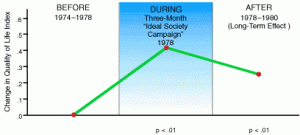 A prospective study was performed to assess the effects of the group practice of the Transcendental Meditation and TM-Sidhi programme on the quality of life in Rhode Island.
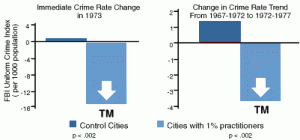 The results show that 24 cities in which 1% of the population had been instructed in the Transcendental Meditation programme by 1972 displayed decreased crime rates during the next year (1973) and decreased crime rate trends during subsequent years (19721977) in comparison to 19671972, in contrast to control cities matched for geographic region, population, college population, and crime rate.
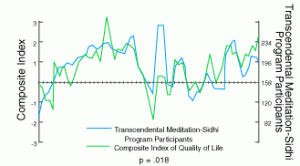 This study indicates that group practice of the Transcendental Meditation and TM-Sidhi programme improved the quality of life in Israel as measured by improvement on an index comprising crime rate, traffic accidents, fires, and the number of war deaths in Lebanon, and by increases in the national stock market and improvements in national mood.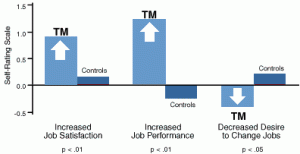
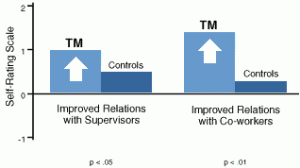 This study found significant improvements in relations with supervisors and co-workers after an average of 11 months practicing Transcendental Meditation, in comparison to control subjects.
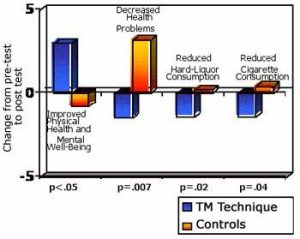
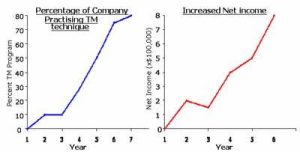
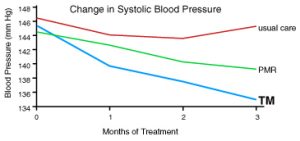 In a clinical experiment with elderly African Americans (mean age 66) dwelling in an inner-city community, Transcendental Meditation was compared with the most widely used method of producing physiological relaxation.
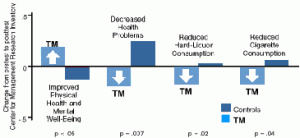 In two companies that introduced the Transcendental Meditation programme, managers and employees who regularly practised Transcendental Meditation improved significantly in overall physical health, mental well-being, and vitality when compared to control subjects with similar jobs in the same companies.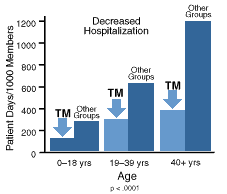
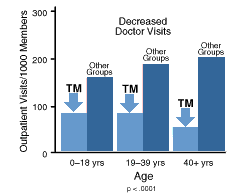
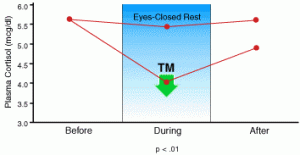 Increased levels of the hormone cortisol in the circulation are well established correlates of both acute and chronic stress.
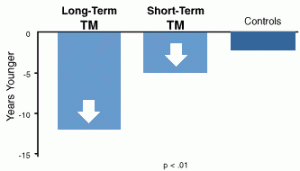 Biological age measures how old a person is physiologically. As a group, long-term meditators who had been practicing Transcendental Meditation for more than 5 years were physiologically 12 years younger than their chronological age, as measured by reduction of blood pressure, and better near-point vision and auditory discrimination.
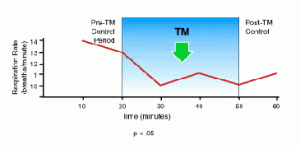 Subjects were measured for changes in breathing rate during the practice of the Transcendental Meditation technique.
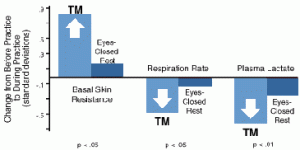 A meta-analysis, the preferred scientific procedure for drawing definitive conclusions from large bodies of research, found Transcendental Meditation produced a significant increase in basal skin resistance compared to eyes-closed rest, indicating profound relaxation.
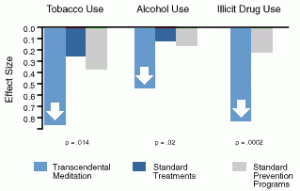 A statistical meta-analysis of 198 independent treatment outcomes found that Transcendental Meditation produced a significantly larger reduction in tobacco, alcohol, and illicit drug use than either standard substance abuse treatments (including counseling, pharmacological treatments, relaxation training, and Twelve-step programmes) or prevention programmes (such as programmes to counteract peer-pressure and promote personal development).
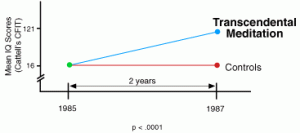 Students at Maharishi International University in Fairfield, Iowa, who regularly practised Transcendental Meditation, increased significantly in intelligence over a 2-year period, compared to control subjects from another Iowa university.
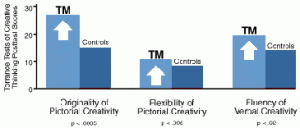 This study used the Torrance Tests of Creative Thinking to measure figural and verbal creativity in a control group and in a group that subsequently learned the Transcendental Meditation technique.
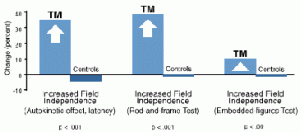 Field independence has been associated with a greater ability to assimilate and structure experience, greater organisation of mind and cognitive clarity, improved memory, greater creative expression, and a stable internal frame of reference.
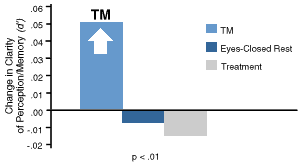 College students instructed in Transcendental Meditation displayed significant improvements in performance over a 2-week period on a perceptual and short-term memory test involving the identification of familiar letter sequences presented rapidly.
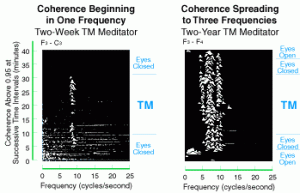 EEG coherence increases between and within the cerebral hemispheres during Transcendental Meditation. EEG coherence is a quantitative index of the degree of long-range spatial ordering of the brain waves.
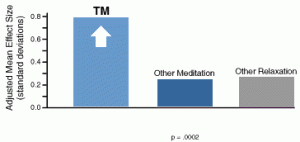 Self actualisation refers to realizing more of one’s inner potential, expressed in every area of life. A statistical meta-analysis of all available studies-of 42 independent studies-indicated that the effect of Transcendental Meditation on increasing self-actualisation is markedly greater than that of other forms of meditation and relaxation. This analysis statistically controlled for length of treatment and quality of research design.
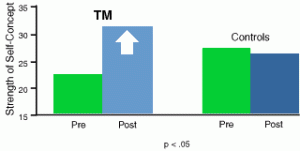 One month after beginning Transcendental Meditation, subjects experienced an improved self-concept in comparison to before learning the technique.
 This three-month study of managers and employees who regularly practised the Transcendental Meditation technique in a Fortune 100 manufacturing company and a smaller distribution-sales company showed that Transcendental Meditation practitioners displayed more relaxed physiological functioning, a greater reduction in anxiety, and reduced tension on the job, when compared to control subjects with similar job positions in the same companies.
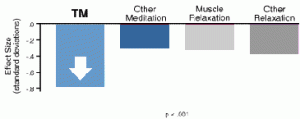 A statistical meta-analysis conducted at Stanford University of all available studies-146 independent outcomes-indicated that the effect of the Transcendental Meditation programme on reducing anxiety as a character trait was much greater than that of all other meditation and relaxation techniques, including muscle relaxation.